

CHAPTER 19 . Palaeoenvironmental Reconstructions
isorenleratane
Xio ! i i i l iiiZ¥~iifl
"
'Xc
:~: I : f 'I
~::: kFZZZ:rz,~=~wi=ZI
Vile F '
Vllb
~
~:: Eii
VI>
Vc
V.
v.
,V,
'v. IV.
::~ fW1W¥ ~
gammacerane
_
marl
_
selenitic gypsum
concentration (mglg bitumen)
Situation A
chemochne in phOlic zone
Situation B
chemocline in water column
but not in photic zone
Situation C
chemocllne in sediment
433
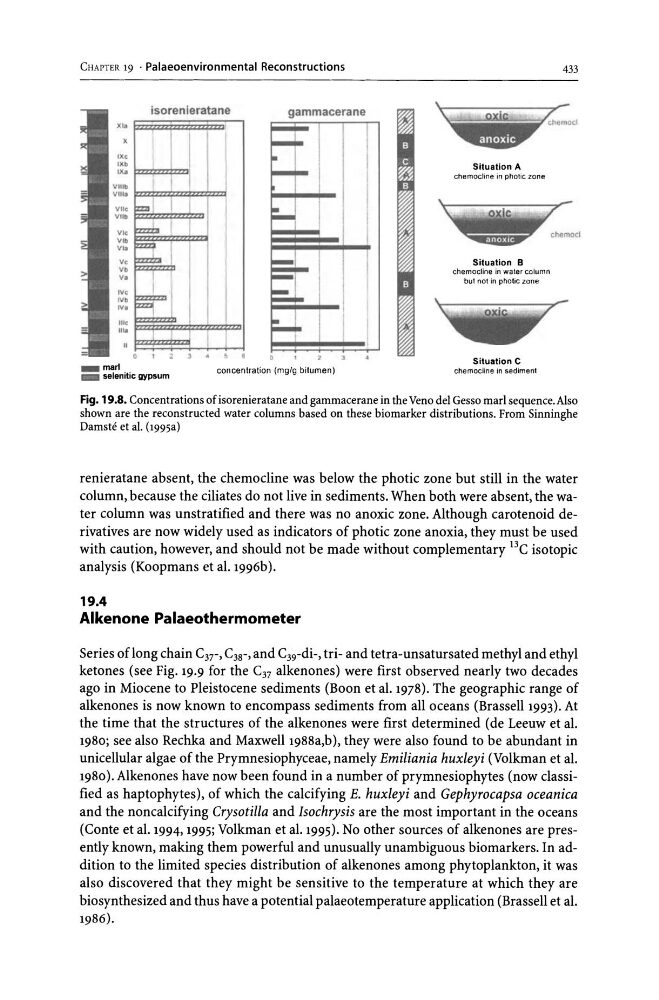
Fig. 19.8. Concentrations of isorenieratane and gammacerane in the Veno del Gesso marl sequence. Also
shown are the reconstructed water columns based on these biomarker distributions. From Sinninghe
Damste et al. (1995a)
renieratane absent, the chemocline was below the photic zone but still in the water
column, because the ciliates do not live in sediments. When both were absent, the water column was unstratified and there was no anoxic zone. Although carotenoid derivatives are now widely used as indicators of photic zone anoxia, they must be used
with caution, however, and should not be made without complementary l3C isotopic
analysis (Koopmans et al. 1996b).
19.4
Alkenone Palaeothermometer
Series oflong chain C3T> C3S-' and C39-di-, tri- and tetra-unsatursated methyl and ethyl
ketones (see Fig. 19.9 for the C37 alkenones) were first observed nearly two decades
ago in Miocene to Pleistocene sediments (Boon et al. 1978). The geographic range of
alkenones is now known to encompass sediments from all oceans (Brassell 1993). At
the time that the structures of the alkenones were first determined (de Leeuw et al.
1980; see also Rechka and Maxwell 1988a,b), they were also found to be abundant in
unicellular algae of the Prymnesiophyceae, namely Emiliania huxleyi (Volkman et al.
1980). Alkenones have now been found in a number of prymnesiophytes (now classified as haptophytes), of which the calcifying E. huxleyi and Gephyrocapsa oceanica
and the noncalcifying Crysotilla and Isochrysis are the most important in the oceans
(Conte et al. 1994, 1995; Volkman et al. 1995). No other sources of alkenones are presently known, making them powerful and unusually unambiguous biomarkers. In addition to the limited species distribution of alkenones among phytoplankton, it was
also discovered that they might be sensitive to the temperature at which they are
biosynthesized and thus have a potential palaeotemperature application (Brassell et al.
1986).
isorenleratane
Xio ! i i i l iiiZ¥~iifl
"
'Xc
:~: I : f 'I
~::: kFZZZ:rz,~=~wi=ZI
Vile F '
Vllb
~
~:: Eii
VI>
Vc
V.
v.
,V,
'v. IV.
::~ fW1W¥ ~
gammacerane
_
marl
_
selenitic gypsum
concentration (mglg bitumen)
Situation A
chemochne in phOlic zone
Situation B
chemocline in water column
but not in photic zone
Situation C
chemocllne in sediment
433
Fig. 19.8. Concentrations of isorenieratane and gammacerane in the Veno del Gesso marl sequence. Also
shown are the reconstructed water columns based on these biomarker distributions. From Sinninghe
Damste et al. (1995a)
renieratane absent, the chemocline was below the photic zone but still in the water
column, because the ciliates do not live in sediments. When both were absent, the water column was unstratified and there was no anoxic zone. Although carotenoid derivatives are now widely used as indicators of photic zone anoxia, they must be used
with caution, however, and should not be made without complementary l3C isotopic
analysis (Koopmans et al. 1996b).
19.4
Alkenone Palaeothermometer
Series oflong chain C3T> C3S-' and C39-di-, tri- and tetra-unsatursated methyl and ethyl
ketones (see Fig. 19.9 for the C37 alkenones) were first observed nearly two decades
ago in Miocene to Pleistocene sediments (Boon et al. 1978). The geographic range of
alkenones is now known to encompass sediments from all oceans (Brassell 1993). At
the time that the structures of the alkenones were first determined (de Leeuw et al.
1980; see also Rechka and Maxwell 1988a,b), they were also found to be abundant in
unicellular algae of the Prymnesiophyceae, namely Emiliania huxleyi (Volkman et al.
1980). Alkenones have now been found in a number of prymnesiophytes (now classified as haptophytes), of which the calcifying E. huxleyi and Gephyrocapsa oceanica
and the noncalcifying Crysotilla and Isochrysis are the most important in the oceans
(Conte et al. 1994, 1995; Volkman et al. 1995). No other sources of alkenones are presently known, making them powerful and unusually unambiguous biomarkers. In addition to the limited species distribution of alkenones among phytoplankton, it was
also discovered that they might be sensitive to the temperature at which they are
biosynthesized and thus have a potential palaeotemperature application (Brassell et al.
1986).