

428
s. Wakeham
The spread of about 8%0 between the highest and lowest values for each carbon number for the terrestrial samples agreed with a 7%0 range for bulk OC. This suggests that
13e values of the individual n-alkanes can be related to vegetation type in the rivers in
the same manner that 13e of bulk OC is related to vegetation type. The core was studied to evaluate whether the alkane-isotope record could be used to reconstruct the
ecosystem history of the region. Bulk OC isotope values in core samples ranged from
-22.3%0 at the base of the core to -19.8%0 at the top of the core (Fig. 19.3). However,
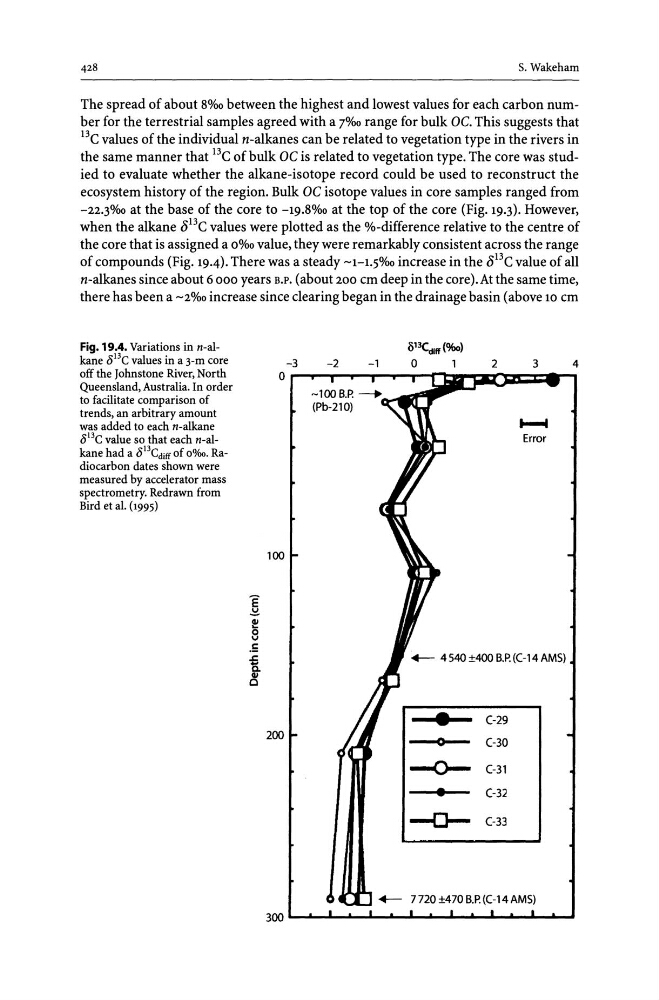
when the alkane 013e values were plotted as the %-difference relative to the centre of
the core that is assigned a 0%0 value, they were remarkably consistent across the range
of compounds (Fig. 19.4). There was a steady -1-1.5%0 increase in the 013e value of all
n-alkanes since about 6 000 years B.P. (about 200 cm deep in the core). At the same time,
there has been a -2%0 increase since dearing began in the drainage basin (above 10 cm
Fig. 19.4. Variations in n-alkane OBC values in a 3-m core
off the Johnstone River, North
Queensland, Australia. In order
to facilitate comparison of
trends, an arbitrary amount
was added to each n-alkane
OBC value so that each n-alkane had a o BCdiff of 00/00. Radiocarbon dates shown were
measured by accelerator mass
spectrometry. Redrawn from
Bird et al. (1995)
E
~
~
v
.5
-= Co
~
o13e d11f (%0)
-3
-2
-1
o
1
2
3
4
o I
r:::w:JaO" •
.......
Error
100
+- 4540 ±400 B.P. ((-14 AMS)
-
(-29
200
(-30
- 0 - (-31
(-32
-a- (-33
+- 7720±470B.P.«(-14AMS)
300 ,
....... &......jL.......!--..I ....... --1~......J.~--1. ........ ....J.. ........ .J
s. Wakeham
The spread of about 8%0 between the highest and lowest values for each carbon number for the terrestrial samples agreed with a 7%0 range for bulk OC. This suggests that
13e values of the individual n-alkanes can be related to vegetation type in the rivers in
the same manner that 13e of bulk OC is related to vegetation type. The core was studied to evaluate whether the alkane-isotope record could be used to reconstruct the
ecosystem history of the region. Bulk OC isotope values in core samples ranged from
-22.3%0 at the base of the core to -19.8%0 at the top of the core (Fig. 19.3). However,
when the alkane 013e values were plotted as the %-difference relative to the centre of
the core that is assigned a 0%0 value, they were remarkably consistent across the range
of compounds (Fig. 19.4). There was a steady -1-1.5%0 increase in the 013e value of all
n-alkanes since about 6 000 years B.P. (about 200 cm deep in the core). At the same time,
there has been a -2%0 increase since dearing began in the drainage basin (above 10 cm
Fig. 19.4. Variations in n-alkane OBC values in a 3-m core
off the Johnstone River, North
Queensland, Australia. In order
to facilitate comparison of
trends, an arbitrary amount
was added to each n-alkane
OBC value so that each n-alkane had a o BCdiff of 00/00. Radiocarbon dates shown were
measured by accelerator mass
spectrometry. Redrawn from
Bird et al. (1995)
E
~
~
v
.5
-= Co
~
o13e d11f (%0)
-3
-2
-1
o
1
2
3
4
o I
r:::w:JaO" •
.......
Error
100
+- 4540 ±400 B.P. ((-14 AMS)
-
(-29
200
(-30
- 0 - (-31
(-32
-a- (-33
+- 7720±470B.P.«(-14AMS)
300 ,
....... &......jL.......!--..I ....... --1~......J.~--1. ........ ....J.. ........ .J