

418
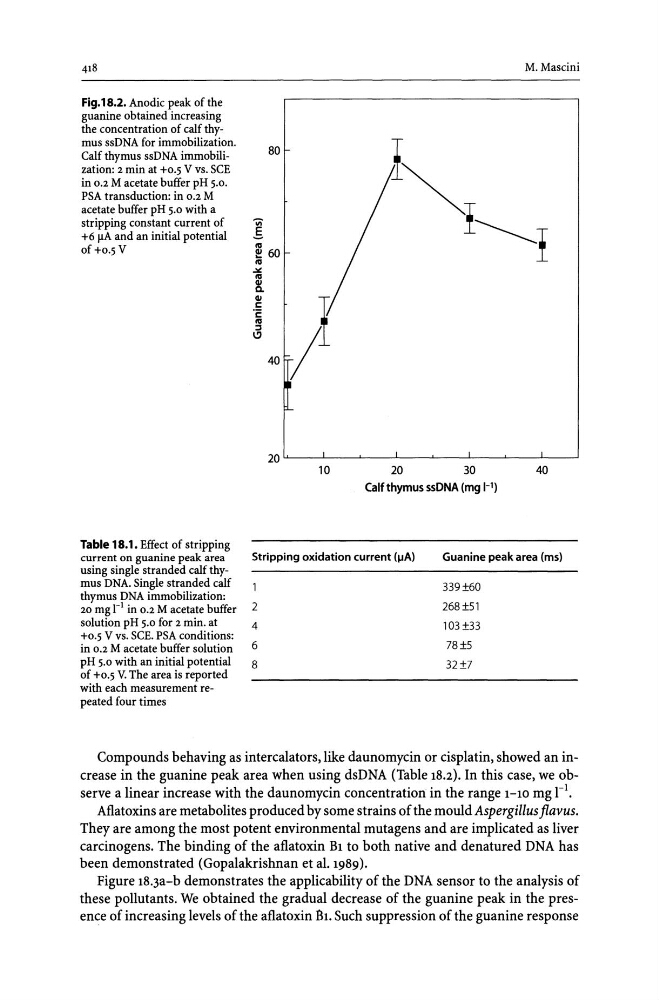
Fig.18.2. Anodic peak of the
guanine obtained increasing
the concentration of calf thymus ssDNA for immobilization.
Calf thymus ssDNA immobilization: 2 min at +0.5 V VS. SCE
in 0.2 M acetate buffer pH 5.0.
PSA transduction: in 0.2 M
acetate buffer pH 5.0 with a
stripping constant current of
+6 flA and an initial potential
of +0.5 V
Table 18.1. Effect of stripping
80
Vi"
Eta
~60
ta
-"
~
'i:
ta
j
1.7
40
M. Mascini
20~1'----L---~---L--~~--~--~---J--~
10
20
30
40
Calf thymus ssDNA (mg 1-1)
current on guanine peak area
Stripping oxidation current (IlA)
Guanine peak area (ms)
using single stranded calf thymus DNA. Single stranded calf
thymus DNA immobilization:
20 mg rl in 0.2 M acetate buffer 2
solution pH 5.0 for 2 min. at
4
+0.5 V VS. SCE. PSA conditions:
in 0.2 M acetate buffer solution
6
pH 5.0 with an initial potential
8
of +0.5 V. The area is reported
with each measurement repeated four times
339±60
268±51
103±33
78±5
32±7
Compounds behaving as intercalators, like daunomycin or cisplatin, showed an increase in the guanine peak area when using dsDNA (Table 18.2). In this case, we observe a linear increase with the daunomycin concentration in the range 1-10 mg rl.
Aflatoxins are metabolites produced by some strains of the mould Aspergillus flavus.
They are among the most potent environmental mutagens and are implicated as liver
carcinogens. The binding of the aflatoxin B1 to both native and denatured DNA has
been demonstrated (Gopalakrishnan et al. 1989).
Figure 18.3a-b demonstrates the applicability of the DNA sensor to the analysis of
these pollutants. We obtained the gradual decrease of the guanine peak in the presence of increasing levels of the aflatoxin B1. Such suppression of the guanine response
Fig.18.2. Anodic peak of the
guanine obtained increasing
the concentration of calf thymus ssDNA for immobilization.
Calf thymus ssDNA immobilization: 2 min at +0.5 V VS. SCE
in 0.2 M acetate buffer pH 5.0.
PSA transduction: in 0.2 M
acetate buffer pH 5.0 with a
stripping constant current of
+6 flA and an initial potential
of +0.5 V
Table 18.1. Effect of stripping
80
Vi"
Eta
~60
ta
-"
~
'i:
ta
j
1.7
40
M. Mascini
20~1'----L---~---L--~~--~--~---J--~
10
20
30
40
Calf thymus ssDNA (mg 1-1)
current on guanine peak area
Stripping oxidation current (IlA)
Guanine peak area (ms)
using single stranded calf thymus DNA. Single stranded calf
thymus DNA immobilization:
20 mg rl in 0.2 M acetate buffer 2
solution pH 5.0 for 2 min. at
4
+0.5 V VS. SCE. PSA conditions:
in 0.2 M acetate buffer solution
6
pH 5.0 with an initial potential
8
of +0.5 V. The area is reported
with each measurement repeated four times
339±60
268±51
103±33
78±5
32±7
Compounds behaving as intercalators, like daunomycin or cisplatin, showed an increase in the guanine peak area when using dsDNA (Table 18.2). In this case, we observe a linear increase with the daunomycin concentration in the range 1-10 mg rl.
Aflatoxins are metabolites produced by some strains of the mould Aspergillus flavus.
They are among the most potent environmental mutagens and are implicated as liver
carcinogens. The binding of the aflatoxin B1 to both native and denatured DNA has
been demonstrated (Gopalakrishnan et al. 1989).
Figure 18.3a-b demonstrates the applicability of the DNA sensor to the analysis of
these pollutants. We obtained the gradual decrease of the guanine peak in the presence of increasing levels of the aflatoxin B1. Such suppression of the guanine response