

CHAPTER 16 • Flow Injection Techniques for the in situ Monitoring of Marine Processes
387
Reagents
P
Sample
"'"d,", J&
Control
Reaction
manifold
Computer
Data output
& Waste
Data
acquisition
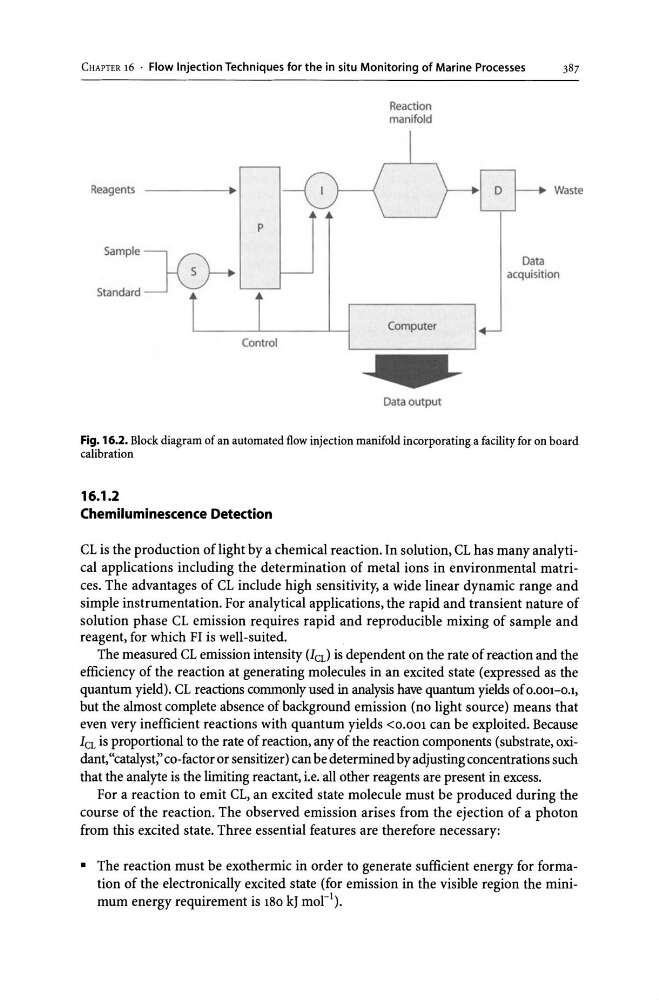
Fig. 16.2. Block diagram of an automated flow injection manifold incorporating a facility for on board
calibration
16.1.2
Chemiluminescence Detection
CL is the production of light by a chemical reaction. In solution, CL has manyanalytical applications including the determination of metal ions in environmental matrices. The advantages of CL include high sensitivity, a wide linear dynamic range and
simple instrumentation. For analytical applications, the rapid and transient nature of
solution phase CL emission requires rapid and reproducible mixing of sample and
reagent, for which FI is well-suited.
The measured CL emission intensity (lCL) is dependent on the rate of reaction and the
efficiency of the reaction at generating molecules in an excited state (expressed as the
quantum yield). CL reactions commonly used in analysis have quantum yields of 0.001-0.1,
but the almost complete absence of background emission (no light source) means that
even very inefficient reactions with quantum yields <0.001 can be exploited. Because
ICL is proportional to the rate of reaction, any of the reaction components (substrate, oxidant, "catalyst;' co-factor or sensitizer) can be determined by adjusting concentrations such
that the analyte is the limiting reactant, i.e. all other reagents are present in excess.
For a reaction to emit CL, an excited state molecule must be produced during the
course of the reaction. The observed emission arises from the ejection of a photon
from this excited state. Three essential features are therefore necessary:
• The reaction must be exothermic in order to generate sufficient energy for formation of the electronically excited state (for emission in the visible region the minimum energy requirement is 180 kJ mor l ).
387
Reagents
P
Sample
"'"d,", J&
Control
Reaction
manifold
Computer
Data output
& Waste
Data
acquisition
Fig. 16.2. Block diagram of an automated flow injection manifold incorporating a facility for on board
calibration
16.1.2
Chemiluminescence Detection
CL is the production of light by a chemical reaction. In solution, CL has manyanalytical applications including the determination of metal ions in environmental matrices. The advantages of CL include high sensitivity, a wide linear dynamic range and
simple instrumentation. For analytical applications, the rapid and transient nature of
solution phase CL emission requires rapid and reproducible mixing of sample and
reagent, for which FI is well-suited.
The measured CL emission intensity (lCL) is dependent on the rate of reaction and the
efficiency of the reaction at generating molecules in an excited state (expressed as the
quantum yield). CL reactions commonly used in analysis have quantum yields of 0.001-0.1,
but the almost complete absence of background emission (no light source) means that
even very inefficient reactions with quantum yields <0.001 can be exploited. Because
ICL is proportional to the rate of reaction, any of the reaction components (substrate, oxidant, "catalyst;' co-factor or sensitizer) can be determined by adjusting concentrations such
that the analyte is the limiting reactant, i.e. all other reagents are present in excess.
For a reaction to emit CL, an excited state molecule must be produced during the
course of the reaction. The observed emission arises from the ejection of a photon
from this excited state. Three essential features are therefore necessary:
• The reaction must be exothermic in order to generate sufficient energy for formation of the electronically excited state (for emission in the visible region the minimum energy requirement is 180 kJ mor l ).