

386
P. J. Worsfold . E. P. Achterberg· A. R. Bowie· R. Sandford· V. Cannizzaro· P. Gardolinski
• Gas dialysis for the diffusion of a gaseous analyte from a carrier (donor) stream
through a microporous membrane into a reagent (acceptor) stream, e.g. for the selective extraction of ammonia from sea water;
• Solid phase reaction columns, in which the injected sample reacts with a solid material, e.g. an immobilized enzyme packed in a column.
Reagent consumption is generally low in FI systems (an important factor for shipboard and submersible applications) and can be reduced still further by using a reagent injection manifold, whereby a discrete volume of reagent is injected into a continuously flowing sample stream. This option is suitable for applications in which the
sample is in abundant supply (as in many marine situations) and is particularly beneficial when expensive reagents are required. Simultaneous FI determinations can
be performed by designing manifolds in which the sample is injected into more than
one flow channel, undergoing different reaction chemistries in each. FI systems are
easily automated, using off-the-shelf components and a notebook PC to control the
operation of the valves, pumps, data acquisition, and processing. A schematic of an
automated FI manifold including the facility for on board calibration is shown in
Fig. 16.2.
In the laboratory, FI has been coupled with most detection systems, but this chapter focuses on shipboard (and submersible) deployment of FI instrumentation in
order to utilize its ability to acquire high quality analytical data with excellent temporal and/or spatial resolution. The following sections describe examples of FI with
chemiluminescence (CL) (Bowie et al. 1996) and spectrophotometric (SPEC) detection, respectively, for the determination of trace metals and nutrients in marine waters.
Pump
Carrier system
I to I
Sample
Injection
valve
01
'" c o
~
01
c:
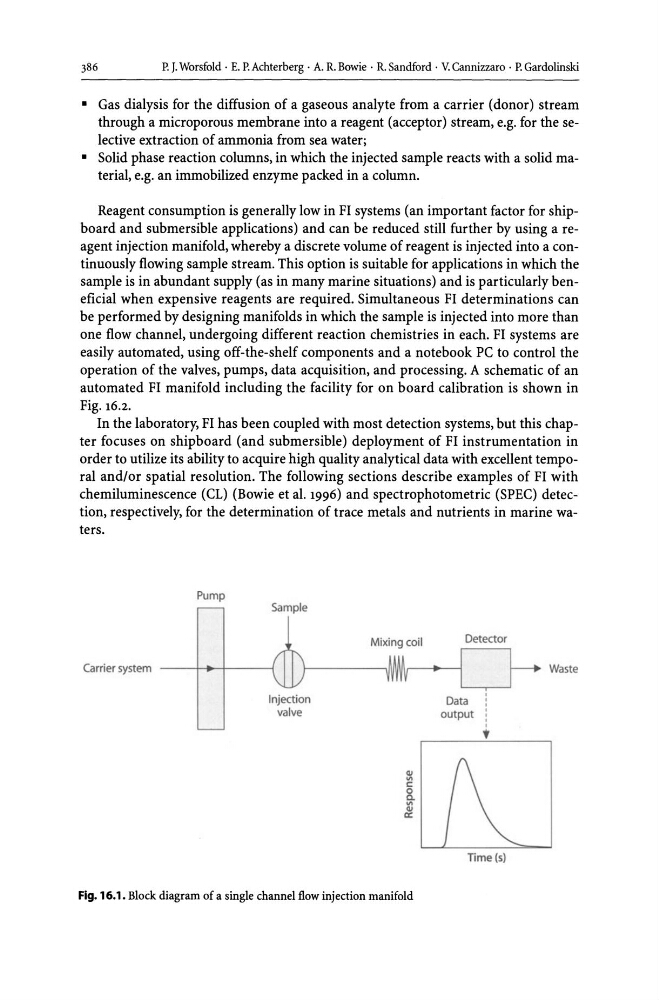
Fig. 16.1. Block diagram of a single channel flow injection manifold
Detector
Data
output ,
•
Time(s}
Waste
P. J. Worsfold . E. P. Achterberg· A. R. Bowie· R. Sandford· V. Cannizzaro· P. Gardolinski
• Gas dialysis for the diffusion of a gaseous analyte from a carrier (donor) stream
through a microporous membrane into a reagent (acceptor) stream, e.g. for the selective extraction of ammonia from sea water;
• Solid phase reaction columns, in which the injected sample reacts with a solid material, e.g. an immobilized enzyme packed in a column.
Reagent consumption is generally low in FI systems (an important factor for shipboard and submersible applications) and can be reduced still further by using a reagent injection manifold, whereby a discrete volume of reagent is injected into a continuously flowing sample stream. This option is suitable for applications in which the
sample is in abundant supply (as in many marine situations) and is particularly beneficial when expensive reagents are required. Simultaneous FI determinations can
be performed by designing manifolds in which the sample is injected into more than
one flow channel, undergoing different reaction chemistries in each. FI systems are
easily automated, using off-the-shelf components and a notebook PC to control the
operation of the valves, pumps, data acquisition, and processing. A schematic of an
automated FI manifold including the facility for on board calibration is shown in
Fig. 16.2.
In the laboratory, FI has been coupled with most detection systems, but this chapter focuses on shipboard (and submersible) deployment of FI instrumentation in
order to utilize its ability to acquire high quality analytical data with excellent temporal and/or spatial resolution. The following sections describe examples of FI with
chemiluminescence (CL) (Bowie et al. 1996) and spectrophotometric (SPEC) detection, respectively, for the determination of trace metals and nutrients in marine waters.
Pump
Carrier system
I to I
Sample
Injection
valve
01
'" c o
~
01
c:
Fig. 16.1. Block diagram of a single channel flow injection manifold
Detector
Data
output ,
•
Time(s}
Waste