

CHAPTER 15 • Toxic Effects of Organometallic Compounds towards Marine Biota
353
ties of these compounds (Patai 1995; Abel et al. 1995; Champ and Seligman 1996; De
Mora 1996; Smith 1998; Barbieri et al. 2000). As a consequence, organotin(IV) compounds are extensively present in natural and marine waters, marine biota, and sediments. Several good books covering the toxic effects of organometallics and comprising organotin(IV) derivatives have been published recently (Arakawa and Wada 1993;
Mennie and Craig 1993; Crompton 1998). Again, for the scope of this review, we will
describe the toxic effects of organotin(IV) derivatives on marine biota reported in the
last ten years.
15.3.2
Organotin in the Marine Biota
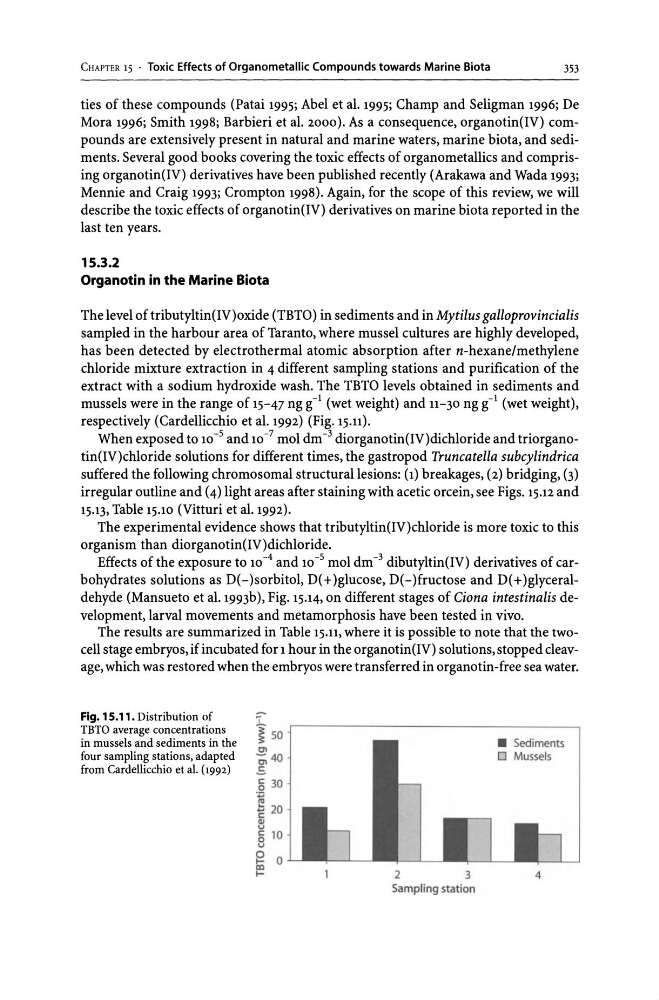
The level of tributyltin(IV)oxide (TBTO) in sediments and in Mytilus galloprovincialis
sampled in the harbour area of Taranto, where mussel cultures are highly developed,
has been detected by electrothermal atomic absorption after n-hexane/methylene
chloride mixture extraction in 4 different sampling stations and purification of the
extract with a sodium hydroxide wash. The TBTO levels obtained in sediments and
mussels were in the range of 15-47 ng g-l (wet weight) and 11-30 ng g-l (wet weight),
respectively (Cardellicchio et al. 1992) (Fig. 15.11).
When exposed to 10- 5 and lO -7 mol dm -3 diorganotin(IV)dichloride and triorganotin(IV)chloride solutions for different times, the gastropod Truncatella subcylindrica
suffered the following chromosomal structural lesions: (1) breakages, (2) bridging, (3)
irregular outline and (4) light areas after staining with acetic orcein, see Figs. 15.12 and
15.13, Table 15.10 (Vitturi et al. 1992).
The experimental evidence shows that tributyltin(IV)chloride is more toxic to this
organism than diorganotin(IV)dichloride.
Effects of the exposure to 10- 4 and lO -5 mol dm -3 dibutyltin(IV) derivatives of carbohydrates solutions as D( - )sorbitol, D( + )glucose, D( - )fructose and D( + )glyceraldehyde (Mansueto et al. 1993b), Fig. 15.14, on different stages of Ciona intestinalis development, larval movements and metamorphosis have been tested in vivo.
The results are summarized in Table 15.11, where it is possible to note that the twocell stage embryos, if incubated for 1 hour in the organotin(IV) solutions, stopped cleavage, which was restored when the embryos were transferred in organotin-free sea water.
Fig. 15.11. Distribution of
TBTO average concentrations
in mussels and sediments in the
four sampling stations, adapted
from Cardellicchio et al. (1992)
,
Iso
$
C\ 40
..s
g 30
.~
~ 20
OJ
~ 10
8
~ 0
I2
3
Sampling station
• Sediments
o Mussels
4
353
ties of these compounds (Patai 1995; Abel et al. 1995; Champ and Seligman 1996; De
Mora 1996; Smith 1998; Barbieri et al. 2000). As a consequence, organotin(IV) compounds are extensively present in natural and marine waters, marine biota, and sediments. Several good books covering the toxic effects of organometallics and comprising organotin(IV) derivatives have been published recently (Arakawa and Wada 1993;
Mennie and Craig 1993; Crompton 1998). Again, for the scope of this review, we will
describe the toxic effects of organotin(IV) derivatives on marine biota reported in the
last ten years.
15.3.2
Organotin in the Marine Biota
The level of tributyltin(IV)oxide (TBTO) in sediments and in Mytilus galloprovincialis
sampled in the harbour area of Taranto, where mussel cultures are highly developed,
has been detected by electrothermal atomic absorption after n-hexane/methylene
chloride mixture extraction in 4 different sampling stations and purification of the
extract with a sodium hydroxide wash. The TBTO levels obtained in sediments and
mussels were in the range of 15-47 ng g-l (wet weight) and 11-30 ng g-l (wet weight),
respectively (Cardellicchio et al. 1992) (Fig. 15.11).
When exposed to 10- 5 and lO -7 mol dm -3 diorganotin(IV)dichloride and triorganotin(IV)chloride solutions for different times, the gastropod Truncatella subcylindrica
suffered the following chromosomal structural lesions: (1) breakages, (2) bridging, (3)
irregular outline and (4) light areas after staining with acetic orcein, see Figs. 15.12 and
15.13, Table 15.10 (Vitturi et al. 1992).
The experimental evidence shows that tributyltin(IV)chloride is more toxic to this
organism than diorganotin(IV)dichloride.
Effects of the exposure to 10- 4 and lO -5 mol dm -3 dibutyltin(IV) derivatives of carbohydrates solutions as D( - )sorbitol, D( + )glucose, D( - )fructose and D( + )glyceraldehyde (Mansueto et al. 1993b), Fig. 15.14, on different stages of Ciona intestinalis development, larval movements and metamorphosis have been tested in vivo.
The results are summarized in Table 15.11, where it is possible to note that the twocell stage embryos, if incubated for 1 hour in the organotin(IV) solutions, stopped cleavage, which was restored when the embryos were transferred in organotin-free sea water.
Fig. 15.11. Distribution of
TBTO average concentrations
in mussels and sediments in the
four sampling stations, adapted
from Cardellicchio et al. (1992)
,
Iso
$
C\ 40
..s
g 30
.~
~ 20
OJ
~ 10
8
~ 0
I2
3
Sampling station
• Sediments
o Mussels
4