

346
L. Pellerito . R. Barbieri . R. Di Stefano . M. Scopelliti . C. Pellerito· T. Fiore . F. Triolo
whereas trimethylarsine oxide and tetramethylarsonium iodide remain unaltered.
None of the other arsenic derivatives are significantly accumulated. Furthermore,
arsenobetaine, arsenocholine and tetramethylarsonium iodide are accumulated by the
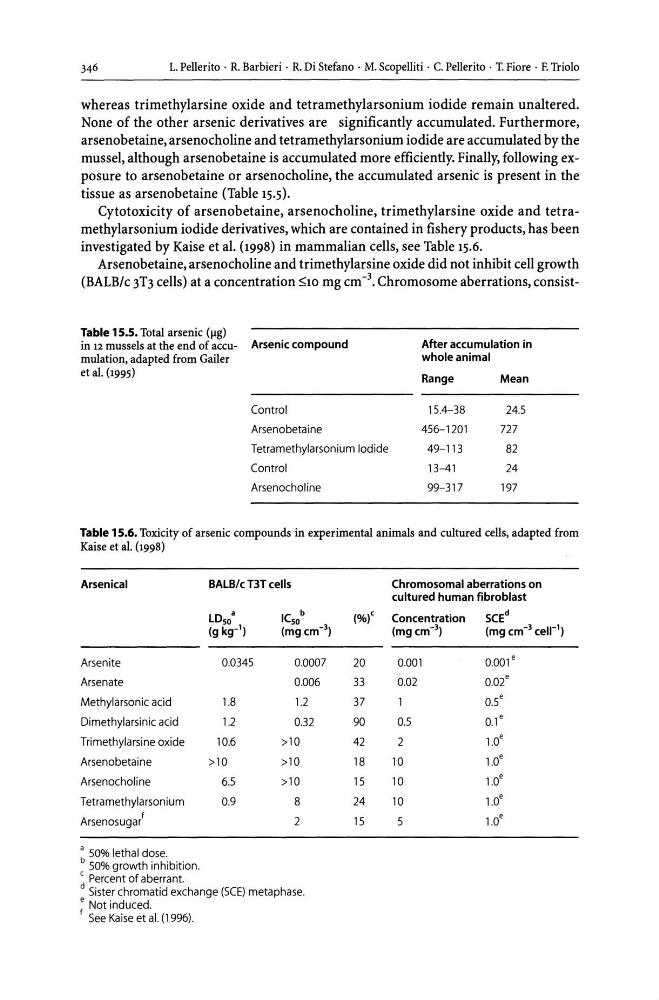
mussel, although arsenobetaine is accumulated more efficiently. Finally, following exposure to arsenobetaine or arsenocholine, the accumulated arsenic is present in the
tissue as arsenobetaine (Table 15.5).
Cytotoxicity of arsenobetaine, arsenocholine, trimethylarsine oxide and tetramethylarsonium iodide derivatives, which are contained in fishery products, has been
investigated by Kaise et al. (1998) in mammalian cells, see Table 15.6.
Arsenobetaine, arsenocholine and trimethylarsine oxide did not inhibit cell growth
(BALB/c 3T3 cells) at a concentration ~1O mg cm- 3 • Chromosome aberrations, consistTable 15.5. Total arsenic (Ilg)
in 12 mussels at the end of accu- Arsenic compound
mulation, adapted from Gailer
et al. (1995)
Control
Arsenobetaine
Tetramethylarsonium Iodide
Control
Arsenocholine
After accumulation in
whole animal
Range
Mean
15.4-38
456-1201
49-113
13-41
99-317
24.5
727
82
24
197
Table 15.6. Toxicity of arsenic compounds in experimental animals and cultured cells, adapted from
Kaise et al. (1998)
Arsenical
Arsenite
Arsenate
Methylarsonic acid
Dimethylarsinic acid
Trimethylarsine oxide
Arsenobetaine
Arsenocholine
Tetramethylarsonium
Arsenosugar
f
a 50% lethal dose.
b 50% growth inhibition.
C Percent of aberrant.
BALBlc HT cells
LDso'
(g kg_l)
ICso b
(mgcm- 3 )
0.0345
0.0007
0.006
1.8
1.2
1.2
0.32
10.6
>10
>10
>10
6.5
>10
0.9
8
2
d Sister chromatid exchange (SCE) metaphase.
; Not induced.
See Kaise et al. (1996).
Chromosomal aberrations on
cultured human fibroblast
(%)c
Concentration
SCE d
(mg cm- 3 )
(mg cm- 3 ceWl)
20
0.001
O.OOl e
33
0.02
0.02 e
37
O.5 e
90
0.5
0.1 e
42
2
1.0 e
18
10
1.0 e
15
10
1.0 e
24
10
1.0 e
15
5
1.0e
L. Pellerito . R. Barbieri . R. Di Stefano . M. Scopelliti . C. Pellerito· T. Fiore . F. Triolo
whereas trimethylarsine oxide and tetramethylarsonium iodide remain unaltered.
None of the other arsenic derivatives are significantly accumulated. Furthermore,
arsenobetaine, arsenocholine and tetramethylarsonium iodide are accumulated by the
mussel, although arsenobetaine is accumulated more efficiently. Finally, following exposure to arsenobetaine or arsenocholine, the accumulated arsenic is present in the
tissue as arsenobetaine (Table 15.5).
Cytotoxicity of arsenobetaine, arsenocholine, trimethylarsine oxide and tetramethylarsonium iodide derivatives, which are contained in fishery products, has been
investigated by Kaise et al. (1998) in mammalian cells, see Table 15.6.
Arsenobetaine, arsenocholine and trimethylarsine oxide did not inhibit cell growth
(BALB/c 3T3 cells) at a concentration ~1O mg cm- 3 • Chromosome aberrations, consistTable 15.5. Total arsenic (Ilg)
in 12 mussels at the end of accu- Arsenic compound
mulation, adapted from Gailer
et al. (1995)
Control
Arsenobetaine
Tetramethylarsonium Iodide
Control
Arsenocholine
After accumulation in
whole animal
Range
Mean
15.4-38
456-1201
49-113
13-41
99-317
24.5
727
82
24
197
Table 15.6. Toxicity of arsenic compounds in experimental animals and cultured cells, adapted from
Kaise et al. (1998)
Arsenical
Arsenite
Arsenate
Methylarsonic acid
Dimethylarsinic acid
Trimethylarsine oxide
Arsenobetaine
Arsenocholine
Tetramethylarsonium
Arsenosugar
f
a 50% lethal dose.
b 50% growth inhibition.
C Percent of aberrant.
BALBlc HT cells
LDso'
(g kg_l)
ICso b
(mgcm- 3 )
0.0345
0.0007
0.006
1.8
1.2
1.2
0.32
10.6
>10
>10
>10
6.5
>10
0.9
8
2
d Sister chromatid exchange (SCE) metaphase.
; Not induced.
See Kaise et al. (1996).
Chromosomal aberrations on
cultured human fibroblast
(%)c
Concentration
SCE d
(mg cm- 3 )
(mg cm- 3 ceWl)
20
0.001
O.OOl e
33
0.02
0.02 e
37
O.5 e
90
0.5
0.1 e
42
2
1.0 e
18
10
1.0 e
15
10
1.0 e
24
10
1.0 e
15
5
1.0e