

CHAPTER 15 • Toxic Effects of Organometallic Compounds towards Marine Biota
345
and finally dimethylarsinate. Polyphysa peniculus did not metabolize dimethylarsinic
acid when it was used as substrate (Cullen et al. 1994) (Table 15.4).
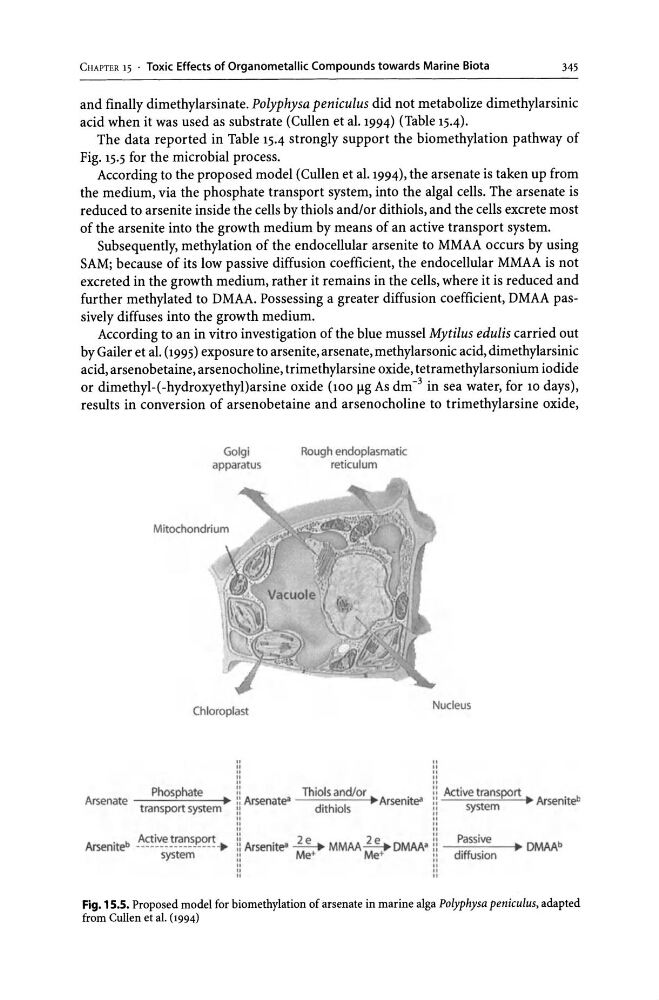
The data reported in Table 15.4 strongly support the biomethylation pathway of
Fig. 15.5 for the microbial process.
According to the proposed model (Cullen et al. 1994), the arsenate is taken up from
the medium, via the phosphate transport system, into the algal cells. The arsenate is
reduced to arsenite inside the cells by thiols and/or dithiols, and the cells excrete most
of the arsenite into the growth medium by means of an active transport system.
Subsequently, methylation of the en do cellular arsenite to MMAA occurs by using
SAM; because of its low passive diffusion coefficient, the endocellular MMAA is not
excreted in the growth medium, rather it remains in the cells, where it is reduced and
further methylated to DMAA. Possessing a greater diffusion coefficient, DMAA passively diffuses into the growth medium.
According to an in vitro investigation of the blue mussel Mytilus edulis carried out
by Gailer et al. (1995) exposure to arsenite, arsenate, methylarsonic acid, dimethylarsinic
acid, arsenobetaine, arsenocholine, trimethylarsine oxide, tetramethylarsonium iodide
or dimethyl-( -hydroxyethyl)arsine oxide (100 Ilg As dm- 3 in sea water, for 10 days),
results in conversion of arsenobetaine and arsenocholine to trimethylarsine oxide,
Golgi
apparatus
Rough endoplasmatic
reticulum
Chloroplast
Nucleus
"
::
"
II
Phosphate
::
Thiols and/or
!! Active transport
Arsenate
• :: Arsenate"
d· h· I
• Arsenite" ::
system
• Arsenitei'
transport system 11
It 10 S
!~
Arsenitei' _~~~~~~!~0sport
system----....
11
I.
::
2 e
2 e
::
Passive
b
:: Arsenite" ~M MMAA-=:-=+M DMAA"::
d.ffu .
.. DMAA
II
e+
e+
II
I
sion
il
!!
Fig. 15.5. Proposed model for biomethylation of arsenate in marine alga Polyphysa peniculus, adapted
from Cullen et al. (1994)
345
and finally dimethylarsinate. Polyphysa peniculus did not metabolize dimethylarsinic
acid when it was used as substrate (Cullen et al. 1994) (Table 15.4).
The data reported in Table 15.4 strongly support the biomethylation pathway of
Fig. 15.5 for the microbial process.
According to the proposed model (Cullen et al. 1994), the arsenate is taken up from
the medium, via the phosphate transport system, into the algal cells. The arsenate is
reduced to arsenite inside the cells by thiols and/or dithiols, and the cells excrete most
of the arsenite into the growth medium by means of an active transport system.
Subsequently, methylation of the en do cellular arsenite to MMAA occurs by using
SAM; because of its low passive diffusion coefficient, the endocellular MMAA is not
excreted in the growth medium, rather it remains in the cells, where it is reduced and
further methylated to DMAA. Possessing a greater diffusion coefficient, DMAA passively diffuses into the growth medium.
According to an in vitro investigation of the blue mussel Mytilus edulis carried out
by Gailer et al. (1995) exposure to arsenite, arsenate, methylarsonic acid, dimethylarsinic
acid, arsenobetaine, arsenocholine, trimethylarsine oxide, tetramethylarsonium iodide
or dimethyl-( -hydroxyethyl)arsine oxide (100 Ilg As dm- 3 in sea water, for 10 days),
results in conversion of arsenobetaine and arsenocholine to trimethylarsine oxide,
Golgi
apparatus
Rough endoplasmatic
reticulum
Chloroplast
Nucleus
"
::
"
II
Phosphate
::
Thiols and/or
!! Active transport
Arsenate
• :: Arsenate"
d· h· I
• Arsenite" ::
system
• Arsenitei'
transport system 11
It 10 S
!~
Arsenitei' _~~~~~~!~0sport
system----....
11
I.
::
2 e
2 e
::
Passive
b
:: Arsenite" ~M MMAA-=:-=+M DMAA"::
d.ffu .
.. DMAA
II
e+
e+
II
I
sion
il
!!
Fig. 15.5. Proposed model for biomethylation of arsenate in marine alga Polyphysa peniculus, adapted
from Cullen et al. (1994)