

CHAPTER 15 • Toxic Effects of Organometallic Compounds towards Marine Biota
341
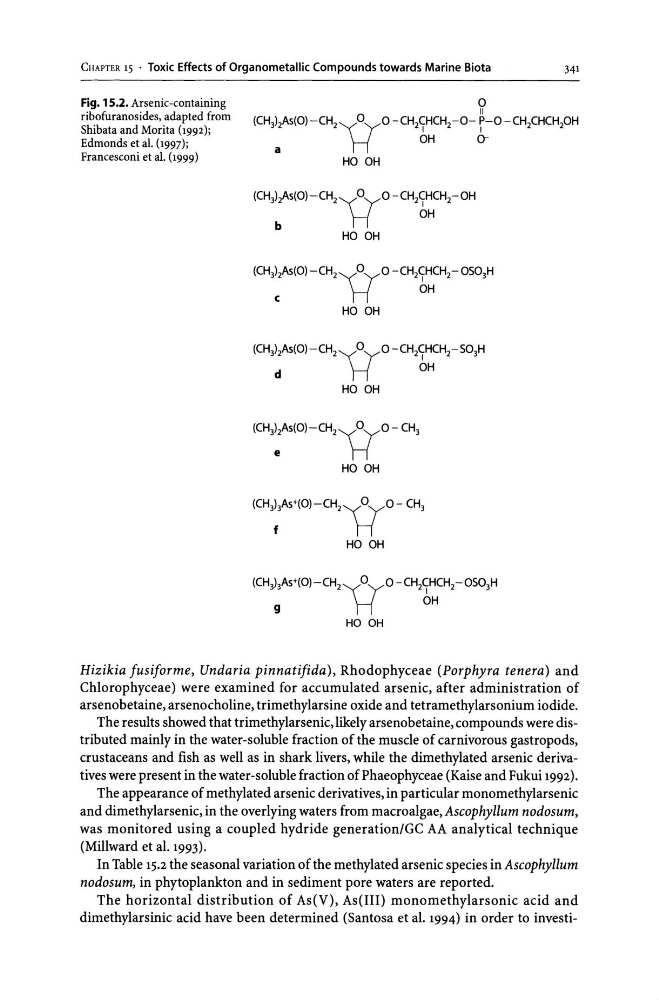
Fig. 1 S.2. Arsenic-containing
ribofuranosides, adapted from
Shibata and Morita (1992);
Edmonds et al. (1997);
Francesconi et al. (1999)
o II
(CH3hAs(O) -CH2 V O 0 - CH2CHCH2-O- P-O - CH2CHCHPH
I
I
OH
0a
HO OH
(CH3hAS(O}-CH2VO O-CH2~HCH2-0H
OH
b
HO OH
(CH3l2As(Ol -CH2VO 0 -CH2~HCH2- OS03H
OH
c
HO OH
(CH3hAS(Ol-CH2,,(0yO -CH2~HCH2-S03H
d
r-i
OH
HO OH
(CH3~AS(Ol-CH2VO - CH3
HO OH
(CH3:3AS+(Ol-CH 2 V
O- CH3
HO OH
(CH3hAS+(Ol-CH2,,(0yO -CH2~HCH2-0S03H
g
r-i
OH
HO OH
Hizikia fusiforme, Undaria pinnatifida), Rhodophyceae (Porphyra tenera) and
Chlorophyceae) were examined for accumulated arsenic, after administration of
arsenobetaine, arsenocholine, trimethylarsine oxide and tetramethylarsonium iodide.
The results showed that trimethylarsenic, likely arsenobetaine, compounds were distributed mainly in the water-soluble fraction of the muscle of carnivorous gastropods,
crustaceans and fish as well as in shark livers, while the dimethylated arsenic derivatives were present in the water-soluble fraction of Phaeophyceae (Kaise and Fukui 1992).
The appearance of methylated arsenic derivatives, in particular monomethylarsenic
and dimethylarsenic, in the overlying waters from macro algae, Ascophyllum nodosum,
was monitored using a coupled hydride generation/GC AA analytical technique
(Millward et al. 1993).
In Table 15.2 the seasonal variation of the methylated arsenic species in Ascophyllum
nodosum, in phytoplankton and in sediment pore waters are reported.
The horizontal distribution of As(V), As(III) monomethylarsonic acid and
dimethylarsinic acid have been determined (Santosa et al. 1994) in order to investi-
341
Fig. 1 S.2. Arsenic-containing
ribofuranosides, adapted from
Shibata and Morita (1992);
Edmonds et al. (1997);
Francesconi et al. (1999)
o II
(CH3hAs(O) -CH2 V O 0 - CH2CHCH2-O- P-O - CH2CHCHPH
I
I
OH
0a
HO OH
(CH3hAS(O}-CH2VO O-CH2~HCH2-0H
OH
b
HO OH
(CH3l2As(Ol -CH2VO 0 -CH2~HCH2- OS03H
OH
c
HO OH
(CH3hAS(Ol-CH2,,(0yO -CH2~HCH2-S03H
d
r-i
OH
HO OH
(CH3~AS(Ol-CH2VO - CH3
HO OH
(CH3:3AS+(Ol-CH 2 V
O- CH3
HO OH
(CH3hAS+(Ol-CH2,,(0yO -CH2~HCH2-0S03H
g
r-i
OH
HO OH
Hizikia fusiforme, Undaria pinnatifida), Rhodophyceae (Porphyra tenera) and
Chlorophyceae) were examined for accumulated arsenic, after administration of
arsenobetaine, arsenocholine, trimethylarsine oxide and tetramethylarsonium iodide.
The results showed that trimethylarsenic, likely arsenobetaine, compounds were distributed mainly in the water-soluble fraction of the muscle of carnivorous gastropods,
crustaceans and fish as well as in shark livers, while the dimethylated arsenic derivatives were present in the water-soluble fraction of Phaeophyceae (Kaise and Fukui 1992).
The appearance of methylated arsenic derivatives, in particular monomethylarsenic
and dimethylarsenic, in the overlying waters from macro algae, Ascophyllum nodosum,
was monitored using a coupled hydride generation/GC AA analytical technique
(Millward et al. 1993).
In Table 15.2 the seasonal variation of the methylated arsenic species in Ascophyllum
nodosum, in phytoplankton and in sediment pore waters are reported.
The horizontal distribution of As(V), As(III) monomethylarsonic acid and
dimethylarsinic acid have been determined (Santosa et al. 1994) in order to investi-