

340
L. Pellerito . R. Barbieri . R. Di Stefano . M. Scopelliti . C. Pellerito . T. Fiore . F. Triolo
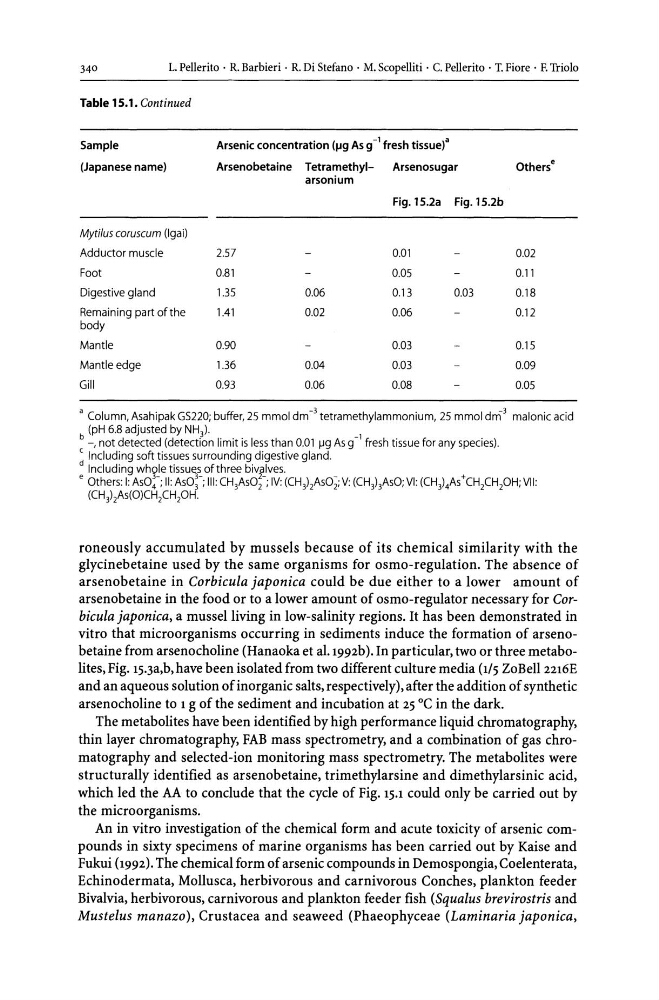
Table 15.1. Continued
Sample
Arsenic concentration (Ilg As 9 -1 fresh tissue)"
(Japanese name)
Arsenobetaine TetramethylArsenosugar
Others
e
arsonium
Fig. 15.2a Fig. 15.2b
Mytilus coruscum (lgai)
Adductor muscle
2.57
0.01
0.02
Foot
0.81
0.05
0.11
Digestive gland
1.35
0.06
0.13
0.03
0.18
Remaining part of the
1.41
0.02
0.06
0.12
body
Mantle
0.90
0.03
0.15
Mantle edge
1.36
0.04
0.03
0.09
Gill
0.93
0.06
0.08
0.05
a Column, Asahipak GS220; buffer, 25 mmol dm -3 tetramethylammonium, 25 mmol dm 3 malonic acid
(pH 6.8 adjusted by NH 3 ).
b _, not detected (detection limit is less than 0.01 ~g As g -1 fresh tissue for any species).
C Including soft tissues surrounding digestive gland.
d Including whole tissues of three bivalves.
e Others: I: AsO!-; II: AsO~-; III: CH3AsO~-; IV: (CH3)2AsO;; V: (CH3)3AsO; VI: (CH3)4As +CH 2 CHPH; VII:
(CH 3 )2As(O)CH 2 CHpH.
roneously accumulated by mussels because of its chemical similarity with the
glycinebetaine used by the same organisms for osmo-regulation. The absence of
arsenobetaine in Corbicula japonica could be due either to a lower amount of
arsenobetaine in the food or to a lower amount of osmo-regulator necessary for Corbicula japonica, a mussel living in low-salinity regions. It has been demonstrated in
vitro that microorganisms occurring in sediments induce the formation of arsenobetaine from arsenocholine (Hanaoka et al. 1992b). In particular, two or three metabolites, Fig. 15.3a,b, have been isolated from two different culture media (115 ZoBell 2216E
and an aqueous solution of inorganic salts, respectively), after the addition of synthetic
arsenocholine to 1 g of the sediment and incubation at 25°C in the dark.
The metabolites have been identified by high performance liquid chromatography,
thin layer chromatography, FAB mass spectrometry, and a combination of gas chromatography and selected-ion monitoring mass spectrometry. The metabolites were
structurally identified as arsenobetaine, trimethylarsine and dimethylarsinic acid,
which led the AA to conclude that the cycle of Fig. 15.1 could only be carried out by
the microorganisms.
An in vitro investigation of the chemical form and acute toxicity of arsenic compounds in sixty specimens of marine organisms has been carried out by Kaise and
Fukui (1992). The chemical form of arsenic compounds in Demospongia, Coelenterata,
Echinodermata, Mollusca, herbivorous and carnivorous Conches, plankton feeder
Bivalvia, herbivorous, carnivorous and plankton feeder fish (Squalus brevirostris and
Mustelus manazo), Crustacea and seaweed (Phaeophyceae (Lamina ria japonica,
L. Pellerito . R. Barbieri . R. Di Stefano . M. Scopelliti . C. Pellerito . T. Fiore . F. Triolo
Table 15.1. Continued
Sample
Arsenic concentration (Ilg As 9 -1 fresh tissue)"
(Japanese name)
Arsenobetaine TetramethylArsenosugar
Others
e
arsonium
Fig. 15.2a Fig. 15.2b
Mytilus coruscum (lgai)
Adductor muscle
2.57
0.01
0.02
Foot
0.81
0.05
0.11
Digestive gland
1.35
0.06
0.13
0.03
0.18
Remaining part of the
1.41
0.02
0.06
0.12
body
Mantle
0.90
0.03
0.15
Mantle edge
1.36
0.04
0.03
0.09
Gill
0.93
0.06
0.08
0.05
a Column, Asahipak GS220; buffer, 25 mmol dm -3 tetramethylammonium, 25 mmol dm 3 malonic acid
(pH 6.8 adjusted by NH 3 ).
b _, not detected (detection limit is less than 0.01 ~g As g -1 fresh tissue for any species).
C Including soft tissues surrounding digestive gland.
d Including whole tissues of three bivalves.
e Others: I: AsO!-; II: AsO~-; III: CH3AsO~-; IV: (CH3)2AsO;; V: (CH3)3AsO; VI: (CH3)4As +CH 2 CHPH; VII:
(CH 3 )2As(O)CH 2 CHpH.
roneously accumulated by mussels because of its chemical similarity with the
glycinebetaine used by the same organisms for osmo-regulation. The absence of
arsenobetaine in Corbicula japonica could be due either to a lower amount of
arsenobetaine in the food or to a lower amount of osmo-regulator necessary for Corbicula japonica, a mussel living in low-salinity regions. It has been demonstrated in
vitro that microorganisms occurring in sediments induce the formation of arsenobetaine from arsenocholine (Hanaoka et al. 1992b). In particular, two or three metabolites, Fig. 15.3a,b, have been isolated from two different culture media (115 ZoBell 2216E
and an aqueous solution of inorganic salts, respectively), after the addition of synthetic
arsenocholine to 1 g of the sediment and incubation at 25°C in the dark.
The metabolites have been identified by high performance liquid chromatography,
thin layer chromatography, FAB mass spectrometry, and a combination of gas chromatography and selected-ion monitoring mass spectrometry. The metabolites were
structurally identified as arsenobetaine, trimethylarsine and dimethylarsinic acid,
which led the AA to conclude that the cycle of Fig. 15.1 could only be carried out by
the microorganisms.
An in vitro investigation of the chemical form and acute toxicity of arsenic compounds in sixty specimens of marine organisms has been carried out by Kaise and
Fukui (1992). The chemical form of arsenic compounds in Demospongia, Coelenterata,
Echinodermata, Mollusca, herbivorous and carnivorous Conches, plankton feeder
Bivalvia, herbivorous, carnivorous and plankton feeder fish (Squalus brevirostris and
Mustelus manazo), Crustacea and seaweed (Phaeophyceae (Lamina ria japonica,