

CHAPTER 14 . Chemistry of Organic Toxicants in Marine Environments
329
Table 14.1. Total depositions of PCBs, benzo(a)pyrene, 2,3>4,7,8-PeCDF and lindane for 1996
Compounds
Unit
Mediterranean Sea
Baltic Sea
North Sea
PCBs
kg yr
-1
1623
715
594
B[a]P
t yr
-1
30
7
12
2,3A),8-PeCDF
9 I-Teqyr
-1
492
65
101
Lindane
t yr
-1
56
18
26
Table 14.2. Deposition densities of PCBs, benzo(a)pyrene, 2,3>4,7,8-PeCDF and lindane for 1996
Compounds
Unit
Mediterranean Sea
Baltic Sea
North Sea
PCBs
-2 -1
472
1843
886
ngm yr
B[a]P
-2 -1
9
18
18
flgm yr
2,3A),8-PeCDF
pg I-Teq m
-2 -1
143
167
151
yr
Lindane
-2 -1
16
46
38
flgm yr
f 30
40
>. j ~ ~r~ I . -
1: 25
i 35 ~------ I ------------ [;l
Ol
!:: 30 . -------.
.. .. ---- ------------ --- -----.. • Dry
..;; 20
.§ 25
~
.~ 15
.~ 20
Qj
0
~ 10
~ 15
0
'U
.;::;
1§ 10
'Vi 5
0
{2 5
Q.
Qj
0
0
0
Mediterranean Baltic Sea
North Sea
Mediterranean Ba ltic Sea
North Sea
Sea
Sea
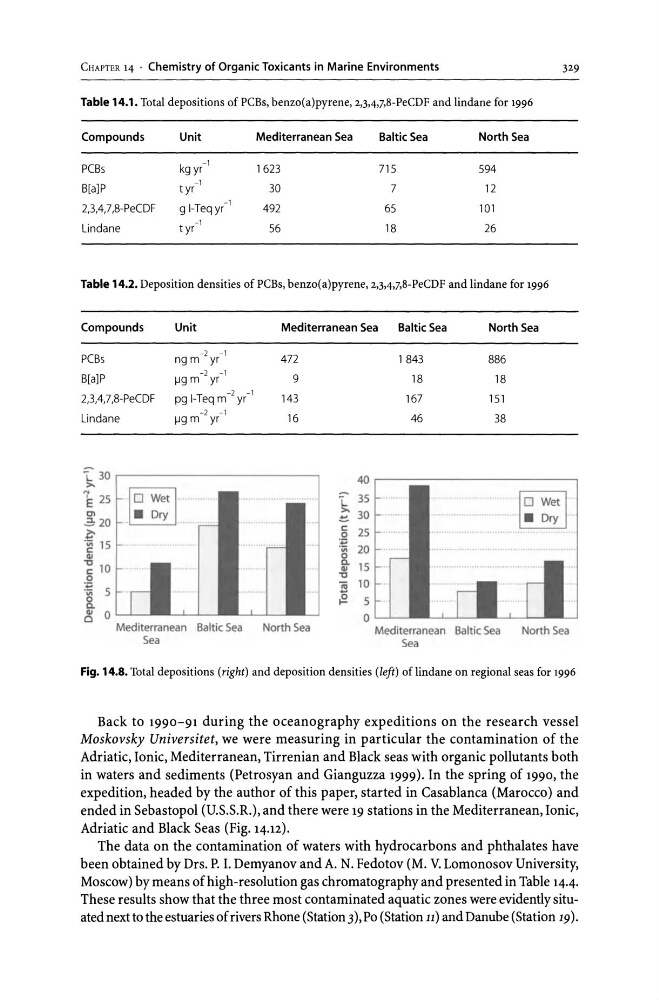
Fig. 14.8. Total depositions (right) and deposition densities (left) oflindane on regional seas for 1996
Back to 1990-91 during the oceanography expeditions on the research vessel
Moskovsky Universitet, we were measuring in particular the contamination of the
Adriatic, Ionic, Mediterranean, Tirrenian and Black seas with organic pollutants both
in waters and sediments (Petrosyan and Gianguzza 1999). In the spring of 1990, the
expedition, headed by the author of this paper, started in Casablanca (Marocco) and
ended in Sebastopol (U.S.S.R.), and there were 19 stations in the Mediterranean, Ionic,
Adriatic and Black Seas (Fig. 14.12).
The data on the contamination of waters with hydrocarbons and phthalates have
been obtained by Drs. P. I. Demyanov and A. N. Fedotov (M. V. Lomonosov University,
Moscow) by means of high-resolution gas chromatography and presented in Table 14.4.
These results show that the three most contaminated aquatic zones were evidently situated next to ilie estuaries of rivers Rhone (Station 3), Po (Station 11) and Danube (Station 19).
329
Table 14.1. Total depositions of PCBs, benzo(a)pyrene, 2,3>4,7,8-PeCDF and lindane for 1996
Compounds
Unit
Mediterranean Sea
Baltic Sea
North Sea
PCBs
kg yr
-1
1623
715
594
B[a]P
t yr
-1
30
7
12
2,3A),8-PeCDF
9 I-Teqyr
-1
492
65
101
Lindane
t yr
-1
56
18
26
Table 14.2. Deposition densities of PCBs, benzo(a)pyrene, 2,3>4,7,8-PeCDF and lindane for 1996
Compounds
Unit
Mediterranean Sea
Baltic Sea
North Sea
PCBs
-2 -1
472
1843
886
ngm yr
B[a]P
-2 -1
9
18
18
flgm yr
2,3A),8-PeCDF
pg I-Teq m
-2 -1
143
167
151
yr
Lindane
-2 -1
16
46
38
flgm yr
f 30
40
>. j ~ ~r~ I . -
1: 25
i 35 ~------ I ------------ [;l
Ol
!:: 30 . -------.
.. .. ---- ------------ --- -----.. • Dry
..;; 20
.§ 25
~
.~ 15
.~ 20
Qj
0
~ 10
~ 15
0
'U
.;::;
1§ 10
'Vi 5
0
{2 5
Q.
Qj
0
0
0
Mediterranean Baltic Sea
North Sea
Mediterranean Ba ltic Sea
North Sea
Sea
Sea
Fig. 14.8. Total depositions (right) and deposition densities (left) oflindane on regional seas for 1996
Back to 1990-91 during the oceanography expeditions on the research vessel
Moskovsky Universitet, we were measuring in particular the contamination of the
Adriatic, Ionic, Mediterranean, Tirrenian and Black seas with organic pollutants both
in waters and sediments (Petrosyan and Gianguzza 1999). In the spring of 1990, the
expedition, headed by the author of this paper, started in Casablanca (Marocco) and
ended in Sebastopol (U.S.S.R.), and there were 19 stations in the Mediterranean, Ionic,
Adriatic and Black Seas (Fig. 14.12).
The data on the contamination of waters with hydrocarbons and phthalates have
been obtained by Drs. P. I. Demyanov and A. N. Fedotov (M. V. Lomonosov University,
Moscow) by means of high-resolution gas chromatography and presented in Table 14.4.
These results show that the three most contaminated aquatic zones were evidently situated next to ilie estuaries of rivers Rhone (Station 3), Po (Station 11) and Danube (Station 19).