

CHAPTER 13 . Endocrine-Disrupting Chemicals in Marine Environment
Thyroid
Metabolism
Growth
Development?
Migration
T TK
Liver
Metabolites
Reproduction
Feedback
Adrenal
Cortisol
Stress response
(Immune system)
Osmoregulation
Metabolism
315
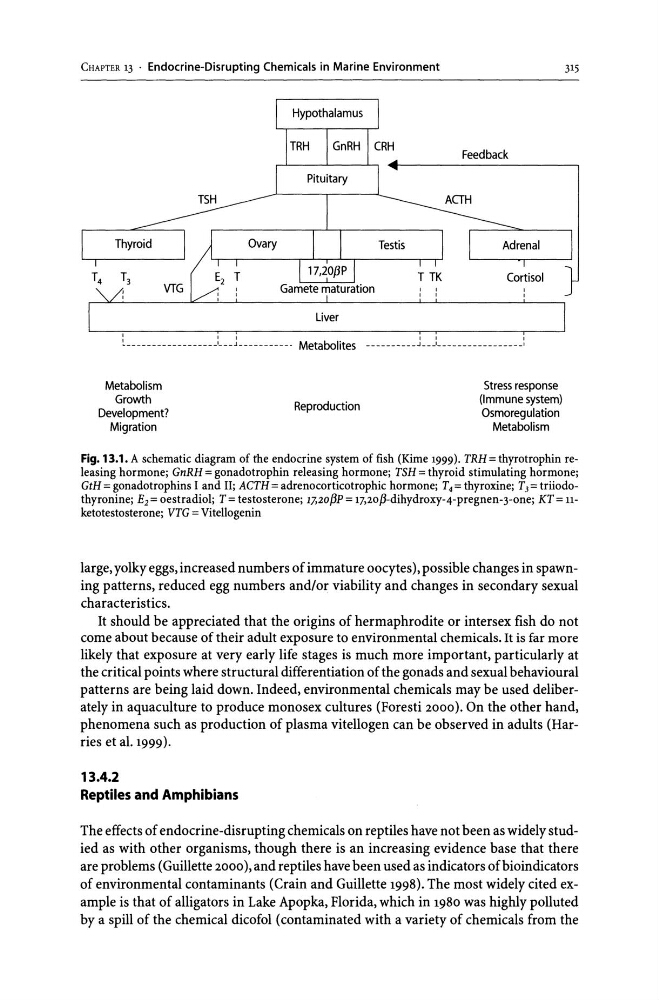
Fig. 13.1. A schematic diagram of the endocrine system of fish (Kime 1999). TRH = thyrotrophin releasing hormone; GnRH = gonadotrophin releasing hormone; TSH = thyroid stimulating hormone;
GtH = gonadotrophins I and II; ACTH = adrenocorticotrophic hormone; T4 = thyroxine; T3 = triiodothyronine; E2 = oestradiol; T = testosterone; IJ,20/3P = 17,2o/3-dihydroxY-4-pregnen-3-one; KT = 11keto testosterone; VTG = Vitellogenin
large, yolky eggs, increased numbers of immature oocytes), possible changes in spawning patterns, reduced egg numbers and/or viability and changes in secondary sexual
characteristics.
It should be appreciated that the origins of hermaphrodite or intersex fish do not
come about because of their adult exposure to environmental chemicals. It is far more
likely that exposure at very early life stages is much more important, particularly at
the critical points where structural differentiation of the gonads and sexual behavioural
patterns are being laid down. Indeed, environmental chemicals may be used deliberately in aquaculture to produce monosex cultures (Foresti 2000). On the other hand,
phenomena such as production of plasma vitellogen can be observed in adults (Harries et al. 1999).
13.4.2
Reptiles and Amphibians
The effects of endocrine-disrupting chemicals on reptiles have not been as widely studied as with other organisms, though there is an increasing evidence base that there
are problems (Guillette 2000), and reptiles have been used as indicators ofbioindicators
of environmental contaminants (Crain and Guillette 1998). The most widely cited example is that of alligators in Lake Apopka, Florida, which in 1980 was highly polluted
by a spill of the chemical dicofol (contaminated with a variety of chemicals from the
Thyroid
Metabolism
Growth
Development?
Migration
T TK
Liver
Metabolites
Reproduction
Feedback
Adrenal
Cortisol
Stress response
(Immune system)
Osmoregulation
Metabolism
315
Fig. 13.1. A schematic diagram of the endocrine system of fish (Kime 1999). TRH = thyrotrophin releasing hormone; GnRH = gonadotrophin releasing hormone; TSH = thyroid stimulating hormone;
GtH = gonadotrophins I and II; ACTH = adrenocorticotrophic hormone; T4 = thyroxine; T3 = triiodothyronine; E2 = oestradiol; T = testosterone; IJ,20/3P = 17,2o/3-dihydroxY-4-pregnen-3-one; KT = 11keto testosterone; VTG = Vitellogenin
large, yolky eggs, increased numbers of immature oocytes), possible changes in spawning patterns, reduced egg numbers and/or viability and changes in secondary sexual
characteristics.
It should be appreciated that the origins of hermaphrodite or intersex fish do not
come about because of their adult exposure to environmental chemicals. It is far more
likely that exposure at very early life stages is much more important, particularly at
the critical points where structural differentiation of the gonads and sexual behavioural
patterns are being laid down. Indeed, environmental chemicals may be used deliberately in aquaculture to produce monosex cultures (Foresti 2000). On the other hand,
phenomena such as production of plasma vitellogen can be observed in adults (Harries et al. 1999).
13.4.2
Reptiles and Amphibians
The effects of endocrine-disrupting chemicals on reptiles have not been as widely studied as with other organisms, though there is an increasing evidence base that there
are problems (Guillette 2000), and reptiles have been used as indicators ofbioindicators
of environmental contaminants (Crain and Guillette 1998). The most widely cited example is that of alligators in Lake Apopka, Florida, which in 1980 was highly polluted
by a spill of the chemical dicofol (contaminated with a variety of chemicals from the