

312
M. R. Preston
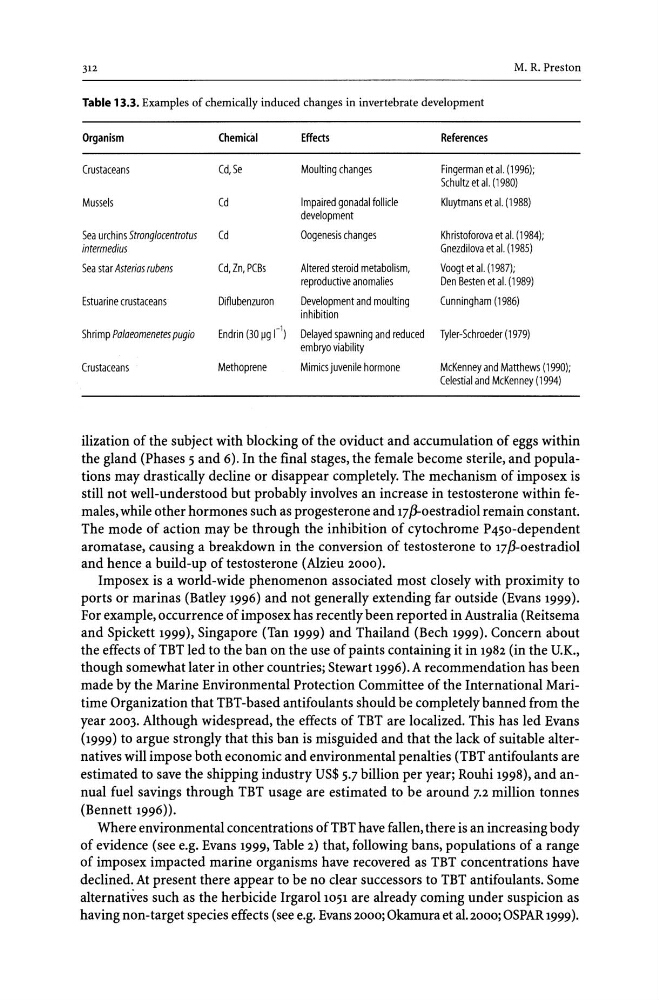
Table 13.3. Examples of chemically induced changes in invertebrate development
Organism
Chemical
Effects
References
Crustaceans
Cd,Se
Moulting changes
Fingerman et al. (1996);
Schultz et al. (1980)
Mussels
Cd
Impaired gonadal follicle
Kluytmans et al. (1988)
development
Sea urchins Stronglocentrotus
Cd
Oogenesis changes
Khristoforova et al. (1984);
intermedius
Gnezdilova et al. (1985)
Sea star Asterias rubens
Cd,Zn, PCBs
Altered steroid metabolism,
Voogt et al. (1987);
reproductive anomalies
Den Besten et al. (1989)
Estuarine crustaceans
Difiubenzuron
Development and moulting
Cunningham (1986)
inhibition
Shrimp Palaeomenetes pugio
Endrin (30 ~g 1-1) Delayed spawning and reduced Tyler-Schroeder (1979)
embryo viability
Crustaceans
Methoprene
Mimics juvenile hormone
McKenney and Matthews (1990);
Celestial and McKenney (1994)
ilization of the subject with blocking of the oviduct and accumulation of eggs within
the gland (Phases 5 and 6). In the final stages, the female become sterile, and populations may drastically decline or disappear completely. The mechanism of imposex is
still not well-understood but probably involves an increase in testosterone within females, while other hormones such as progesterone and 17p-oestradiol remain constant.
The mode of action may be through the inhibition of cytochrome P450-dependent
aromatase, causing a breakdown in the conversion of testosterone to 17/3-oestradiol
and hence a build-up of testosterone (Alzieu 2000).
Imposex is a world-wide phenomenon associated most closely with proximity to
ports or marinas (Batley 1996) and not generally extending far outside (Evans 1999).
For example, occurrence of imposex has recently been reported in Australia (Reitsema
and Spickett 1999), Singapore (Tan 1999) and Thailand (Bech 1999). Concern about
the effects of TBT led to the ban on the use of paints containing it in 1982 (in the U.K.,
though somewhat later in other countries; Stewart 1996). A recommendation has been
made by the Marine Environmental Protection Committee of the International Maritime Organization that TBT -based antifoulants should be completely banned from the
year 2003. Although widespread, the effects of TBT are localized. This has led Evans
(1999) to argue strongly that this ban is misguided and that the lack of suitable alternatives will impose both economic and environmental penalties (TBT antifoulants are
estimated to save the shipping industry US$ 5.7 billion per year; Rouhi 1998), and annual fuel savings through TBT usage are estimated to be around 7.2 million tonnes
(Bennett 1996)).
Where environmental concentrations ofTBT have fallen, there is an increasing body
of evidence (see e.g. Evans 1999, Table 2) that, following bans, populations of a range
of imposex impacted marine organisms have recovered as TBT concentrations have
declined. At present there appear to be no clear successors to TBT antifoulants. Some
alternatives such as the herbicide Irgarol1051 are already coming under suspicion as
having non-target species effects (see e.g. Evans 2000; Okamura et al. 2000; OSPAR 1999).
M. R. Preston
Table 13.3. Examples of chemically induced changes in invertebrate development
Organism
Chemical
Effects
References
Crustaceans
Cd,Se
Moulting changes
Fingerman et al. (1996);
Schultz et al. (1980)
Mussels
Cd
Impaired gonadal follicle
Kluytmans et al. (1988)
development
Sea urchins Stronglocentrotus
Cd
Oogenesis changes
Khristoforova et al. (1984);
intermedius
Gnezdilova et al. (1985)
Sea star Asterias rubens
Cd,Zn, PCBs
Altered steroid metabolism,
Voogt et al. (1987);
reproductive anomalies
Den Besten et al. (1989)
Estuarine crustaceans
Difiubenzuron
Development and moulting
Cunningham (1986)
inhibition
Shrimp Palaeomenetes pugio
Endrin (30 ~g 1-1) Delayed spawning and reduced Tyler-Schroeder (1979)
embryo viability
Crustaceans
Methoprene
Mimics juvenile hormone
McKenney and Matthews (1990);
Celestial and McKenney (1994)
ilization of the subject with blocking of the oviduct and accumulation of eggs within
the gland (Phases 5 and 6). In the final stages, the female become sterile, and populations may drastically decline or disappear completely. The mechanism of imposex is
still not well-understood but probably involves an increase in testosterone within females, while other hormones such as progesterone and 17p-oestradiol remain constant.
The mode of action may be through the inhibition of cytochrome P450-dependent
aromatase, causing a breakdown in the conversion of testosterone to 17/3-oestradiol
and hence a build-up of testosterone (Alzieu 2000).
Imposex is a world-wide phenomenon associated most closely with proximity to
ports or marinas (Batley 1996) and not generally extending far outside (Evans 1999).
For example, occurrence of imposex has recently been reported in Australia (Reitsema
and Spickett 1999), Singapore (Tan 1999) and Thailand (Bech 1999). Concern about
the effects of TBT led to the ban on the use of paints containing it in 1982 (in the U.K.,
though somewhat later in other countries; Stewart 1996). A recommendation has been
made by the Marine Environmental Protection Committee of the International Maritime Organization that TBT -based antifoulants should be completely banned from the
year 2003. Although widespread, the effects of TBT are localized. This has led Evans
(1999) to argue strongly that this ban is misguided and that the lack of suitable alternatives will impose both economic and environmental penalties (TBT antifoulants are
estimated to save the shipping industry US$ 5.7 billion per year; Rouhi 1998), and annual fuel savings through TBT usage are estimated to be around 7.2 million tonnes
(Bennett 1996)).
Where environmental concentrations ofTBT have fallen, there is an increasing body
of evidence (see e.g. Evans 1999, Table 2) that, following bans, populations of a range
of imposex impacted marine organisms have recovered as TBT concentrations have
declined. At present there appear to be no clear successors to TBT antifoulants. Some
alternatives such as the herbicide Irgarol1051 are already coming under suspicion as
having non-target species effects (see e.g. Evans 2000; Okamura et al. 2000; OSPAR 1999).