

CHAPTER 13 . Endocrine-Disrupting Chemicals in Marine Environment
311
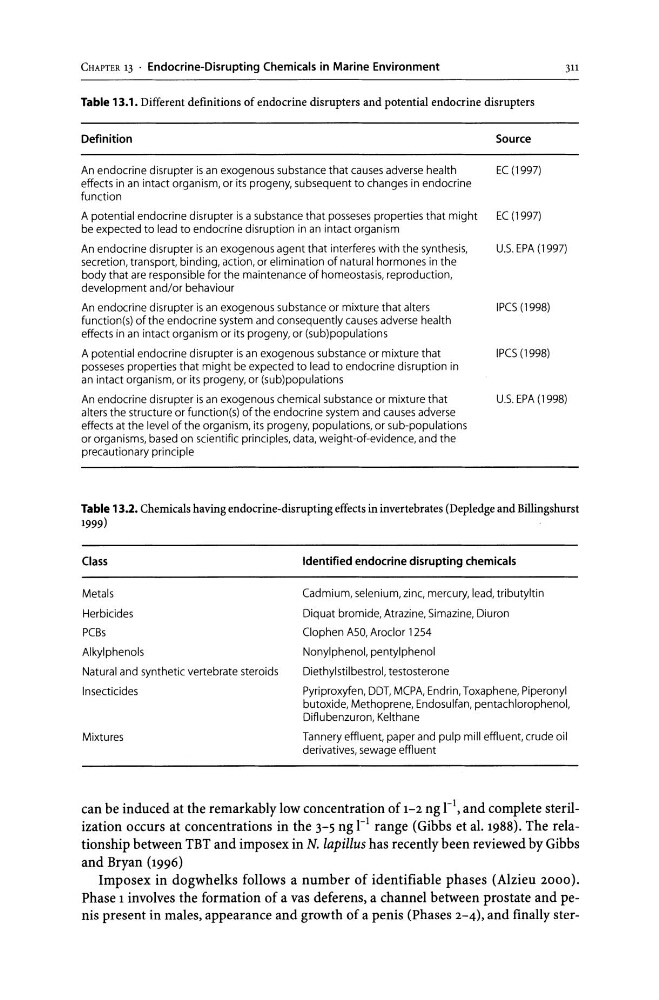
Table 13.1. Different definitions of endocrine disrupters and potential endocrine disrupters
Definition
Source
An endocrine disrupter is an exogenous substance that causes adverse health
EC (1997)
effects in an intact organism, or its progeny, subsequent to changes in endocrine
function
A potential endocrine disrupter is a substance that posseses properties that might
EC (1997)
be expected to lead to endocrine disruption in an intact organism
An endocrine disrupter is an exogenous agent that interferes with the synthesis,
U.s. EPA (1997)
secretion, transport, binding, action, or elimination of natural hormones in the
body that are responsible for the maintenance of homeostasis, reproduction,
development and/or behaviour
An endocrine disrupter is an exogenous substance or mixture that alters
IPCS (1998)
function(s) of the endocrine system and consequently causes adverse health
effects in an intact organism or its progeny, or (sub)populations
A potential endocrine disrupter is an exogenous substance or mixture that
IPCS (1998)
posseses properties that might be expected to lead to endocrine disruption in
an intact organism, or its progeny, or (sub)populations
An endocrine disrupter is an exogenous chemical substance or mixture that
U.s. EPA (1998)
alters the structure or function(s) of the endocrine system and causes adverse
effects at the level of the organism, its progeny, populations, or sub-populations
or organisms, based on scientific principles, data, weight-of-evidence, and the
precautionary principle
Table 13.2. Chemicals having endocrine-disrupting effects in invertebrates (Depledge and Billingshurst
1999)
Class
Metals
Herbicides
PCBs
Alkylphenols
Natural and synthetic vertebrate steroids
Insecticides
Mixtures
Identified endocrine disrupting chemicals
Cadmium, selenium, zinc, mercury, lead, tributyltin
Diquat bromide, Atrazine, Simazine, Diuron
Clop hen A50, Aroclor 1254
Nonylphenol, pentylphenol
Diethylstilbestrol, testosterone
Pyriproxyfen, DDT, MCPA, Endrin, Toxaphene, Piperonyl
butoxide, Methoprene, Endosulfan, pentachlorophenol,
Diflubenzuron, Kelthane
Tannery effluent, paper and pulp mill effluent, crude oil
derivatives, sewage effluent
can be induced at the remarkably low concentration of 1-2 ng rl, and complete sterilization occurs at concentrations in the 3-5 ng rl range (Gibbs et al. 1988). The relationship between TBT and imposex in N. lapillus has recently been reviewed by Gibbs
and Bryan (1996)
Imposex in dogwhelks follows a number of identifiable phases (Alzieu 2000).
Phase 1 involves the formation of a vas deferens, a channel between prostate and penis present in males, appearance and growth of a penis (Phases 2-4), and finally ster-
311
Table 13.1. Different definitions of endocrine disrupters and potential endocrine disrupters
Definition
Source
An endocrine disrupter is an exogenous substance that causes adverse health
EC (1997)
effects in an intact organism, or its progeny, subsequent to changes in endocrine
function
A potential endocrine disrupter is a substance that posseses properties that might
EC (1997)
be expected to lead to endocrine disruption in an intact organism
An endocrine disrupter is an exogenous agent that interferes with the synthesis,
U.s. EPA (1997)
secretion, transport, binding, action, or elimination of natural hormones in the
body that are responsible for the maintenance of homeostasis, reproduction,
development and/or behaviour
An endocrine disrupter is an exogenous substance or mixture that alters
IPCS (1998)
function(s) of the endocrine system and consequently causes adverse health
effects in an intact organism or its progeny, or (sub)populations
A potential endocrine disrupter is an exogenous substance or mixture that
IPCS (1998)
posseses properties that might be expected to lead to endocrine disruption in
an intact organism, or its progeny, or (sub)populations
An endocrine disrupter is an exogenous chemical substance or mixture that
U.s. EPA (1998)
alters the structure or function(s) of the endocrine system and causes adverse
effects at the level of the organism, its progeny, populations, or sub-populations
or organisms, based on scientific principles, data, weight-of-evidence, and the
precautionary principle
Table 13.2. Chemicals having endocrine-disrupting effects in invertebrates (Depledge and Billingshurst
1999)
Class
Metals
Herbicides
PCBs
Alkylphenols
Natural and synthetic vertebrate steroids
Insecticides
Mixtures
Identified endocrine disrupting chemicals
Cadmium, selenium, zinc, mercury, lead, tributyltin
Diquat bromide, Atrazine, Simazine, Diuron
Clop hen A50, Aroclor 1254
Nonylphenol, pentylphenol
Diethylstilbestrol, testosterone
Pyriproxyfen, DDT, MCPA, Endrin, Toxaphene, Piperonyl
butoxide, Methoprene, Endosulfan, pentachlorophenol,
Diflubenzuron, Kelthane
Tannery effluent, paper and pulp mill effluent, crude oil
derivatives, sewage effluent
can be induced at the remarkably low concentration of 1-2 ng rl, and complete sterilization occurs at concentrations in the 3-5 ng rl range (Gibbs et al. 1988). The relationship between TBT and imposex in N. lapillus has recently been reviewed by Gibbs
and Bryan (1996)
Imposex in dogwhelks follows a number of identifiable phases (Alzieu 2000).
Phase 1 involves the formation of a vas deferens, a channel between prostate and penis present in males, appearance and growth of a penis (Phases 2-4), and finally ster-