

CHAPTER 1 • Sea Water as an Electrolyte
10
8 Ig 6
EJ
b
- x
~ 4
I
S.
2
ov
o
Sea water
0 NaCl
0 MgCl 2
•
Na 2 S0 4
\l MgS0 4
2
15
\l
4
6
8
10
Salinity
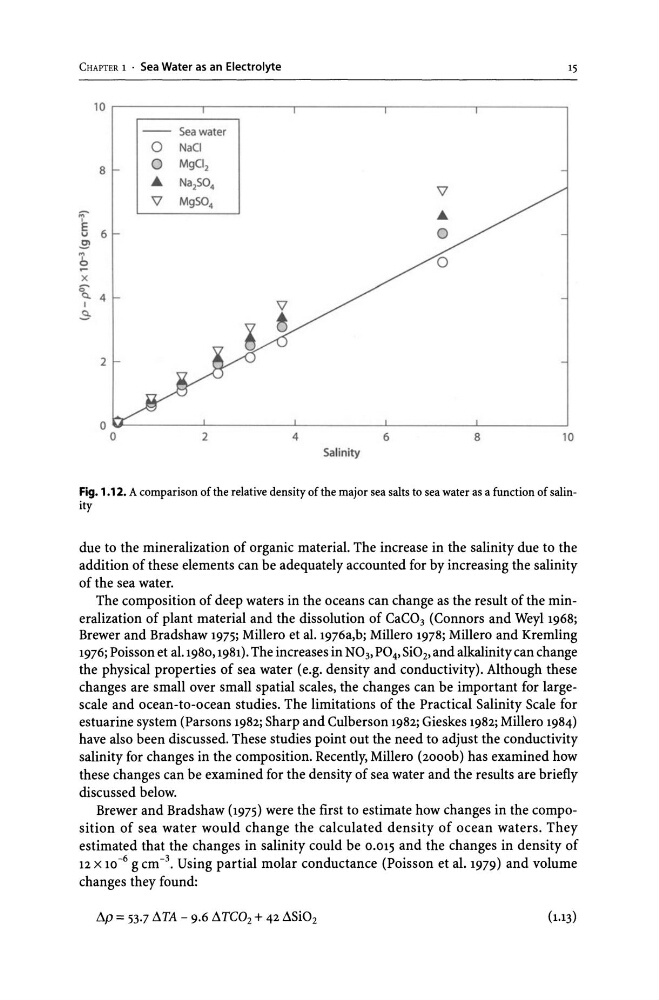
Fig. 1.12. A comparison of the relative density of the major sea salts to sea water as a function of salinity
due to the mineralization of organic material. The increase in the salinity due to the
addition of these elements can be adequately accounted for by increasing the salinity
of the sea water.
The composition of deep waters in the oceans can change as the result of the mineralization of plant material and the dissolution of CaC03 (Connors and Weyl1968;
Brewer and Bradshaw 1975; Millero et al. 1976a,b; Millero 1978; Millero and Kremling
1976; Poisson et al.1980, 1981). The increases in N03, P04, Si02, and alkalinity can change
the physical properties of sea water (e.g. density and conductivity). Although these
changes are small over small spatial scales, the changes can be important for largescale and ocean-to-ocean studies. The limitations of the Practical Salinity Scale for
estuarine system (Parsons 1982; Sharp and Culberson 1982; Gieskes 1982; Millero 1984)
have also been discussed. These studies point out the need to adjust the conductivity
salinity for changes in the composition. Recently, Millero (2000b) has examined how
these changes can be examined for the density of sea water and the results are briefly
discussed below.
Brewer and Bradshaw (1975) were the first to estimate how changes in the composition of sea water would change the calculated density of ocean waters. They
estimated that the changes in salinity could be 0.015 and the changes in density of
12 x 10 -6 g em -3. Using partial molar conductance (Poisson et al. 1979) and volume
changes they found:
I1p = 5J.7I1TA - 9.6 11 TC02 + 4211Si02
(1.13)
10
8 Ig 6
EJ
b
- x
~ 4
I
S.
2
ov
o
Sea water
0 NaCl
0 MgCl 2
•
Na 2 S0 4
\l MgS0 4
2
15
\l
4
6
8
10
Salinity
Fig. 1.12. A comparison of the relative density of the major sea salts to sea water as a function of salinity
due to the mineralization of organic material. The increase in the salinity due to the
addition of these elements can be adequately accounted for by increasing the salinity
of the sea water.
The composition of deep waters in the oceans can change as the result of the mineralization of plant material and the dissolution of CaC03 (Connors and Weyl1968;
Brewer and Bradshaw 1975; Millero et al. 1976a,b; Millero 1978; Millero and Kremling
1976; Poisson et al.1980, 1981). The increases in N03, P04, Si02, and alkalinity can change
the physical properties of sea water (e.g. density and conductivity). Although these
changes are small over small spatial scales, the changes can be important for largescale and ocean-to-ocean studies. The limitations of the Practical Salinity Scale for
estuarine system (Parsons 1982; Sharp and Culberson 1982; Gieskes 1982; Millero 1984)
have also been discussed. These studies point out the need to adjust the conductivity
salinity for changes in the composition. Recently, Millero (2000b) has examined how
these changes can be examined for the density of sea water and the results are briefly
discussed below.
Brewer and Bradshaw (1975) were the first to estimate how changes in the composition of sea water would change the calculated density of ocean waters. They
estimated that the changes in salinity could be 0.015 and the changes in density of
12 x 10 -6 g em -3. Using partial molar conductance (Poisson et al. 1979) and volume
changes they found:
I1p = 5J.7I1TA - 9.6 11 TC02 + 4211Si02
(1.13)