

CHAPTER 11 • Acid-Base Equilibria in Saline Media: Application of the MSA
[AH][H+]Y AHYH+ = K;Ql(Yi)
K! = [AHr] YAH!
InK! = InK; + In Y AH± + In Y H+ -In YAH!
I
l ellhs
nYi = nYi + nYi
Iny AH ± = 2Am = A'CMX
T
*
I
leI
lhs leI
lhs
InKl = InKl + A CMX + ny H + + ny H + - ny AH ! - ny AH !
P K* +_I_[lnyel -lnye! +lnyhS _lnyhS ]=PK T +A'C
1
IniO
H+
AH!
H+
AH!
1
MX
Y(O'Vdw(optim.)) = pK! + A' CMX
291
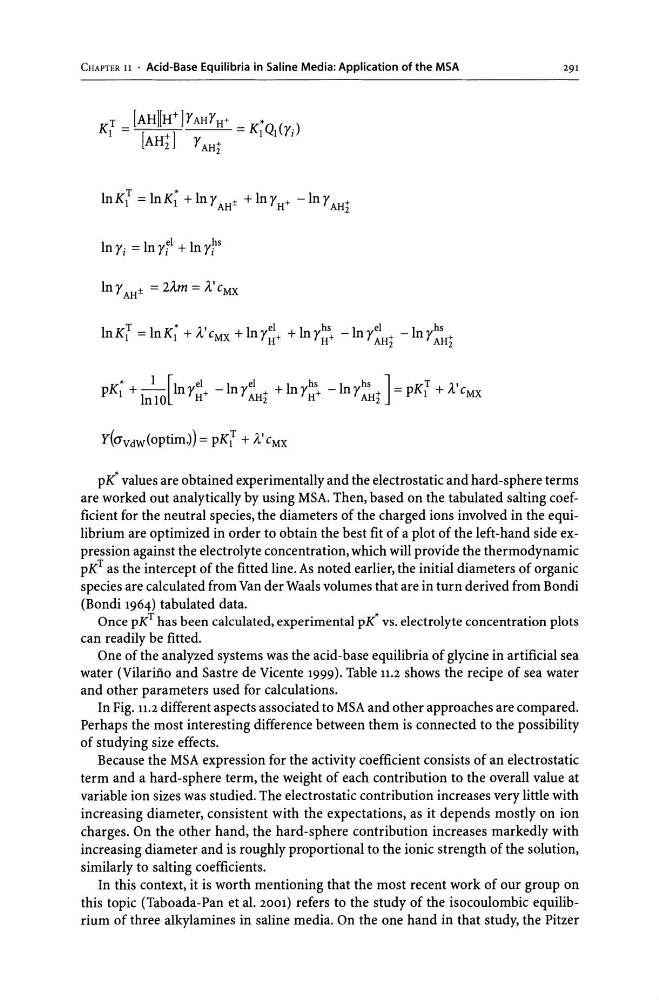
pK* values are obtained experimentally and the electrostatic and hard-sphere terms
are worked out analytically by using MSA. Then, based on the tabulated salting coefficient for the neutral species, the diameters of the charged ions involved in the equilibrium are optimized in order to obtain the best fit of a plot of the left-hand side expression against the electrolyte concentration, which will provide the thermodynamic
pK T as the intercept of the fitted line. As noted earlier, the initial diameters of organic
species are calculated from Van der Waals volumes that are in turn derived from Bondi
(Bondi 1964) tabulated data.
Once pK T has been calculated, experimental pK* vs. electrolyte concentration plots
can readily be fitted.
One of the analyzed systems was the acid-base equilibria of glycine in artificial sea
water (Vilarino and Sastre de Vicente 1999). Table 11.2 shows the recipe of sea water
and other parameters used for calculations.
In Fig. 11.2 different aspects associated to MSA and other approaches are compared.
Perhaps the most interesting difference between them is connected to the possibility
of studying size effects.
Because the MSA expression for the activity coefficient consists of an electrostatic
term and a hard-sphere term, the weight of each contribution to the overall value at
variable ion sizes was studied. The electrostatic contribution increases very little with
increasing diameter, consistent with the expectations, as it depends mostly on ion
charges. On the other hand, the hard-sphere contribution increases markedly with
increasing diameter and is roughly proportional to the ionic strength of the solution,
similarly to salting coefficients.
In this context, it is worth mentioning that the most recent work of our group on
this topic (Taboada-Pan et al. 2001) refers to the study of the isocoulombic equilibrium of three alkylamines in saline media. On the one hand in that study, the Pitzer
[AH][H+]Y AHYH+ = K;Ql(Yi)
K! = [AHr] YAH!
InK! = InK; + In Y AH± + In Y H+ -In YAH!
I
l ellhs
nYi = nYi + nYi
Iny AH ± = 2Am = A'CMX
T
*
I
leI
lhs leI
lhs
InKl = InKl + A CMX + ny H + + ny H + - ny AH ! - ny AH !
P K* +_I_[lnyel -lnye! +lnyhS _lnyhS ]=PK T +A'C
1
IniO
H+
AH!
H+
AH!
1
MX
Y(O'Vdw(optim.)) = pK! + A' CMX
291
pK* values are obtained experimentally and the electrostatic and hard-sphere terms
are worked out analytically by using MSA. Then, based on the tabulated salting coefficient for the neutral species, the diameters of the charged ions involved in the equilibrium are optimized in order to obtain the best fit of a plot of the left-hand side expression against the electrolyte concentration, which will provide the thermodynamic
pK T as the intercept of the fitted line. As noted earlier, the initial diameters of organic
species are calculated from Van der Waals volumes that are in turn derived from Bondi
(Bondi 1964) tabulated data.
Once pK T has been calculated, experimental pK* vs. electrolyte concentration plots
can readily be fitted.
One of the analyzed systems was the acid-base equilibria of glycine in artificial sea
water (Vilarino and Sastre de Vicente 1999). Table 11.2 shows the recipe of sea water
and other parameters used for calculations.
In Fig. 11.2 different aspects associated to MSA and other approaches are compared.
Perhaps the most interesting difference between them is connected to the possibility
of studying size effects.
Because the MSA expression for the activity coefficient consists of an electrostatic
term and a hard-sphere term, the weight of each contribution to the overall value at
variable ion sizes was studied. The electrostatic contribution increases very little with
increasing diameter, consistent with the expectations, as it depends mostly on ion
charges. On the other hand, the hard-sphere contribution increases markedly with
increasing diameter and is roughly proportional to the ionic strength of the solution,
similarly to salting coefficients.
In this context, it is worth mentioning that the most recent work of our group on
this topic (Taboada-Pan et al. 2001) refers to the study of the isocoulombic equilibrium of three alkylamines in saline media. On the one hand in that study, the Pitzer