

290
M. E. Sastre de Vicente . T. Vilarifto
11.8
An Example: Fitting pK vs.1 Plot by Use of MSA for an
Isocoulombic Equilibrium
If we take as an example the isocoulombic equilibrium: AH+ = A + H+, the first step is
always the estimation of the scaling parameter, r. The way of obtaining parameter 2T
from the general expression (see Fig. 11.1) depends on the number of ions present in
solution; the procedure usually involves solving an algebraic equation of a high order.
Thus, the equation for a binary salt is of sixth order and must be resolved numerically.
For this reason, various explicit approximations to Thave been developed, one of the
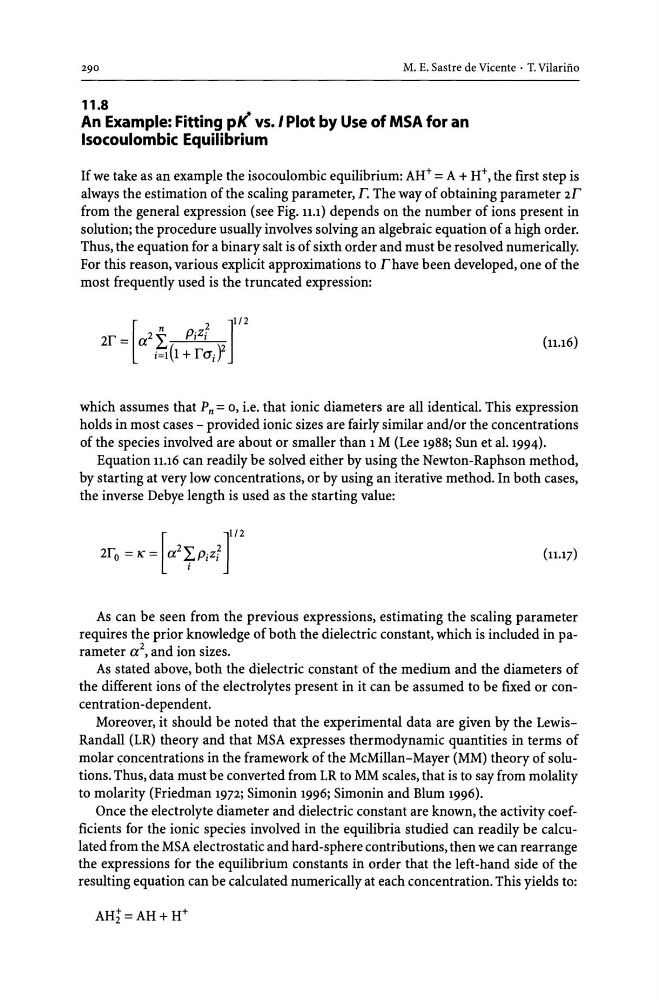
most frequently used is the truncated expression:
J
II2
2
n
PiZi
2r = [ a2 ti(1 + rO"if
(11.16)
which assumes that P n = 0, i.e. that ionic diameters are all identical. This expression
holds in most cases - provided ionic sizes are fairly similar and/or the concentrations
of the species involved are about or smaller than 1 M (Lee 1988; Sun et al. 1994).
Equation 11.16 can readily be solved either by using the Newton-Raphson method,
by starting at very low concentrations, or by using an iterative method. In both cases,
the inverse Debye length is used as the starting value:
[
]
112
2ro = 1(" = a2:tp;zl
(11.17)
As can be seen from the previous expressions, estimating the scaling parameter
requires the prior knowledge of both the dielectric constant, which is included in parameter a 2 , and ion sizes.
As stated above, both the dielectric constant of the medium and the diameters of
the different ions of the electrolytes present in it can be assumed to be fixed or concentration-dependent.
Moreover, it should be noted that the experimental data are given by the LewisRandall (LR) theory and that MSA expresses thermodynamic quantities in terms of
molar concentrations in the framework of the McMillan-Mayer (MM) theory of solutions. Thus, data must be converted from LR to MM scales, that is to say from molality
to molarity (Friedman 1972; Simonin 1996; Simonin and Blum 1996).
Once the electrolyte diameter and dielectric constant are known, the activity coefficients for the ionic species involved in the equilibria studied can readily be calculated from the MSA electrostatic and hard-sphere contributions, then we can rearrange
the expressions for the equilibrium constants in order that the left-hand side of the
resulting equation can be calculated numerically at each concentration. This yields to:
AH;=AH+ H+
M. E. Sastre de Vicente . T. Vilarifto
11.8
An Example: Fitting pK vs.1 Plot by Use of MSA for an
Isocoulombic Equilibrium
If we take as an example the isocoulombic equilibrium: AH+ = A + H+, the first step is
always the estimation of the scaling parameter, r. The way of obtaining parameter 2T
from the general expression (see Fig. 11.1) depends on the number of ions present in
solution; the procedure usually involves solving an algebraic equation of a high order.
Thus, the equation for a binary salt is of sixth order and must be resolved numerically.
For this reason, various explicit approximations to Thave been developed, one of the
most frequently used is the truncated expression:
J
II2
2
n
PiZi
2r = [ a2 ti(1 + rO"if
(11.16)
which assumes that P n = 0, i.e. that ionic diameters are all identical. This expression
holds in most cases - provided ionic sizes are fairly similar and/or the concentrations
of the species involved are about or smaller than 1 M (Lee 1988; Sun et al. 1994).
Equation 11.16 can readily be solved either by using the Newton-Raphson method,
by starting at very low concentrations, or by using an iterative method. In both cases,
the inverse Debye length is used as the starting value:
[
]
112
2ro = 1(" = a2:tp;zl
(11.17)
As can be seen from the previous expressions, estimating the scaling parameter
requires the prior knowledge of both the dielectric constant, which is included in parameter a 2 , and ion sizes.
As stated above, both the dielectric constant of the medium and the diameters of
the different ions of the electrolytes present in it can be assumed to be fixed or concentration-dependent.
Moreover, it should be noted that the experimental data are given by the LewisRandall (LR) theory and that MSA expresses thermodynamic quantities in terms of
molar concentrations in the framework of the McMillan-Mayer (MM) theory of solutions. Thus, data must be converted from LR to MM scales, that is to say from molality
to molarity (Friedman 1972; Simonin 1996; Simonin and Blum 1996).
Once the electrolyte diameter and dielectric constant are known, the activity coefficients for the ionic species involved in the equilibria studied can readily be calculated from the MSA electrostatic and hard-sphere contributions, then we can rearrange
the expressions for the equilibrium constants in order that the left-hand side of the
resulting equation can be calculated numerically at each concentration. This yields to:
AH;=AH+ H+