

288
M. E. Sastre de Vicente . T. Vilarino
The most relevant aspect in the expression of log yby using the MSA is that all parameters appearing in the equations shown in Fig. 11.1 are an explicitly simple function of charges, diameters, concentrations, dielectric constant and temperature.
11.5
Comparison With the Pitzer Model
At this point, let us recall the expression for the activity coefficient of an ion, using,
for example, a Pitzer equation.
The corresponding expression for the more general case of an electrolyte mixture
is (Pitzer 1973,1991) given as:
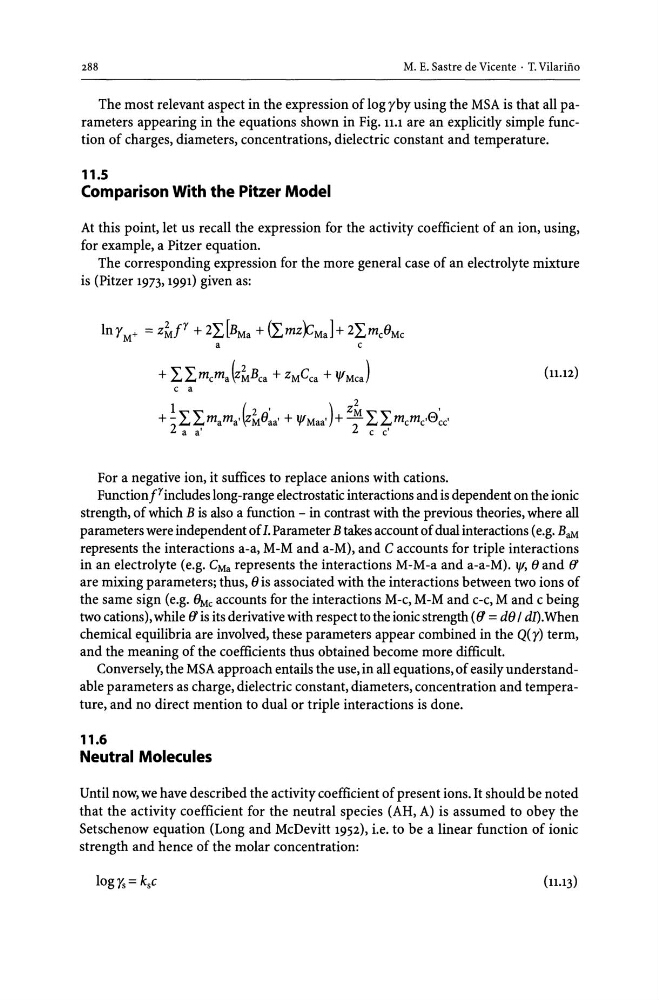
InYM+ = z~F + 2I,[BMa + ttmz~MaJ+ 2I,mc8Mc
a
+ I,I,mcma (z~Bca + zMCca + ljIMcJ
(n.12)
c a
1
(2 '
) z~
,
+ - I, I, mama,\zM8aa' + ljIMaa' + - I, I, mcmc,8cc'
2 a a'
2 c c'
For a negative ion, it suffices to replace anions with cations.
Function fYindudes long-range electrostatic interactions and is dependent on tile ionic
strengili, of which B is also a function - in contrast witil the previous theories, where all
parameters were independent of 1. Parameter B takes account of dual interactions (e.g. BaM
represents the interactions a-a, M-M and a-M), and C accounts for triple interactions
in an electrolyte (e.g. CMa represents the interactions M-M-a and a-a-M). ljI, e and f!
are mixing parameters; thus, 8 is associated with the interactions between two ions of
the same sign (e.g. ~c accounts for the interactions M-c, M-M and c-c, M and c being
two cations), while 8' is its derivative witil respectto tile ionic strengili (8' = d8 I dI).When
chemical equilibria are involved, these parameters appear combined in the Q( y) term,
and the meaning of the coefficients thus obtained become more difficult.
Conversely, the MSA approach entails the use, in all equations, of easily understandable parameters as charge, dielectric constant, diameters, concentration and temperature, and no direct mention to dual or triple interactions is done.
11.6
Neutral Molecules
Until now, we have described the activity coefficient of present ions. It should be noted
that the activity coefficient for the neutral species (AH, A) is assumed to obey the
Setschenow equation (Long and McDevitt 1952), i.e. to be a linear function of ionic
strength and hence of the molar concentration:
logy. = ksc
(11.13)
M. E. Sastre de Vicente . T. Vilarino
The most relevant aspect in the expression of log yby using the MSA is that all parameters appearing in the equations shown in Fig. 11.1 are an explicitly simple function of charges, diameters, concentrations, dielectric constant and temperature.
11.5
Comparison With the Pitzer Model
At this point, let us recall the expression for the activity coefficient of an ion, using,
for example, a Pitzer equation.
The corresponding expression for the more general case of an electrolyte mixture
is (Pitzer 1973,1991) given as:
InYM+ = z~F + 2I,[BMa + ttmz~MaJ+ 2I,mc8Mc
a
+ I,I,mcma (z~Bca + zMCca + ljIMcJ
(n.12)
c a
1
(2 '
) z~
,
+ - I, I, mama,\zM8aa' + ljIMaa' + - I, I, mcmc,8cc'
2 a a'
2 c c'
For a negative ion, it suffices to replace anions with cations.
Function fYindudes long-range electrostatic interactions and is dependent on tile ionic
strengili, of which B is also a function - in contrast witil the previous theories, where all
parameters were independent of 1. Parameter B takes account of dual interactions (e.g. BaM
represents the interactions a-a, M-M and a-M), and C accounts for triple interactions
in an electrolyte (e.g. CMa represents the interactions M-M-a and a-a-M). ljI, e and f!
are mixing parameters; thus, 8 is associated with the interactions between two ions of
the same sign (e.g. ~c accounts for the interactions M-c, M-M and c-c, M and c being
two cations), while 8' is its derivative witil respectto tile ionic strengili (8' = d8 I dI).When
chemical equilibria are involved, these parameters appear combined in the Q( y) term,
and the meaning of the coefficients thus obtained become more difficult.
Conversely, the MSA approach entails the use, in all equations, of easily understandable parameters as charge, dielectric constant, diameters, concentration and temperature, and no direct mention to dual or triple interactions is done.
11.6
Neutral Molecules
Until now, we have described the activity coefficient of present ions. It should be noted
that the activity coefficient for the neutral species (AH, A) is assumed to obey the
Setschenow equation (Long and McDevitt 1952), i.e. to be a linear function of ionic
strength and hence of the molar concentration:
logy. = ksc
(11.13)