

CHAPTER 11 . Acid-Base Equilibria in Saline Media: Application of the MSA
287
This dichotomy in the conceptualization of solution interactions has prevailed in
modelling electrolyte solutions since the beginning of the development of theories
early in this century.
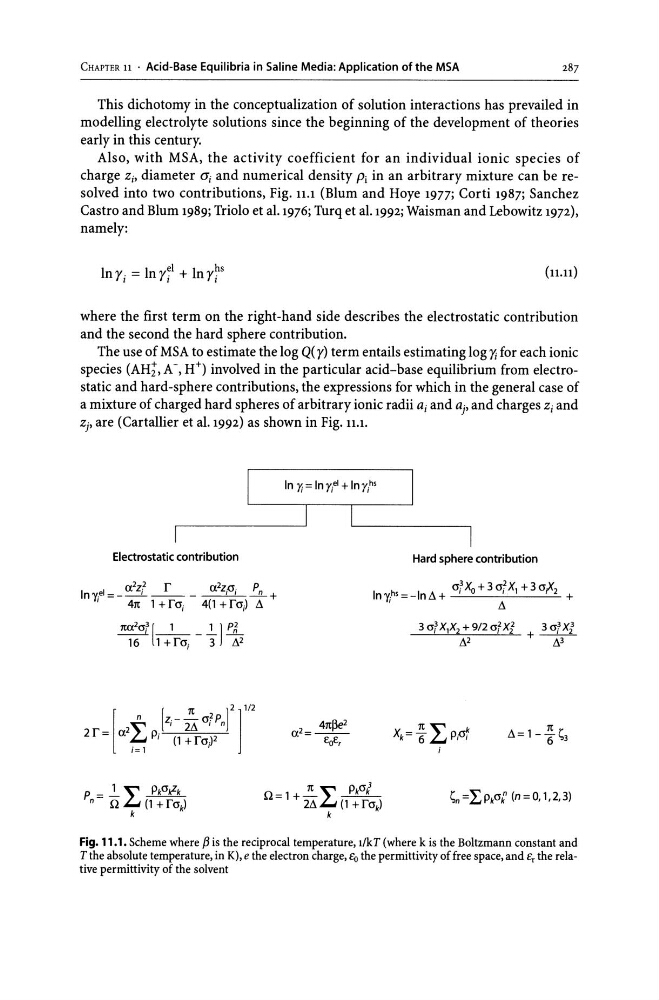
Also, with MSA, the activity coefficient for an individual ionic species of
charge Zi, diameter (ji and numerical density Pi in an arbitrary mixture can be resolved into two contributions, Fig. 11.1 (Blum and Hoye 1977; Corti 1987; Sanchez
Castro and Blum 1989; Triolo et al. 1976; Turq et al. 1992; Waisman and Lebowitz 1972),
namely:
I
I cl I hs
nYi = nYi + nYi
(n.n)
where the first term on the right-hand side describes the electrostatic contribution
and the second the hard sphere contribution.
The use of MSA to estimate the log Q( Y) term entails estimating log Yi for each ionic
species (AHr, A-, H+) involved in the particular acid-base equilibrium from electrostatic and hard-sphere contributions, the expressions for which in the general case of
a mixture of charged hard spheres of arbitrary ionic radii ai and aj, and charges Zi and
Zj' are (Cartallier et al. 1992) as shown in Fig. 11.1.
Electrostatic contribution
Hard sphere contribution
In .el = _ a 2 z? _f_ _ a 2 z,.crj !.n.. +
1,
41t 1 + faj 4(1 + faj} tl
In yr' = -In tl + at Xo + 3 at X, + 3 0'12
tl
+
1tCl. 2 a1 [1
1 1 P~
~ 1 + fa j - 3" LY
[
n
[z. _ 1t 2 ]2 112
2f= a 2LPj I 2tl crjP n I
j= 1
(1 + foj)2
p _ ~ ~ Pka~k
n- n ~ (1 +fa k )
k
a2 = 41t~e2
~
1t
Pka?
n = 1 + 2tl L (1 + fa k )
k
3 0' 1 X,X2 + 9/2 crt xf
tl 2
+ 3 cr1 xi
tl 3
X =~ ~pak
k
6 ~ / I
tl=1-~S3
Sn=LPka{ (n=O, 1,2,3)
Fig. 11.1. Scheme where f3 is the reciprocal temperature, 11k T (where k is the Boltzmann constant and
Tthe absolute temperature, in K), e the electron charge, t'Q the permittivity of free space, and e, the relative permittivity of the solvent
287
This dichotomy in the conceptualization of solution interactions has prevailed in
modelling electrolyte solutions since the beginning of the development of theories
early in this century.
Also, with MSA, the activity coefficient for an individual ionic species of
charge Zi, diameter (ji and numerical density Pi in an arbitrary mixture can be resolved into two contributions, Fig. 11.1 (Blum and Hoye 1977; Corti 1987; Sanchez
Castro and Blum 1989; Triolo et al. 1976; Turq et al. 1992; Waisman and Lebowitz 1972),
namely:
I
I cl I hs
nYi = nYi + nYi
(n.n)
where the first term on the right-hand side describes the electrostatic contribution
and the second the hard sphere contribution.
The use of MSA to estimate the log Q( Y) term entails estimating log Yi for each ionic
species (AHr, A-, H+) involved in the particular acid-base equilibrium from electrostatic and hard-sphere contributions, the expressions for which in the general case of
a mixture of charged hard spheres of arbitrary ionic radii ai and aj, and charges Zi and
Zj' are (Cartallier et al. 1992) as shown in Fig. 11.1.
Electrostatic contribution
Hard sphere contribution
In .el = _ a 2 z? _f_ _ a 2 z,.crj !.n.. +
1,
41t 1 + faj 4(1 + faj} tl
In yr' = -In tl + at Xo + 3 at X, + 3 0'12
tl
+
1tCl. 2 a1 [1
1 1 P~
~ 1 + fa j - 3" LY
[
n
[z. _ 1t 2 ]2 112
2f= a 2LPj I 2tl crjP n I
j= 1
(1 + foj)2
p _ ~ ~ Pka~k
n- n ~ (1 +fa k )
k
a2 = 41t~e2
~
1t
Pka?
n = 1 + 2tl L (1 + fa k )
k
3 0' 1 X,X2 + 9/2 crt xf
tl 2
+ 3 cr1 xi
tl 3
X =~ ~pak
k
6 ~ / I
tl=1-~S3
Sn=LPka{ (n=O, 1,2,3)
Fig. 11.1. Scheme where f3 is the reciprocal temperature, 11k T (where k is the Boltzmann constant and
Tthe absolute temperature, in K), e the electron charge, t'Q the permittivity of free space, and e, the relative permittivity of the solvent