

CHAPTER 11 • Acid-Base Equilibria in Saline Media: Application of the MSA
285
11.3
pK vs.lonic Strength Equations
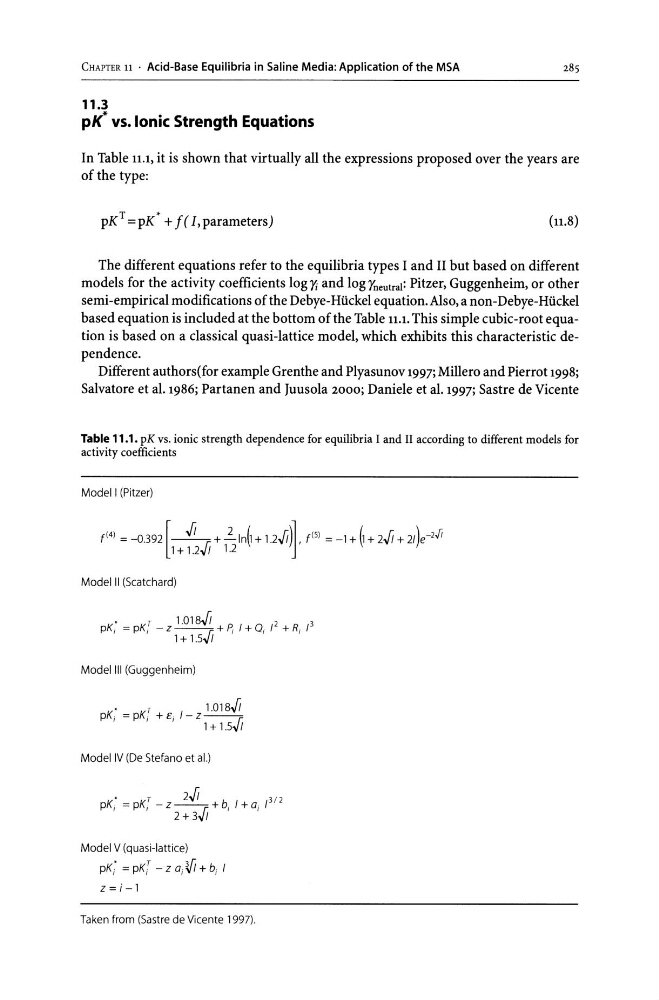
In Table 11.1, it is shown that virtually all the expressions proposed over the years are
of the type:
T
*
pK =pK + f( I,parameters)
(11.8)
The different equations refer to the equilibria types I and II but based on different
models for the activity coefficients logy; and logYneutral: Pitzer, Guggenheim, or other
semi-empirical modifications of the Debye-Huckel equation. Also, a non-Debye-Huckel
based equation is included at the bottom of the Table 11.1. This simple cubic-root equation is based on a classical quasi-lattice model, which exhibits this characteristic dependence.
Different authors(for example Grenthe and Plyasunov 1997; Millero and Pierrot 1998;
Salvatore et al. 1986; Partanen and Juusola 2000; Daniele et al. 1997; Sastre de Vicente
Table 11.1. pK vs. ionic strength dependence for equilibria I and II according to different models for
activity coefficients
Modell (Pitzer)
{(4) = -0.392 [~ + 21n(1 + 1.N,!)1 , {(5) = -1 + ( 1 + 2/1 + 21 )e-2ft
1 + 1.2/1 1.2
J
Model II (Scatchard)
•
T
1.018/1
2
3
pK, = pK, - Z------r. + p, 1 + 0, 1 + R, I
1+1.5,,1
Model III (Guggenheim)
pK;" =pKT +£, I-z 1.018/1
1 + 1.5/1
Model IV (De Stefano et al.)
•
T
2/1
3/2
pK; = pK; - Z----r, + b, 1 + 0; 1
2 + 3,,1
Model V (quasi-lattice)
•
T
3r.
pK; = pK; - z o;vl + b, 1
z=i-1
Taken from (Sastre de Vicente 1997).
285
11.3
pK vs.lonic Strength Equations
In Table 11.1, it is shown that virtually all the expressions proposed over the years are
of the type:
T
*
pK =pK + f( I,parameters)
(11.8)
The different equations refer to the equilibria types I and II but based on different
models for the activity coefficients logy; and logYneutral: Pitzer, Guggenheim, or other
semi-empirical modifications of the Debye-Huckel equation. Also, a non-Debye-Huckel
based equation is included at the bottom of the Table 11.1. This simple cubic-root equation is based on a classical quasi-lattice model, which exhibits this characteristic dependence.
Different authors(for example Grenthe and Plyasunov 1997; Millero and Pierrot 1998;
Salvatore et al. 1986; Partanen and Juusola 2000; Daniele et al. 1997; Sastre de Vicente
Table 11.1. pK vs. ionic strength dependence for equilibria I and II according to different models for
activity coefficients
Modell (Pitzer)
{(4) = -0.392 [~ + 21n(1 + 1.N,!)1 , {(5) = -1 + ( 1 + 2/1 + 21 )e-2ft
1 + 1.2/1 1.2
J
Model II (Scatchard)
•
T
1.018/1
2
3
pK, = pK, - Z------r. + p, 1 + 0, 1 + R, I
1+1.5,,1
Model III (Guggenheim)
pK;" =pKT +£, I-z 1.018/1
1 + 1.5/1
Model IV (De Stefano et al.)
•
T
2/1
3/2
pK; = pK; - Z----r, + b, 1 + 0; 1
2 + 3,,1
Model V (quasi-lattice)
•
T
3r.
pK; = pK; - z o;vl + b, 1
z=i-1
Taken from (Sastre de Vicente 1997).