

284
M. E. Sastre de Vicente· T. Vilarifto
• Type II:
AH~=AH+ H+
(11.2)
This reaction is usually termed "isocoulombic:' Because the net charge of reactants and products is the same, the change in water structure is usually small.
• Type III:
-AH~=AH+ H+
(11.3)
This reaction can be considered to be a particular case of Type I and involves
the zwitterionic species -AH+, which usually behaves as a neutral molecule or as
two separate ions depending on the separation between positive and negative
charge.
• Type IV:
Type IV refers to complex molecules. It is worth mentioning that the study of
the different aspects of the above simple equilibria I and II is the first step to encompass the analysis of acid-base equilibria of polyelectrolytic molecules.
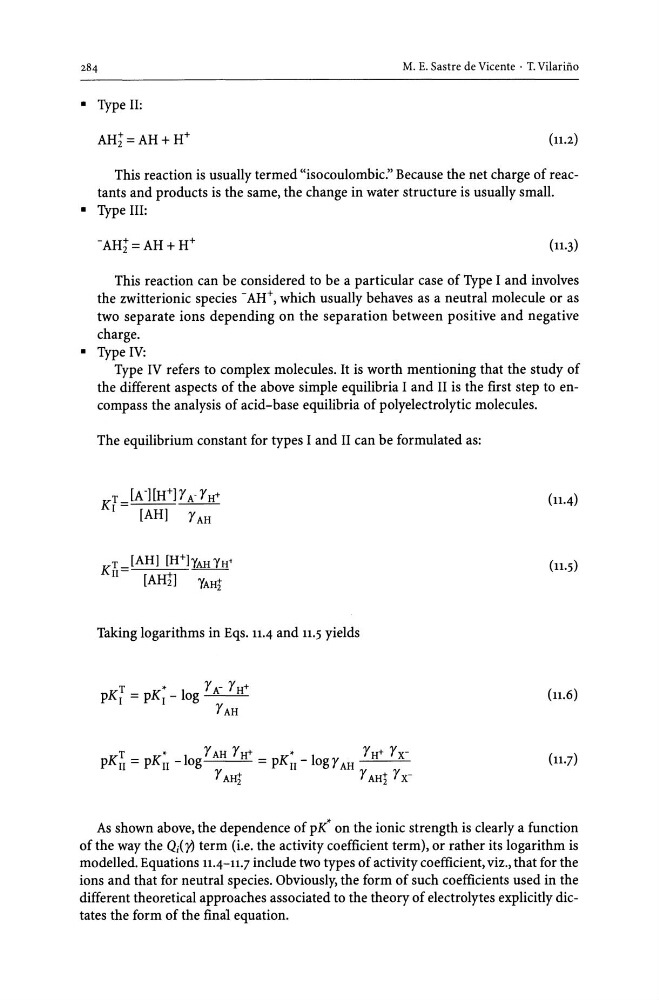
The equilibrium constant for types I and II can be formulated as:
T _[A-][H+jY A- Y H +
KI - [AHj
hH
T _[AHj [H+)YAHYH'
K II -
[AH!J
YAH!
Taking logarithms in Eqs. 11.4 and 11.5 yields
pK i = pK; _ log Y A- Y W
YAH
T
*
YAHYW
*
YH+YxpK II = pK II -log
= pK II - log YAH --'-'-----"-YAH!
YAH! Yx(11.4)
(n·5)
(11.6)
(1l.7)
As shown above, the dependence of pK* on the ionic strength is clearly a function
of the way the Qi( y) term (i.e. the activity coefficient term), or rather its logarithm is
modelled. Equations 11.4-11.7 include two types of activity coefficient, viz., that for the
ions and that for neutral species. Obviously, the form of such coefficients used in the
different theoretical approaches associated to the theory of electrolytes explicitly dictates the form of the final equation.
M. E. Sastre de Vicente· T. Vilarifto
• Type II:
AH~=AH+ H+
(11.2)
This reaction is usually termed "isocoulombic:' Because the net charge of reactants and products is the same, the change in water structure is usually small.
• Type III:
-AH~=AH+ H+
(11.3)
This reaction can be considered to be a particular case of Type I and involves
the zwitterionic species -AH+, which usually behaves as a neutral molecule or as
two separate ions depending on the separation between positive and negative
charge.
• Type IV:
Type IV refers to complex molecules. It is worth mentioning that the study of
the different aspects of the above simple equilibria I and II is the first step to encompass the analysis of acid-base equilibria of polyelectrolytic molecules.
The equilibrium constant for types I and II can be formulated as:
T _[A-][H+jY A- Y H +
KI - [AHj
hH
T _[AHj [H+)YAHYH'
K II -
[AH!J
YAH!
Taking logarithms in Eqs. 11.4 and 11.5 yields
pK i = pK; _ log Y A- Y W
YAH
T
*
YAHYW
*
YH+YxpK II = pK II -log
= pK II - log YAH --'-'-----"-YAH!
YAH! Yx(11.4)
(n·5)
(11.6)
(1l.7)
As shown above, the dependence of pK* on the ionic strength is clearly a function
of the way the Qi( y) term (i.e. the activity coefficient term), or rather its logarithm is
modelled. Equations 11.4-11.7 include two types of activity coefficient, viz., that for the
ions and that for neutral species. Obviously, the form of such coefficients used in the
different theoretical approaches associated to the theory of electrolytes explicitly dictates the form of the final equation.