

CHAPTER 10 • Equilibrium Analysis, the Ionic Medium Method and Activity Factors
271
[3(1) = 0 always differ from the tabulated values from Pitzer (1991) given in parenthesis
for the electrolytes in Fig. 10.1; NaCl: [3(0) = 0.110 (0.0765); MgCl 2 : [3(0) = 0.557 (0.352)
and NdCl 3 : [3(0) = 1.247 (0.568). The error increases with the charge type of the electrolyte. To conclude: The Pitzer equations must be used with both the [3(0) and [3(1)
terms.
An examination of the values of [3(1) at 298.15 K from Pitzer (1973) shows that they
are correlated with the charge type of the electrolyte: for most 1-1 electrolytes the values of {fJ) fall in a range 0.20 ±0.20, for most 2-1 electrolytes in the range 1.4 ±0.6, and
for most 3-1 electrolytes in the range 5.2 ±1.2. These averages may be used as "fixed"
values of [3(1) in the Pitzer equations, thus reducing the number of unknown parameters.
It may be important to be able to transfer parameters from one ion interaction
model to the other. We will now demonstrate how this can be done in the ionic strength
range, 0 < 1< 3-4 m, where the SIT and Pitzer models are approximately equivalent.
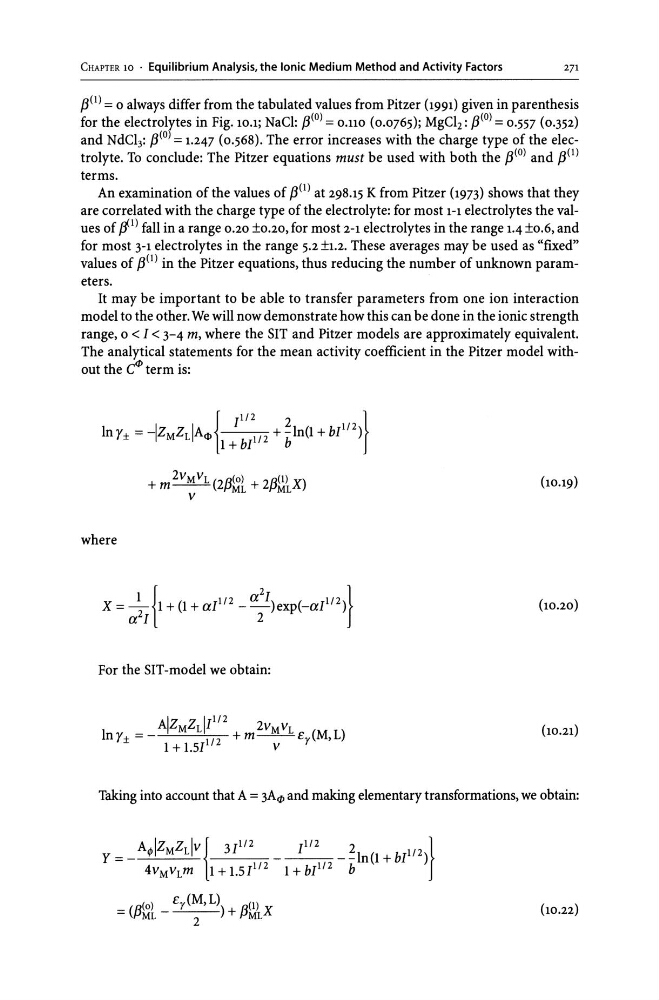
The analytical statements for the mean activity coefficient in the Pitzer model without the C tP term is:
{
11/2
2
}
lny± =-!ZMZL!AtP
1/2 +-In(1+bII12)
1 + bI
b
2VM VL (2[3(0) + 2[3(1) X)
+m-- ML
ML
V
(10.19)
where
X = - 1 + (1 + aI 1I2 - -)exp(-aI lIz )
1 {
a
2 I
}
a 2 I
2
(10.20)
For the SIT-model we obtain:
A!ZM Z L!I 1IZ + m2VMVL £y(M,L)
lny±=- 1+1.51112
v
(10.21)
Taking into account that A = 3AtP and making elementary transformations, we obtain:
Y = I/J M L
_
I
_ ~ln(l + bI1I2)
A !Z Z !v{ 31 112
112
}
4vM v Lm 1 + 1.51 112 1 + bI 1I2 b
£ (M L)
- ([3(0) -
y
, ) + [3(1) X
- ML
2
ML
(10.22)
271
[3(1) = 0 always differ from the tabulated values from Pitzer (1991) given in parenthesis
for the electrolytes in Fig. 10.1; NaCl: [3(0) = 0.110 (0.0765); MgCl 2 : [3(0) = 0.557 (0.352)
and NdCl 3 : [3(0) = 1.247 (0.568). The error increases with the charge type of the electrolyte. To conclude: The Pitzer equations must be used with both the [3(0) and [3(1)
terms.
An examination of the values of [3(1) at 298.15 K from Pitzer (1973) shows that they
are correlated with the charge type of the electrolyte: for most 1-1 electrolytes the values of {fJ) fall in a range 0.20 ±0.20, for most 2-1 electrolytes in the range 1.4 ±0.6, and
for most 3-1 electrolytes in the range 5.2 ±1.2. These averages may be used as "fixed"
values of [3(1) in the Pitzer equations, thus reducing the number of unknown parameters.
It may be important to be able to transfer parameters from one ion interaction
model to the other. We will now demonstrate how this can be done in the ionic strength
range, 0 < 1< 3-4 m, where the SIT and Pitzer models are approximately equivalent.
The analytical statements for the mean activity coefficient in the Pitzer model without the C tP term is:
{
11/2
2
}
lny± =-!ZMZL!AtP
1/2 +-In(1+bII12)
1 + bI
b
2VM VL (2[3(0) + 2[3(1) X)
+m-- ML
ML
V
(10.19)
where
X = - 1 + (1 + aI 1I2 - -)exp(-aI lIz )
1 {
a
2 I
}
a 2 I
2
(10.20)
For the SIT-model we obtain:
A!ZM Z L!I 1IZ + m2VMVL £y(M,L)
lny±=- 1+1.51112
v
(10.21)
Taking into account that A = 3AtP and making elementary transformations, we obtain:
Y = I/J M L
_
I
_ ~ln(l + bI1I2)
A !Z Z !v{ 31 112
112
}
4vM v Lm 1 + 1.51 112 1 + bI 1I2 b
£ (M L)
- ([3(0) -
y
, ) + [3(1) X
- ML
2
ML
(10.22)