

CHAPTER 9 . Binding Ability of Inorganic Major Components of Sea Water
249
actions are quite significant, both in terms of stability constant values and in terms of
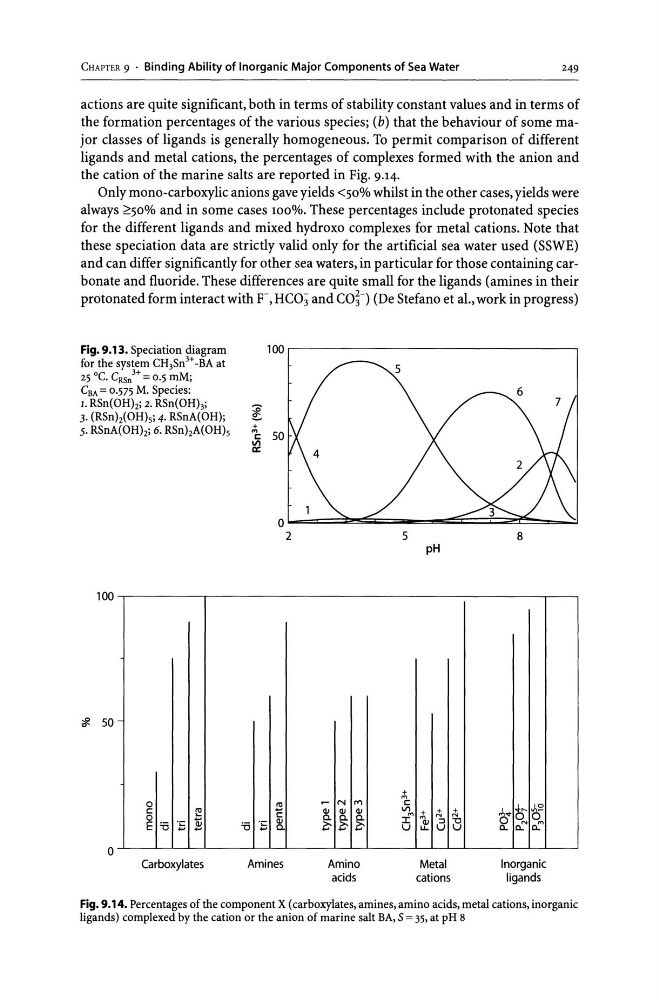
the formation percentages of the various species; (b) that the behaviour of some major classes of ligands is generally homogeneous. To permit comparison of different
ligands and metal cations, the percentages of complexes formed with the anion and
the cation of the marine salts are reported in Pig. 9.14.
Only mono-carboxylic anions gave yields <50% whilst in the other cases, yields were
always 2':50% and in some cases 100%. These percentages include protonated species
for the different ligands and mixed hydroxo complexes for metal cations. Note that
these speciation data are strictly valid only for the artificial sea water used (SSWE)
and can differ significantly for other sea waters, in particular for those containing carbonate and fluoride. These differences are quite small for the ligands (amines in their
protonated form interact with P-, RCO; and CO~-) (De Stefano et ai., work in progress)
Fig. 9.13. Speciation diagram
for the system CH3Sn H -BA at
25°C. CRSn 3 + = 0.5 mM;
CBA = 0.575 M. Species:
1. RSn(OHh; 2. RSn(OHh;
3. (RSnlz(OH)s; 4. RSnA(OH);
5. RSnA(OH}z; 6. RSn}zA(OHls
100
~ 50
0
r::
~
0
E'O oS 21
o
Carboxylates
100rl----------------------------------~
l
;l;
r::
l:Q
i9 r::
'0 "S
Q)
0.
Amines
~
N
...,
Q)
Q)
Q)
0.0. 0.
Z'~ Z'
Amino
acids
5
;l;
r::
Vl
r.'"
U
pH
~
+ +
N
N
:::l"O
UU
Metal
cations
8
I
10
~v ct ~
0.. 0.. 0..
Inorganic
ligands
Fig. 9.14. Percentages of the component X (carboxylates, amines, amino acids, metal cations, inorganic
ligands) complexed by the cation or the anion of marine salt BA, S = 35, at pH 8
249
actions are quite significant, both in terms of stability constant values and in terms of
the formation percentages of the various species; (b) that the behaviour of some major classes of ligands is generally homogeneous. To permit comparison of different
ligands and metal cations, the percentages of complexes formed with the anion and
the cation of the marine salts are reported in Pig. 9.14.
Only mono-carboxylic anions gave yields <50% whilst in the other cases, yields were
always 2':50% and in some cases 100%. These percentages include protonated species
for the different ligands and mixed hydroxo complexes for metal cations. Note that
these speciation data are strictly valid only for the artificial sea water used (SSWE)
and can differ significantly for other sea waters, in particular for those containing carbonate and fluoride. These differences are quite small for the ligands (amines in their
protonated form interact with P-, RCO; and CO~-) (De Stefano et ai., work in progress)
Fig. 9.13. Speciation diagram
for the system CH3Sn H -BA at
25°C. CRSn 3 + = 0.5 mM;
CBA = 0.575 M. Species:
1. RSn(OHh; 2. RSn(OHh;
3. (RSnlz(OH)s; 4. RSnA(OH);
5. RSnA(OH}z; 6. RSn}zA(OHls
100
~ 50
0
r::
~
0
E'O oS 21
o
Carboxylates
100rl----------------------------------~
l
;l;
r::
l:Q
i9 r::
'0 "S
Q)
0.
Amines
~
N
...,
Q)
Q)
Q)
0.0. 0.
Z'~ Z'
Amino
acids
5
;l;
r::
Vl
r.'"
U
pH
~
+ +
N
N
:::l"O
UU
Metal
cations
8
I
10
~v ct ~
0.. 0.. 0..
Inorganic
ligands
Fig. 9.14. Percentages of the component X (carboxylates, amines, amino acids, metal cations, inorganic
ligands) complexed by the cation or the anion of marine salt BA, S = 35, at pH 8