

248
C. De Stefano . C. Foti . A. Gianguzza . D. Piazzese . S. Sammartano
ids of different hardness on the Lewis scale depending on the groups bonded to the
tin(IV) (Tobias et al. 1966). They therefore show a strong tendency to hydrolysis in
aqueous solution, resulting in some cases in condensation reactions of the monomeric
conjugate bases with the formation of polynuclear hydroxo-complexes in solution
according to the following general reaction (Tobias et al. 1966):
qRnSn(OH2)~+ + pH 2 0 = PH30+ + (R n Sn)q(OH)p(OH 2 );qz-P)+
The hydrolysis processes of mono-, di- and trimethyltin(IV) cations have recently
been reviewed, extensively investigated and defined in different ionic media, including SSWE, in a wide range of ionic strengths and salinities (De Stefano et al. 1999b
1999C 2000aj Foti et al. 1999, 2000). Hydrolysis constants for mono-, di- and trimethyltin(IV) cations are shown in Table A9.7 of appendix (Sect. A9.2)
Once hydrolytic equilibria have been defined for all ilie organotin(IV) cations investigated, ilie interactions of simple and hydroxo-organotin(IV) species wiili ilie anion A of
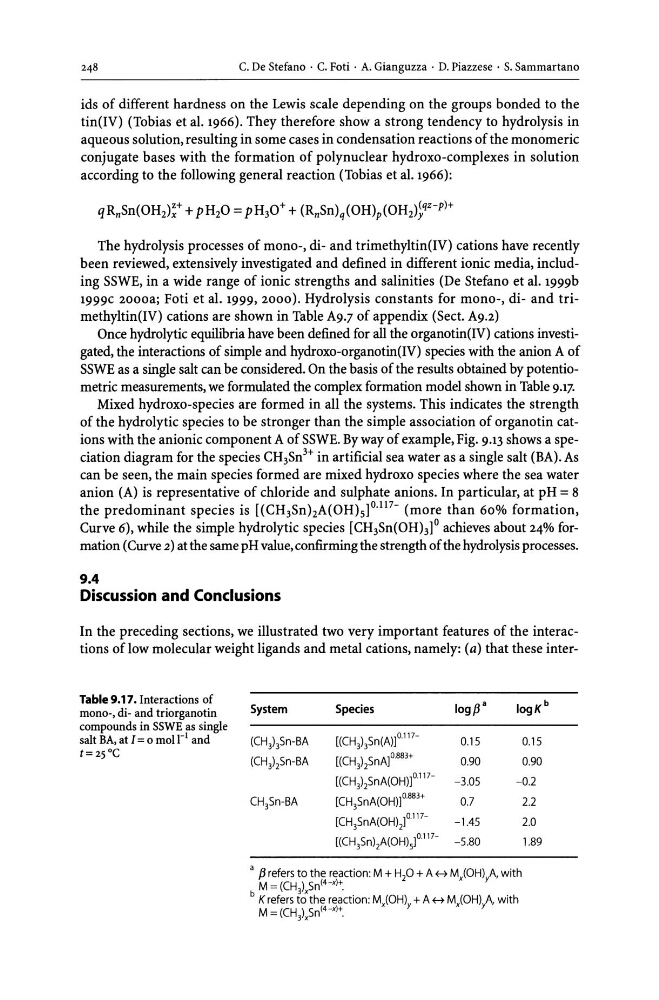
SSWE as a single salt can be considered. On ilie basis of the results obtained by potentiometric measurements, we formulated ilie complex formation model shown in Table 9.17.
Mixed hydroxo-species are formed in all the systems. This indicates the strength
of the hydrolytic species to be stronger than the simple association of organotin cations with the anionic component A of SSWE. By way of example, Fig. 9.13 shows a speciation diagram for the species CH 3 Sn 3 + in artificial sea water as a single salt (BA). As
can be seen, the main species formed are mixed hydroxo species where the sea water
anion (A) is representative of chloride and sulphate anions. In particular, at pH = 8
the predominant species is [(CH 3 SnhA(OHhlo. 1l7 - (more than 60% formation,
Curve 6), while the simple hydrolytic species [CH3Sn(OHhlo achieves about 24% formation (Curve 2) at ilie same pH value, confirming the strengili of ilie hydrolysis processes.
9.4
Discussion and Conclusions
In the preceding sections, we illustrated two very important features of the interactions of low molecular weight ligands and metal cations, namely: (a) that these interTable 9.17. Interactions of
mono-, di- and triorganotin
compounds in SSWE as single
salt BA, at 1=0 mol rl and
t= 25°C
System
Species
10gf3"
10gK b
(CH 3 l 3 Sn-BA
[(CH 3 l 3 Sn(Al]o.1170.15
0.15
(C H 3 l 2 Sn-BA
[( CH 3 l 2 SnA]O.883+
0.90
0.90
[(CH 3 l 2 SnA(OHl]Ol17-3.05
-0.2
CH 3 Sn-BA
[CH 3 SnA(OHl]0883+
0.7
[CH 3 SnA(OHll l17 -
-1.45
[(CH3Snl2A(OHl/117- -5.80
a 13 refers to the reaction: M + Hp + A H M)OHll' with
M = (CH)xSn(4-X)+.
b K refers to the reaction: M)OHly + A H M)OHl,A with
M = (CH3lxSn(4-X)+.
2.2
2.0
1.89
C. De Stefano . C. Foti . A. Gianguzza . D. Piazzese . S. Sammartano
ids of different hardness on the Lewis scale depending on the groups bonded to the
tin(IV) (Tobias et al. 1966). They therefore show a strong tendency to hydrolysis in
aqueous solution, resulting in some cases in condensation reactions of the monomeric
conjugate bases with the formation of polynuclear hydroxo-complexes in solution
according to the following general reaction (Tobias et al. 1966):
qRnSn(OH2)~+ + pH 2 0 = PH30+ + (R n Sn)q(OH)p(OH 2 );qz-P)+
The hydrolysis processes of mono-, di- and trimethyltin(IV) cations have recently
been reviewed, extensively investigated and defined in different ionic media, including SSWE, in a wide range of ionic strengths and salinities (De Stefano et al. 1999b
1999C 2000aj Foti et al. 1999, 2000). Hydrolysis constants for mono-, di- and trimethyltin(IV) cations are shown in Table A9.7 of appendix (Sect. A9.2)
Once hydrolytic equilibria have been defined for all ilie organotin(IV) cations investigated, ilie interactions of simple and hydroxo-organotin(IV) species wiili ilie anion A of
SSWE as a single salt can be considered. On ilie basis of the results obtained by potentiometric measurements, we formulated ilie complex formation model shown in Table 9.17.
Mixed hydroxo-species are formed in all the systems. This indicates the strength
of the hydrolytic species to be stronger than the simple association of organotin cations with the anionic component A of SSWE. By way of example, Fig. 9.13 shows a speciation diagram for the species CH 3 Sn 3 + in artificial sea water as a single salt (BA). As
can be seen, the main species formed are mixed hydroxo species where the sea water
anion (A) is representative of chloride and sulphate anions. In particular, at pH = 8
the predominant species is [(CH 3 SnhA(OHhlo. 1l7 - (more than 60% formation,
Curve 6), while the simple hydrolytic species [CH3Sn(OHhlo achieves about 24% formation (Curve 2) at ilie same pH value, confirming the strengili of ilie hydrolysis processes.
9.4
Discussion and Conclusions
In the preceding sections, we illustrated two very important features of the interactions of low molecular weight ligands and metal cations, namely: (a) that these interTable 9.17. Interactions of
mono-, di- and triorganotin
compounds in SSWE as single
salt BA, at 1=0 mol rl and
t= 25°C
System
Species
10gf3"
10gK b
(CH 3 l 3 Sn-BA
[(CH 3 l 3 Sn(Al]o.1170.15
0.15
(C H 3 l 2 Sn-BA
[( CH 3 l 2 SnA]O.883+
0.90
0.90
[(CH 3 l 2 SnA(OHl]Ol17-3.05
-0.2
CH 3 Sn-BA
[CH 3 SnA(OHl]0883+
0.7
[CH 3 SnA(OHll l17 -
-1.45
[(CH3Snl2A(OHl/117- -5.80
a 13 refers to the reaction: M + Hp + A H M)OHll' with
M = (CH)xSn(4-X)+.
b K refers to the reaction: M)OHly + A H M)OHl,A with
M = (CH3lxSn(4-X)+.
2.2
2.0
1.89