

246
C. De Stefano . C. Foti . A. Gianguzza . D. Piazzese . S. Sammartano
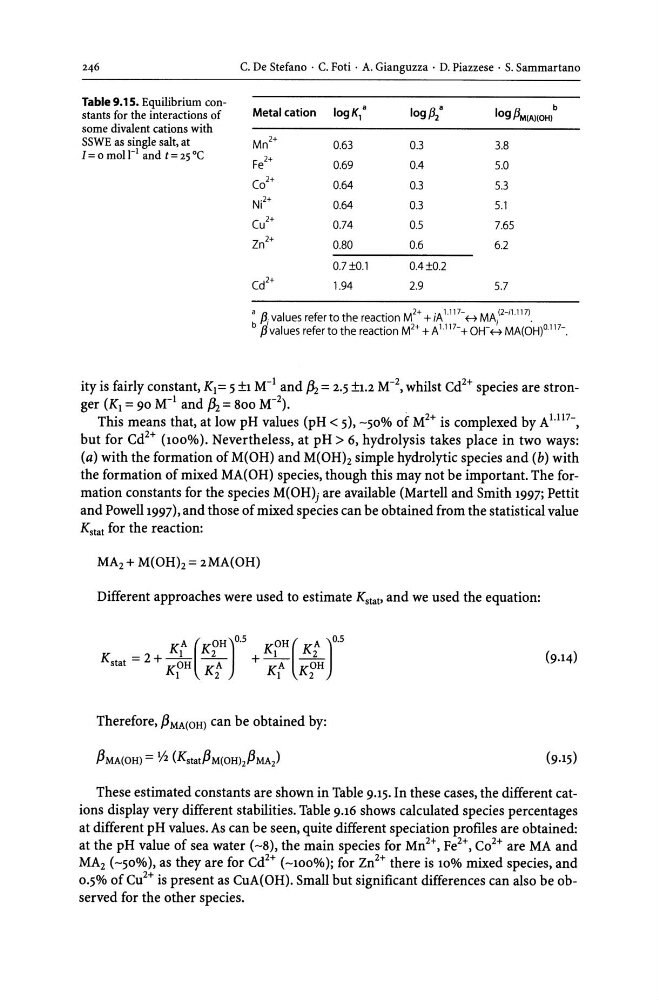
Table 9.15. Equilibrium constants for the interactions of
some divalent cations with
SSWE as single salt, at
Metal cation
10gK l '
10gf3/
log f3M(A)(OH)
b
1= 0 moll-l and t= 2S oC
Mn2+
0.63
OJ
3.8
Fe 2 +
0.69
0.4
5.0
C0 2 +
0.64
OJ
503
Ni 2 +
0.64
OJ
5.1
Cu 2 +
0.74
0.5
7.65
Zn 2 +
0.80
0.6
6.2
0.7 to.1
O.4tO.2
Cd 2 +
1.94
2.9
5.7
a f3 i values refer to the reaction M2+ + iA 1.117-H MAi2-ill17)
b f3values refer to the reaction M2+ + A 1.117-+ OW H MA(OH)o.117-.
ity is fairly constant, K1= 5 ±1 M- 1 and ~ = 2.5 ±1.2 M- l , whilst Cd l + species are stronger (Kl = 90 M- 1 and ~ = 800 M- l ).
.
This means that, at low pH values (pH < 5), -50% of Ml+ is complexed by Al. ll7 -,
but for Cd2+ (100%). Nevertheless, at pH> 6, hydrolysis takes place in two ways:
(a) with the formation of M(OH) and M(OHh simple hydrolytic species and (b) with
the formation of mixed MA(OH) species, though this may not be important. The formation constants for the species M(OH)j are available (Martell and Smith 1997; Pettit
and Powell 1997), and those of mixed species can be obtained from the statistical value
K stat for the reaction:
MAl + M(OHh = 2MA(OH)
Different approaches were used to estimate Kstat> and we used the equation:
A (OH}O'5
OH (
A }o.5
Kl Kl
Kl
Kl
K stat = 2 + ----em -A- + ------p: OH
Kl
Kl
Kl K2
(9.14)
Therefore, f3MA(OH) can be obtained by:
f3MA(OH) = 0 (Kstatf3M(OHjzf3MAz)
(9.15)
These estimated constants are shown in Table 9.15. In these cases, the different cations display very different stabilities. Table 9.16 shows calculated species percentages
at different pH values. As can be seen, quite different speciation profiles are obtained:
at the pH value of sea water (-8), the main species for Mnz+, Fe z +, Co z + are MA and
MA z (-50%), as they are for Cd z + (-100%); for Znz+ there is 10% mixed species, and
0.5% of Cu z + is present as CuA(OH). Small but significant differences can also be observed for the other species.
C. De Stefano . C. Foti . A. Gianguzza . D. Piazzese . S. Sammartano
Table 9.15. Equilibrium constants for the interactions of
some divalent cations with
SSWE as single salt, at
Metal cation
10gK l '
10gf3/
log f3M(A)(OH)
b
1= 0 moll-l and t= 2S oC
Mn2+
0.63
OJ
3.8
Fe 2 +
0.69
0.4
5.0
C0 2 +
0.64
OJ
503
Ni 2 +
0.64
OJ
5.1
Cu 2 +
0.74
0.5
7.65
Zn 2 +
0.80
0.6
6.2
0.7 to.1
O.4tO.2
Cd 2 +
1.94
2.9
5.7
a f3 i values refer to the reaction M2+ + iA 1.117-H MAi2-ill17)
b f3values refer to the reaction M2+ + A 1.117-+ OW H MA(OH)o.117-.
ity is fairly constant, K1= 5 ±1 M- 1 and ~ = 2.5 ±1.2 M- l , whilst Cd l + species are stronger (Kl = 90 M- 1 and ~ = 800 M- l ).
.
This means that, at low pH values (pH < 5), -50% of Ml+ is complexed by Al. ll7 -,
but for Cd2+ (100%). Nevertheless, at pH> 6, hydrolysis takes place in two ways:
(a) with the formation of M(OH) and M(OHh simple hydrolytic species and (b) with
the formation of mixed MA(OH) species, though this may not be important. The formation constants for the species M(OH)j are available (Martell and Smith 1997; Pettit
and Powell 1997), and those of mixed species can be obtained from the statistical value
K stat for the reaction:
MAl + M(OHh = 2MA(OH)
Different approaches were used to estimate Kstat> and we used the equation:
A (OH}O'5
OH (
A }o.5
Kl Kl
Kl
Kl
K stat = 2 + ----em -A- + ------p: OH
Kl
Kl
Kl K2
(9.14)
Therefore, f3MA(OH) can be obtained by:
f3MA(OH) = 0 (Kstatf3M(OHjzf3MAz)
(9.15)
These estimated constants are shown in Table 9.15. In these cases, the different cations display very different stabilities. Table 9.16 shows calculated species percentages
at different pH values. As can be seen, quite different speciation profiles are obtained:
at the pH value of sea water (-8), the main species for Mnz+, Fe z +, Co z + are MA and
MA z (-50%), as they are for Cd z + (-100%); for Znz+ there is 10% mixed species, and
0.5% of Cu z + is present as CuA(OH). Small but significant differences can also be observed for the other species.