

CHAPTER 9 . Binding Ability of Inorganic Major Components of Sea Water
245
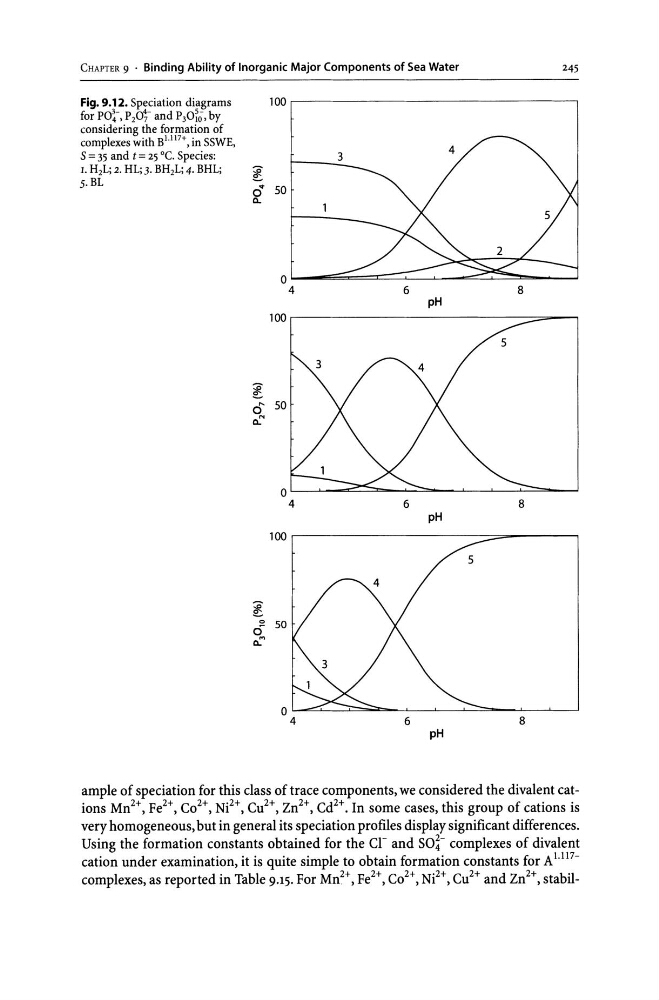
Fig. 9.12. Speciation diagrams
for p~-, P20~- and P30io, by
considering the formation of
complexes with B1. 1l7 +, in SSWE,
S = 35 and t = 25°C. Species:
1. H2L; 2. HL; 3. BH2L; 4. BHL;
S.BL
100,1 ---------------------------------,
£.
0'" 50
0.
3
4
o !
?:::7'""7C
-----=;::::t:=""""""---::
4
6
pH
8
100" ---------------------------------==---~
l
o
0.'"
l
100 I
6 50
0.'"
6
~
6
5
8
pH
/'
8
pH
ample of speciation for this class of trace components, we considered the divalent cations Mn2+, Fe 2 +, Co2+, Ni 2 +, Cu 2 +, Zn 2 +, Cd 2 +. In some cases, this group of cations is
very homogeneous, but in general its speciation profiles display significant differences.
Using the formation constants obtained for the cr and SO~- complexes of divalent
cation under examination, it is quite simple to obtain formation constants for A 1.117complexes, as reported in Table 9.15. For Mn2+, Fe 2 +, Co 2 +, Ni2+, Cu 2 + and Zn 2 +, stabil-
245
Fig. 9.12. Speciation diagrams
for p~-, P20~- and P30io, by
considering the formation of
complexes with B1. 1l7 +, in SSWE,
S = 35 and t = 25°C. Species:
1. H2L; 2. HL; 3. BH2L; 4. BHL;
S.BL
100,1 ---------------------------------,
£.
0'" 50
0.
3
4
o !
?:::7'""7C
-----=;::::t:=""""""---::
4
6
pH
8
100" ---------------------------------==---~
l
o
0.'"
l
100 I
6 50
0.'"
6
~
6
5
8
pH
/'
8
pH
ample of speciation for this class of trace components, we considered the divalent cations Mn2+, Fe 2 +, Co2+, Ni 2 +, Cu 2 +, Zn 2 +, Cd 2 +. In some cases, this group of cations is
very homogeneous, but in general its speciation profiles display significant differences.
Using the formation constants obtained for the cr and SO~- complexes of divalent
cation under examination, it is quite simple to obtain formation constants for A 1.117complexes, as reported in Table 9.15. For Mn2+, Fe 2 +, Co 2 +, Ni2+, Cu 2 + and Zn 2 +, stabil-