

242
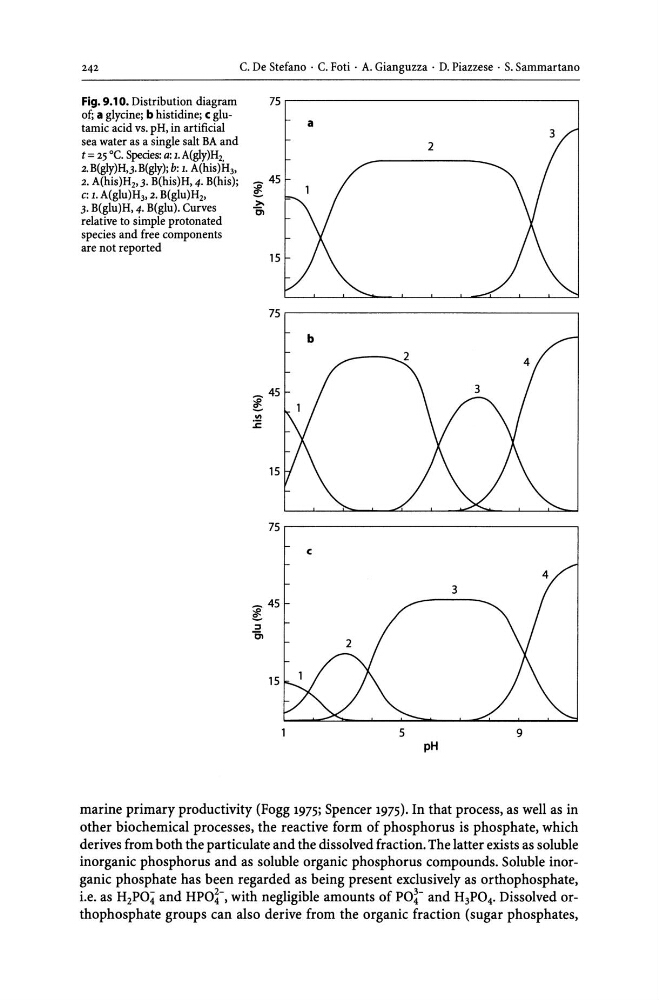
Fig. 9.10. Distribution diagram
of; a glycine; b histidine; c glutamic acid vs. pH, in artificial
sea water as a single salt BA and
t = 25 0c. Species: a: 1. A(gly)H2•
2. B(gly)H,3.B(gly); b: 1. A(his)H3,
2. A(his)H2,J. B(his)H, 4. B(his);
c: 1. A(glu)H3' 2. B(glu)H2,
3. B(glu)H, 4. B(glu). Curves
relative to simple protonated
species and free components
are not reported
C. De Stefano . C. Foti . A. Gianguzza . D. Piazzese . S. Sammartano
75" -----------------------------------------,
~ 45
>0-.
15
a
2
75" ----------------------------------,
b
~ 45
II!
:c
15
75,.-------------------------------------,
c
3
~ 45
::l
0-.
15
5
9
pH
marine primary productivity (Fogg 1975; Spencer 1975). In that process, as well as in
other biochemical processes, the reactive form of phosphorus is phosphate, which
derives from both the particulate and the dissolved fraction. The latter exists as soluble
inorganic phosphorus and as soluble organic phosphorus compounds. Soluble inorganic phosphate has been regarded as being present exclusively as orthophosphate,
i.e. as H 2 P0 4 and HPO~-, with negligible amounts of PO~- and H 3 P0 4 • Dissolved orthophosphate groups can also derive from the organic fraction (sugar phosphates,
Fig. 9.10. Distribution diagram
of; a glycine; b histidine; c glutamic acid vs. pH, in artificial
sea water as a single salt BA and
t = 25 0c. Species: a: 1. A(gly)H2•
2. B(gly)H,3.B(gly); b: 1. A(his)H3,
2. A(his)H2,J. B(his)H, 4. B(his);
c: 1. A(glu)H3' 2. B(glu)H2,
3. B(glu)H, 4. B(glu). Curves
relative to simple protonated
species and free components
are not reported
C. De Stefano . C. Foti . A. Gianguzza . D. Piazzese . S. Sammartano
75" -----------------------------------------,
~ 45
>0-.
15
a
2
75" ----------------------------------,
b
~ 45
II!
:c
15
75,.-------------------------------------,
c
3
~ 45
::l
0-.
15
5
9
pH
marine primary productivity (Fogg 1975; Spencer 1975). In that process, as well as in
other biochemical processes, the reactive form of phosphorus is phosphate, which
derives from both the particulate and the dissolved fraction. The latter exists as soluble
inorganic phosphorus and as soluble organic phosphorus compounds. Soluble inorganic phosphate has been regarded as being present exclusively as orthophosphate,
i.e. as H 2 P0 4 and HPO~-, with negligible amounts of PO~- and H 3 P0 4 • Dissolved orthophosphate groups can also derive from the organic fraction (sugar phosphates,