

CHAPTER 9 . Binding Ability of Inorganic Major Components of Sea Water
241
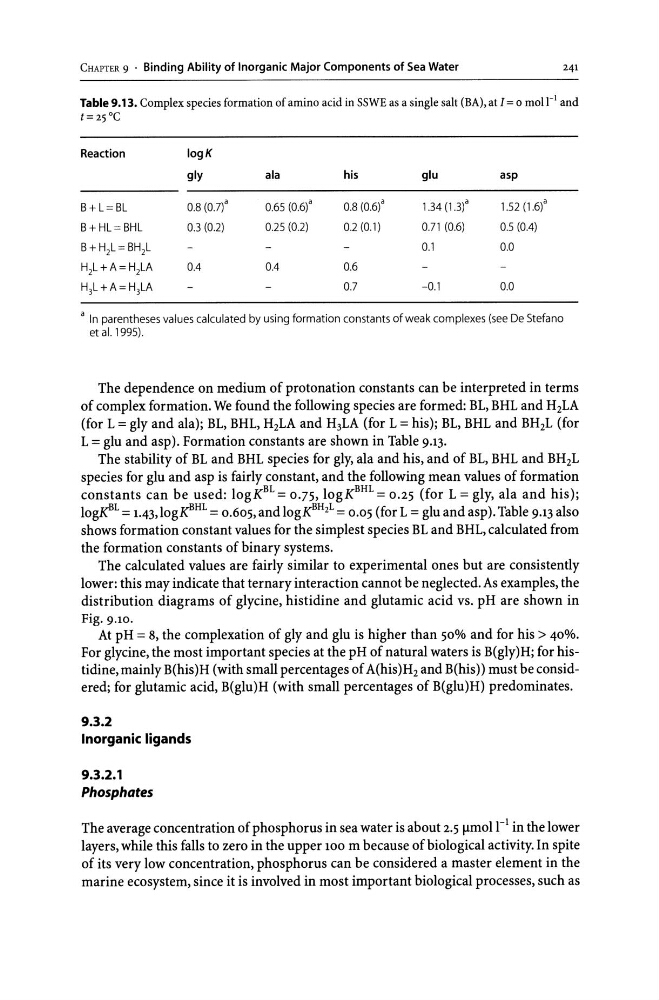
Table 9.13. Complex species formation of amino acid in SSWE as a single salt (BA), at 1=0 mol t 1 and
t= 25°C
Reaction
logK
gly
ala
his
glu
asp
B + L= BL
0.8 (0.7)'
0.65 (0.6)'
0.8 (0.6)'
1.34 (1.3)'
1.52 (1.6)'
B+HL=BHL
0.3 (0.2)
0.25 (0.2)
0.2 (0.1)
0.71 (0.6)
0.5 (0.4)
B + H2L = BH2L
0.1
0.0
H2L+ A= H2LA
0.4
0.4
0.6
HJL+ A = HJLA
0.7
-0.1
0.0
, In parentheses values calculated by using formation constants of weak complexes (see De Stefano
et al. 1995).
The dependence on medium of protonation constants can be interpreted in terms
of complex formation. We found the following species are formed: BL, BHL and H2LA
(for L = gly and ala); BL, BHL, H2LA and H3LA (for L = his); BL, BHL and BH2L (for
L = glu and asp). Formation constants are shown in Table 9.13.
The stability of BL and BHL species for gly, ala and his, and of BL, BHL and BH2L
species for glu and asp is fairly constant, and the following mean values of formation
constants can be used: 10gKBL = 0.75, 10gKBHL = 0.25 (for L = gly, ala and his);
10gKBL = 1.43, 10gKBHL = 0.605, and logKBH2L = 0.05 (for L = glu and asp). Table 9.13 also
shows formation constant values for the simplest species BL and BHL, calculated from
the formation constants of binary systems.
The calculated values are fairly similar to experimental ones but are consistently
lower: this may indicate that ternary interaction cannot be neglected. As examples, the
distribution diagrams of glycine, histidine and glutamic acid vs. pH are shown in
Fig. 9.10.
At pH = 8, the complexation of gly and glu is higher than 50% and for his> 40%.
For glycine, the most important species at the pH of natural waters is B(gly)H; for histidine, mainly B(his)H (with small percentages of A(his )H 2 and B(his)) must be considered; for glutamic acid, B(glu)H (with small percentages of B(glu)H) predominates.
9.3.2
Inorganic ligands
9.3.2.1
Phosphates
The average concentration of phosphorus in sea water is about 2.5 flmol rl in the lower
layers, while this falls to zero in the upper 100 m because of biological activity. In spite
of its very low concentration, phosphorus can be considered a master element in the
marine ecosystem, since it is involved in most important biological processes, such as
241
Table 9.13. Complex species formation of amino acid in SSWE as a single salt (BA), at 1=0 mol t 1 and
t= 25°C
Reaction
logK
gly
ala
his
glu
asp
B + L= BL
0.8 (0.7)'
0.65 (0.6)'
0.8 (0.6)'
1.34 (1.3)'
1.52 (1.6)'
B+HL=BHL
0.3 (0.2)
0.25 (0.2)
0.2 (0.1)
0.71 (0.6)
0.5 (0.4)
B + H2L = BH2L
0.1
0.0
H2L+ A= H2LA
0.4
0.4
0.6
HJL+ A = HJLA
0.7
-0.1
0.0
, In parentheses values calculated by using formation constants of weak complexes (see De Stefano
et al. 1995).
The dependence on medium of protonation constants can be interpreted in terms
of complex formation. We found the following species are formed: BL, BHL and H2LA
(for L = gly and ala); BL, BHL, H2LA and H3LA (for L = his); BL, BHL and BH2L (for
L = glu and asp). Formation constants are shown in Table 9.13.
The stability of BL and BHL species for gly, ala and his, and of BL, BHL and BH2L
species for glu and asp is fairly constant, and the following mean values of formation
constants can be used: 10gKBL = 0.75, 10gKBHL = 0.25 (for L = gly, ala and his);
10gKBL = 1.43, 10gKBHL = 0.605, and logKBH2L = 0.05 (for L = glu and asp). Table 9.13 also
shows formation constant values for the simplest species BL and BHL, calculated from
the formation constants of binary systems.
The calculated values are fairly similar to experimental ones but are consistently
lower: this may indicate that ternary interaction cannot be neglected. As examples, the
distribution diagrams of glycine, histidine and glutamic acid vs. pH are shown in
Fig. 9.10.
At pH = 8, the complexation of gly and glu is higher than 50% and for his> 40%.
For glycine, the most important species at the pH of natural waters is B(gly)H; for histidine, mainly B(his)H (with small percentages of A(his )H 2 and B(his)) must be considered; for glutamic acid, B(glu)H (with small percentages of B(glu)H) predominates.
9.3.2
Inorganic ligands
9.3.2.1
Phosphates
The average concentration of phosphorus in sea water is about 2.5 flmol rl in the lower
layers, while this falls to zero in the upper 100 m because of biological activity. In spite
of its very low concentration, phosphorus can be considered a master element in the
marine ecosystem, since it is involved in most important biological processes, such as