

238
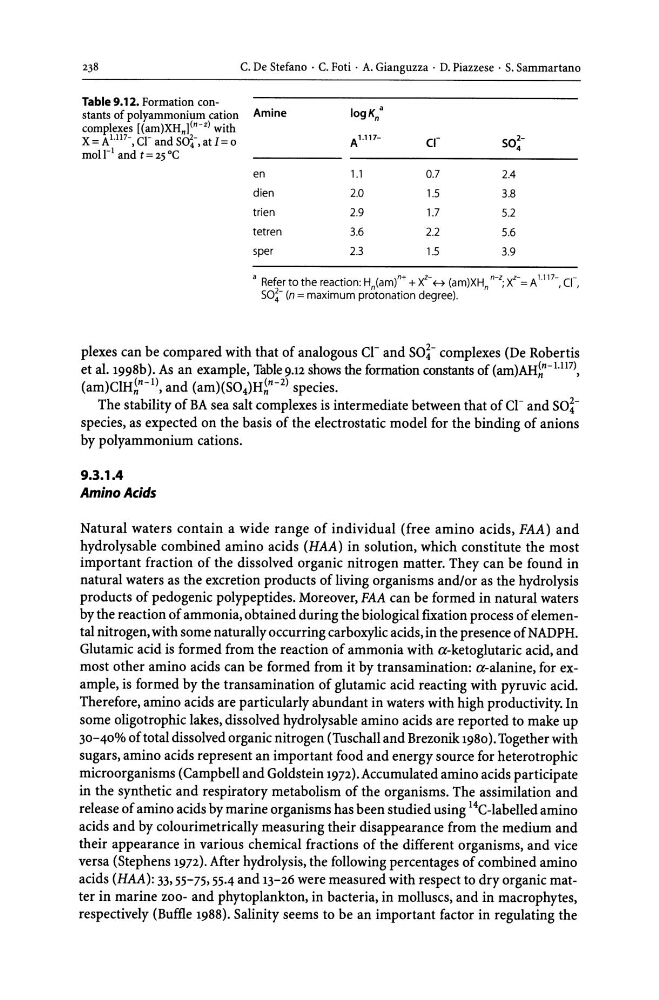
Table 9.12. Formation constants of polyammonium cation
complexes [(am)XHnl(n-z) with
X= Al. ll7 -, ct and Scn-, at! = 0
molt l and t=25°C
C. De Stefano· C. Foti . A. Gianguzza . D. Piazzese . S. Sammartano
Amine
logK n
a
A1.117cr
SO~en
1.1
0.7
2.4
dien
2.0
1.5
3.8
trien
2.9
1.7
5.2
tetren
3.6
2.2
5.6
sper
2.3
1.5
3.9
a Refer to the reaction: Hn(am)"+ + Xz-H (am)XH n n-z; Xz-= A 1.1 17-, CI-,
SO~- (n = maximum protonation degree).
plexes can be compared with that of analogous cr and SO~- complexes (De Robertis
et al. 1998b). As an example, Table 9.12 shows the formation constants of (am)AH~n-l.ll7),
(am)ClH~n-l), and (am)(S04)H~n-2) species.
The stability of BA sea salt complexes is intermediate between that of cr and SO~species, as expected on the basis of the electrostatic model for the binding of anions
by polyammonium cations.
9.3.1.4
Amino Acids
Natural waters contain a wide range of individual (free amino acids, FAA) and
hydrolysable combined amino acids (HAA) in solution, which constitute the most
important fraction of the dissolved organic nitrogen matter. They can be found in
natural waters as the excretion products of living organisms and/or as the hydrolysis
products of pedogenic polypeptides. Moreover, FAA can be formed in natural waters
by the reaction of ammonia, obtained during the biological fIxation process of elemental nitrogen, with some naturally occurring carboxylic acids, in the presence ofNADPH.
Glutamic acid is formed from the reaction of ammonia with a-ketoglutaric acid, and
most other amino acids can be formed from it by transamination: a-alanine, for example, is formed by the transamination of glutamic acid reacting with pyruvic acid.
Therefore, amino acids are particularly abundant in waters with high productivity. In
some oligotrophic lakes, dissolved hydrolysable amino acids are reported to make up
30-40% of total dissolved organic nitrogen (Tuschall and Brezonik 1980). Together with
sugars, amino acids represent an important food and energy source for heterotrophic
microorganisms (Campbell and Goldstein 1972). Accumulated amino acids participate
in the synthetic and respiratory metabolism of the organisms. The assimilation and
release of amino acids by marine organisms has been studied using 14C-Iabelled amino
acids and by colourimetrically measuring their disappearance from the medium and
their appearance in various chemical fractions of the different organisms, and vice
versa (Stephens 1972). After hydrolysis, the following percentages of combined amino
acids (HAA): 33,55-75,55.4 and 13-26 were measured with respect to dry organic matter in marine zoo- and phytoplankton, in bacteria, in molluscs, and in macrophytes,
respectively (Buffle 1988). Salinity seems to be an important factor in regulating the
Table 9.12. Formation constants of polyammonium cation
complexes [(am)XHnl(n-z) with
X= Al. ll7 -, ct and Scn-, at! = 0
molt l and t=25°C
C. De Stefano· C. Foti . A. Gianguzza . D. Piazzese . S. Sammartano
Amine
logK n
a
A1.117cr
SO~en
1.1
0.7
2.4
dien
2.0
1.5
3.8
trien
2.9
1.7
5.2
tetren
3.6
2.2
5.6
sper
2.3
1.5
3.9
a Refer to the reaction: Hn(am)"+ + Xz-H (am)XH n n-z; Xz-= A 1.1 17-, CI-,
SO~- (n = maximum protonation degree).
plexes can be compared with that of analogous cr and SO~- complexes (De Robertis
et al. 1998b). As an example, Table 9.12 shows the formation constants of (am)AH~n-l.ll7),
(am)ClH~n-l), and (am)(S04)H~n-2) species.
The stability of BA sea salt complexes is intermediate between that of cr and SO~species, as expected on the basis of the electrostatic model for the binding of anions
by polyammonium cations.
9.3.1.4
Amino Acids
Natural waters contain a wide range of individual (free amino acids, FAA) and
hydrolysable combined amino acids (HAA) in solution, which constitute the most
important fraction of the dissolved organic nitrogen matter. They can be found in
natural waters as the excretion products of living organisms and/or as the hydrolysis
products of pedogenic polypeptides. Moreover, FAA can be formed in natural waters
by the reaction of ammonia, obtained during the biological fIxation process of elemental nitrogen, with some naturally occurring carboxylic acids, in the presence ofNADPH.
Glutamic acid is formed from the reaction of ammonia with a-ketoglutaric acid, and
most other amino acids can be formed from it by transamination: a-alanine, for example, is formed by the transamination of glutamic acid reacting with pyruvic acid.
Therefore, amino acids are particularly abundant in waters with high productivity. In
some oligotrophic lakes, dissolved hydrolysable amino acids are reported to make up
30-40% of total dissolved organic nitrogen (Tuschall and Brezonik 1980). Together with
sugars, amino acids represent an important food and energy source for heterotrophic
microorganisms (Campbell and Goldstein 1972). Accumulated amino acids participate
in the synthetic and respiratory metabolism of the organisms. The assimilation and
release of amino acids by marine organisms has been studied using 14C-Iabelled amino
acids and by colourimetrically measuring their disappearance from the medium and
their appearance in various chemical fractions of the different organisms, and vice
versa (Stephens 1972). After hydrolysis, the following percentages of combined amino
acids (HAA): 33,55-75,55.4 and 13-26 were measured with respect to dry organic matter in marine zoo- and phytoplankton, in bacteria, in molluscs, and in macrophytes,
respectively (Buffle 1988). Salinity seems to be an important factor in regulating the