

CHAPTER 9 . Binding Ability of Inorganic Major Components of Sea Water
237
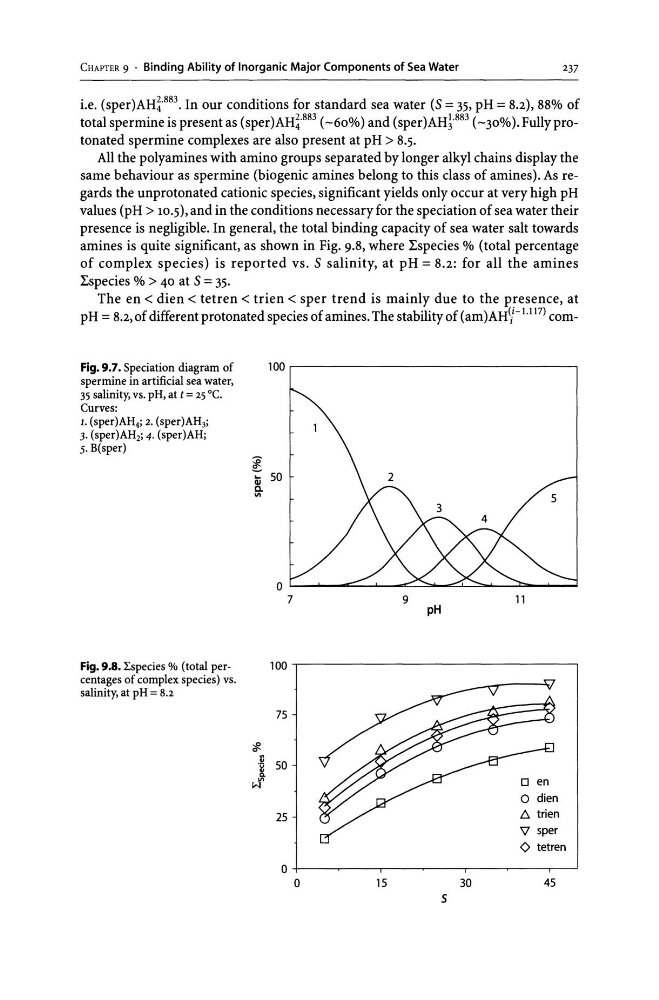
i.e. (sper)AH~·883. In our conditions for standard sea water (S = 35, pH = 8.2), 88% of
total spermine is present as (sper)AH~·883 (-60%) and (sper)AH~·883 (-30%). Fully protonated spermine complexes are also present at pH > 8.5.
All the polyamines with amino groups separated by longer alkyl chains display the
same behaviour as spermine (biogenic amines belong to this class of amines). As regards the unprotonated cationic species, significant yields only occur at very high pH
values (pH> 10.5), and in the conditions necessary for the speciation of sea water their
presence is negligible. In general, the total binding capacity of sea water salt towards
amines is quite significant, as shown in Fig. 9.8, where Lspecies % (total percentage
of complex species) is reported vs. S salinity, at pH = 8.2: for all the amines
Lspecies % > 40 at S = 35.
The en < dien < tetren < trien < sper trend is mainly due to the presence, at
pH = 8.2, of different protonated species of amines. The stability of (am)AHY-1.l17) comFig. 9.7. Speciation diagram of
100 ,r-------------------~
spermine in artificial sea water,
35 salinity, vs. pH, at t = 25°C.
Curves:
1. (sper)AH4; 2. (sper)AH3;
3. (sper)AH2; 4. (sper)AH;
5. B(sper)
~
lu 50
Co
'"
o I
r<::
d"""":-"""""'"
-6 ............... '
:l>
7
9
11
pH
Fig. 9.8. Ispecies % (total per100 ~-------------------~
centages of complex species) vs.
salinity, at pH = 8.2
Co
v-l' "
75
50
25
o en
o dien
D,. trien
\1 sper
<> tetren
O+I---------.----~--_,r---~----._~
o
15
30
45
5
237
i.e. (sper)AH~·883. In our conditions for standard sea water (S = 35, pH = 8.2), 88% of
total spermine is present as (sper)AH~·883 (-60%) and (sper)AH~·883 (-30%). Fully protonated spermine complexes are also present at pH > 8.5.
All the polyamines with amino groups separated by longer alkyl chains display the
same behaviour as spermine (biogenic amines belong to this class of amines). As regards the unprotonated cationic species, significant yields only occur at very high pH
values (pH> 10.5), and in the conditions necessary for the speciation of sea water their
presence is negligible. In general, the total binding capacity of sea water salt towards
amines is quite significant, as shown in Fig. 9.8, where Lspecies % (total percentage
of complex species) is reported vs. S salinity, at pH = 8.2: for all the amines
Lspecies % > 40 at S = 35.
The en < dien < tetren < trien < sper trend is mainly due to the presence, at
pH = 8.2, of different protonated species of amines. The stability of (am)AHY-1.l17) comFig. 9.7. Speciation diagram of
100 ,r-------------------~
spermine in artificial sea water,
35 salinity, vs. pH, at t = 25°C.
Curves:
1. (sper)AH4; 2. (sper)AH3;
3. (sper)AH2; 4. (sper)AH;
5. B(sper)
~
lu 50
Co
'"
o I
r<::
d"""":-"""""'"
-6 ............... '
:l>
7
9
11
pH
Fig. 9.8. Ispecies % (total per100 ~-------------------~
centages of complex species) vs.
salinity, at pH = 8.2
Co
v-l' "
75
50
25
o en
o dien
D,. trien
\1 sper
<> tetren
O+I---------.----~--_,r---~----._~
o
15
30
45
5