

228
C. De Stefano· C. Foti . A. Gianguzza . D. Piazzese . S. Sammartano
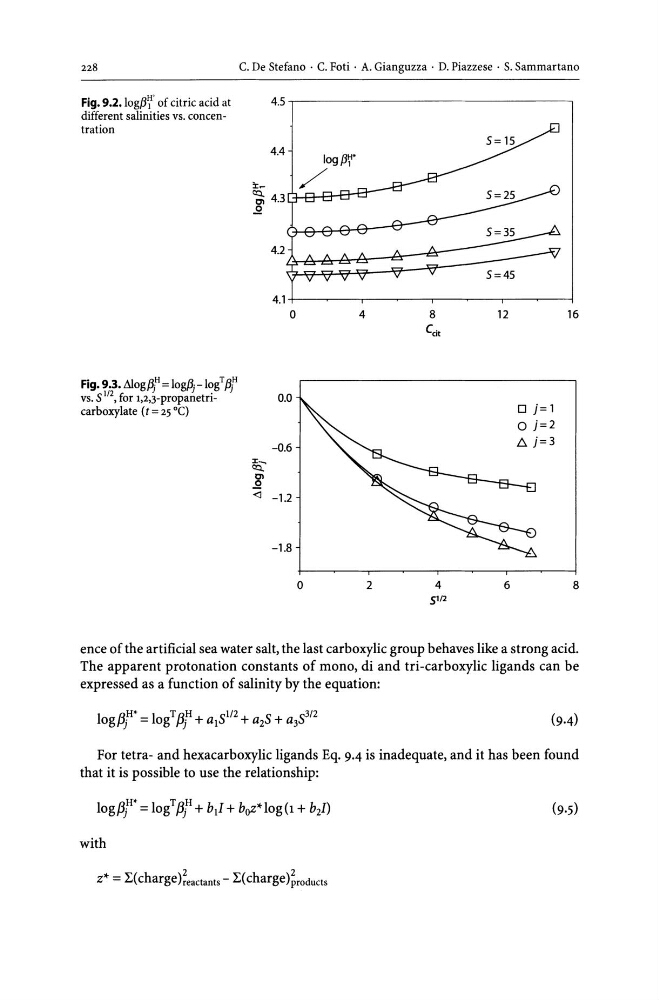
Fig. 9.2.logf3~' of citric acid at
4.5 , ' - - - - - - - - - - - - - - - - - - - - ,
different salinities vs, concentration
4.4
logf3~'
'=/
}4.3~
4,1 +I----.--~-___,-~--_---_I
Fig. 9.3. Mogf3r = log/3j _logT f3r
vs. S1l2, for 1,2,3-propanetricarboxylate (t = 25 °C)
o
0.0
-0.6
",.<:Q.
8'
-1.8
o
4
2
8
C eit
4
5 1/2
12
6
D j=1
o j=2
f:::" j=3
16
8
ence of the artificial sea water salt, the last carboxylic group behaves like a strong acid.
The apparent protonation constants of mono, di and tri-carboxylic ligands can be
expressed as a function of salinity by the equation:
10gf3t = 10gT f3r + atSliZ + azS + a3 S31Z
(9·4)
For tetra- and hexacarboxylic ligands Eq. 9.4 is inadequate, and it has been found
that it is possible to use the relationship:
10gf3t = 10g T f3r+ btl + boz*log(l + bzl)
(9.5)
with
z* = L( charge );eactants - L( charge )~roducts
C. De Stefano· C. Foti . A. Gianguzza . D. Piazzese . S. Sammartano
Fig. 9.2.logf3~' of citric acid at
4.5 , ' - - - - - - - - - - - - - - - - - - - - ,
different salinities vs, concentration
4.4
logf3~'
'=/
}4.3~
4,1 +I----.--~-___,-~--_---_I
Fig. 9.3. Mogf3r = log/3j _logT f3r
vs. S1l2, for 1,2,3-propanetricarboxylate (t = 25 °C)
o
0.0
-0.6
",.<:Q.
8'
-1.8
o
4
2
8
C eit
4
5 1/2
12
6
D j=1
o j=2
f:::" j=3
16
8
ence of the artificial sea water salt, the last carboxylic group behaves like a strong acid.
The apparent protonation constants of mono, di and tri-carboxylic ligands can be
expressed as a function of salinity by the equation:
10gf3t = 10gT f3r + atSliZ + azS + a3 S31Z
(9·4)
For tetra- and hexacarboxylic ligands Eq. 9.4 is inadequate, and it has been found
that it is possible to use the relationship:
10gf3t = 10g T f3r+ btl + boz*log(l + bzl)
(9.5)
with
z* = L( charge );eactants - L( charge )~roducts