

CHAPTER 9 . Binding Ability of Inorganic Major Components of Sea Water
227
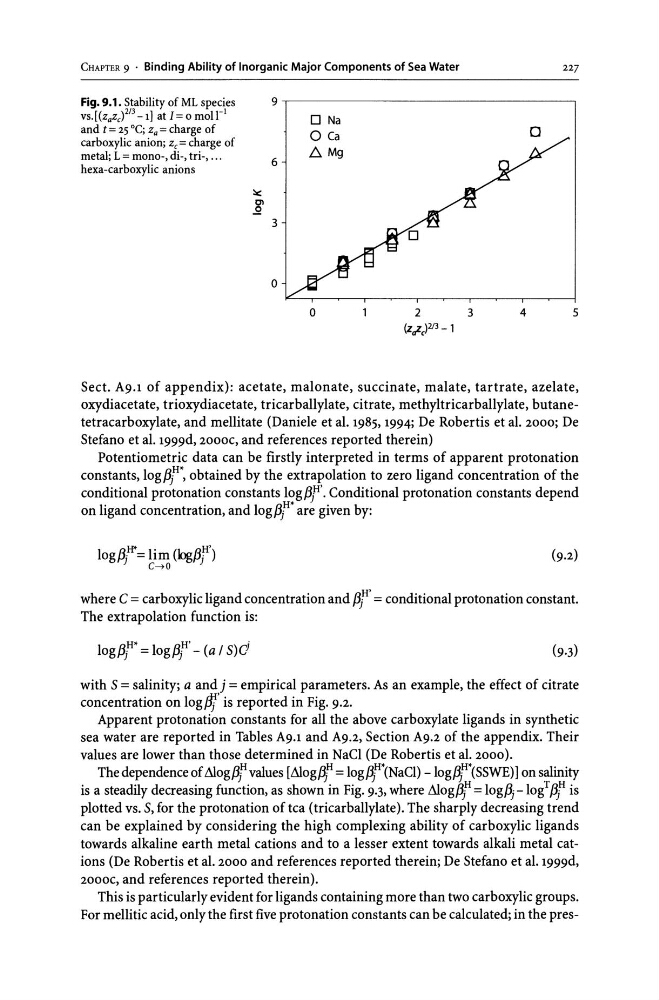
Fig. 9.1. Stability of ML species
vs.[(zazcl2l3 -1] at 1=0 moll- 1
and t = 25°C; Za = charge of
carboxylic anion; z, = charge of
metal; L = mono-, di-, tri-, ...
hexa-carboxylic anions
9,----------------------------------,
6
~
]'
3
o
DNa
o Ca
.6. Mg
o
2
(Z~c)213 -1
3
4
o
5
Sect. A9.1 of appendix): acetate, malonate, succinate, malate, tartrate, azelate,
oxydiacetate, trioxydiacetate, tricarballylate, citrate, methyltricarballylate, butanetetracarboxylate, and mellitate (Daniele et al. 1985, 1994; De Robertis et al. 2000; De
Stefano et al. 1999d, 2000C, and references reported therein)
Potentiometric data can be firstly interpreted in terms of apparent protonation
constants, 10gf3t, obtained by the extrapolation to zero ligand concentration of the
conditional protonation constants 10gf3{. Conditional protonation constants depend
on ligand concentration, and 10gf3t are given by:
H*.
H'
10gf3· = 11m (1ogf3. )
J
c-->o
J
(9.2)
where C = carboxylic ligand concentration and f3r = conditional protonation constant.
The extrapolation function is:
10gf3t = 10gf3{ - (a / S)d
(9.3)
with S = salinity; a and j = empirical parameters. As an example, the effect of citrate
concentration on log[lf' is reported in Fig. 9.2.
Apparent protonation constants for all the above carboxylate ligands in synthetic
sea water are reported in Tables A9.1 and A9.2, Section A9.2 of the appendix. Their
values are lower than those determined in NaCI (De Robertis et al. 2000).
The dependence of Mogf3rvalues [Mogl1 H = 10gf3t(NaCI) -logl1H*(SSWE)) on salinity
is a steadily decreasing function, as shown in Fig. 9.3, where Mogf3r = 10gf3j _logT I1H is
plotted vs. S, for the protonation of tca (tricarballylate). The sharply decreasing trend
can be explained by considering the high complexing ability of carboxylic ligands
towards alkaline earth metal cations and to a lesser extent towards alkali metal cations (De Robertis et al. 2000 and references reported therein; De Stefano et al. 1999d,
2000C, and references reported therein).
This is particularly evident for ligands containing more than two carboxylic groups.
For mellitic acid, only the first five proton at ion constants can be calculated; in the pres-
227
Fig. 9.1. Stability of ML species
vs.[(zazcl2l3 -1] at 1=0 moll- 1
and t = 25°C; Za = charge of
carboxylic anion; z, = charge of
metal; L = mono-, di-, tri-, ...
hexa-carboxylic anions
9,----------------------------------,
6
~
]'
3
o
DNa
o Ca
.6. Mg
o
2
(Z~c)213 -1
3
4
o
5
Sect. A9.1 of appendix): acetate, malonate, succinate, malate, tartrate, azelate,
oxydiacetate, trioxydiacetate, tricarballylate, citrate, methyltricarballylate, butanetetracarboxylate, and mellitate (Daniele et al. 1985, 1994; De Robertis et al. 2000; De
Stefano et al. 1999d, 2000C, and references reported therein)
Potentiometric data can be firstly interpreted in terms of apparent protonation
constants, 10gf3t, obtained by the extrapolation to zero ligand concentration of the
conditional protonation constants 10gf3{. Conditional protonation constants depend
on ligand concentration, and 10gf3t are given by:
H*.
H'
10gf3· = 11m (1ogf3. )
J
c-->o
J
(9.2)
where C = carboxylic ligand concentration and f3r = conditional protonation constant.
The extrapolation function is:
10gf3t = 10gf3{ - (a / S)d
(9.3)
with S = salinity; a and j = empirical parameters. As an example, the effect of citrate
concentration on log[lf' is reported in Fig. 9.2.
Apparent protonation constants for all the above carboxylate ligands in synthetic
sea water are reported in Tables A9.1 and A9.2, Section A9.2 of the appendix. Their
values are lower than those determined in NaCI (De Robertis et al. 2000).
The dependence of Mogf3rvalues [Mogl1 H = 10gf3t(NaCI) -logl1H*(SSWE)) on salinity
is a steadily decreasing function, as shown in Fig. 9.3, where Mogf3r = 10gf3j _logT I1H is
plotted vs. S, for the protonation of tca (tricarballylate). The sharply decreasing trend
can be explained by considering the high complexing ability of carboxylic ligands
towards alkaline earth metal cations and to a lesser extent towards alkali metal cations (De Robertis et al. 2000 and references reported therein; De Stefano et al. 1999d,
2000C, and references reported therein).
This is particularly evident for ligands containing more than two carboxylic groups.
For mellitic acid, only the first five proton at ion constants can be calculated; in the pres-