

222
C. De Stefano· C. Foti . A. Gianguzza . D. Piazzese . S. Sammartano
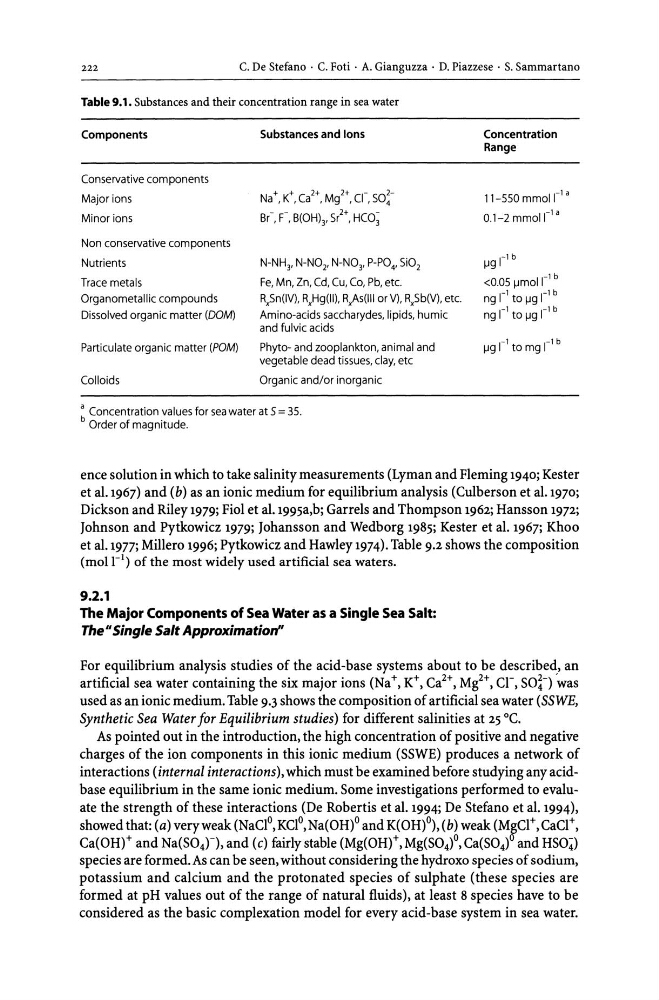
Table 9.1. Substances and their concentration range in sea water
Components
Conservative components
Major ions
Minor ions
Non conservative components
Nutrients
Trace metals
Organometallic compounds
Dissolved organic matter (DOM)
Particulate organic matter (POM)
Colloids
Substances and Ions
Na +, K+, ci+, Mg 2 +, CI-, 50~Br-, F-, B(OH)3' 5r 2 +, HCO;
N-NH3' N-N0 2 , N-N0 3 , P-P0 4 , 5i0 2
Fe, Mn, Zn, Cd, Cu, Co, Pb, etc.
R x 5n(lV), RxHg(ll), R"As(l1l or V), R x 5b(V), etc.
Amino-acids saccharydes, lipids, humic
and fulvic acids
Phyto- and zooplankton, animal and
vegetable dead tissues, clay, etc
Organic and/or inorganic
a Concentration values for sea water at 5 = 35.
b Order of magnitude.
Concentration
Range
11-550 mmoll- 1 a
0.1-2 mmol 1- 1a
IJg 1-' b
<0.05 IJmol r' b
ng 1-' to IJg 1- 1 b
ng 1-' to IJg 1-' b
IJg 1-' to mg 1- 1 b
ence solution in which to take salinity measurements (Lyman and Fleming 1940; Kester
et al. 1967) and (b) as an ionic medium for equilibrium analysis (Culberson et al.1970;
Dickson and Riley 1979; Fiol et al. 1995a,b; Garrels and Thompson 1962; Hansson 1972;
Johnson and Pytkowicz 1979; Johansson and Wedborg 1985; Kester et al. 1967; Khoo
et al. 1977; Millero 1996; Pytkowicz and Hawley 1974). Table 9.2 shows the composition
(mol rl) of the most widely used artificial sea waters.
9.2.1
The Major Components of Sea Water as a Single Sea Salt:
Theil Single Salt Approximation"
For equilibrium analysis studies of the acid-base systems about to be described, an
artificial sea water containing the six major ions (Na +, K+, Ca 2 +, Mg2+, cr, SO~-) was
used as an ionic medium. Table 9.3 shows the composition of artificial sea water (SSWE,
Synthetic Sea Water for Equilibrium studies) for different salinities at 25°C.
As pointed out in the introduction, the high concentration of positive and negative
charges of the ion components in this ionic medium (SSWE) produces a network of
interactions (internal interactions), which must be examined before studying any acidbase equilibrium in the same ionic medium. Some investigations performed to evaluate the strength of these interactions (De Robertis et al. 1994; De Stefano et al. 1994),
showed that: (a) very weak (NaClO, KClO, Na(OH)O and K(OH)O), (b) weak (MgCl+,CaCl+,
Ca(OH)+ and Na(S04f), and (c) fairly stable (Mg(OHt, Mg(S04)O, Ca(S04)o and HS0 4 )
species are formed. As can be seen, without considering the hydroxo species of sodium,
potassium and calcium and the protonated species of sulphate (these species are
formed at pH values out of the range of natural fluids), at least 8 species have to be
considered as the basic complexation model for every acid-base system in sea water.
C. De Stefano· C. Foti . A. Gianguzza . D. Piazzese . S. Sammartano
Table 9.1. Substances and their concentration range in sea water
Components
Conservative components
Major ions
Minor ions
Non conservative components
Nutrients
Trace metals
Organometallic compounds
Dissolved organic matter (DOM)
Particulate organic matter (POM)
Colloids
Substances and Ions
Na +, K+, ci+, Mg 2 +, CI-, 50~Br-, F-, B(OH)3' 5r 2 +, HCO;
N-NH3' N-N0 2 , N-N0 3 , P-P0 4 , 5i0 2
Fe, Mn, Zn, Cd, Cu, Co, Pb, etc.
R x 5n(lV), RxHg(ll), R"As(l1l or V), R x 5b(V), etc.
Amino-acids saccharydes, lipids, humic
and fulvic acids
Phyto- and zooplankton, animal and
vegetable dead tissues, clay, etc
Organic and/or inorganic
a Concentration values for sea water at 5 = 35.
b Order of magnitude.
Concentration
Range
11-550 mmoll- 1 a
0.1-2 mmol 1- 1a
IJg 1-' b
<0.05 IJmol r' b
ng 1-' to IJg 1- 1 b
ng 1-' to IJg 1-' b
IJg 1-' to mg 1- 1 b
ence solution in which to take salinity measurements (Lyman and Fleming 1940; Kester
et al. 1967) and (b) as an ionic medium for equilibrium analysis (Culberson et al.1970;
Dickson and Riley 1979; Fiol et al. 1995a,b; Garrels and Thompson 1962; Hansson 1972;
Johnson and Pytkowicz 1979; Johansson and Wedborg 1985; Kester et al. 1967; Khoo
et al. 1977; Millero 1996; Pytkowicz and Hawley 1974). Table 9.2 shows the composition
(mol rl) of the most widely used artificial sea waters.
9.2.1
The Major Components of Sea Water as a Single Sea Salt:
Theil Single Salt Approximation"
For equilibrium analysis studies of the acid-base systems about to be described, an
artificial sea water containing the six major ions (Na +, K+, Ca 2 +, Mg2+, cr, SO~-) was
used as an ionic medium. Table 9.3 shows the composition of artificial sea water (SSWE,
Synthetic Sea Water for Equilibrium studies) for different salinities at 25°C.
As pointed out in the introduction, the high concentration of positive and negative
charges of the ion components in this ionic medium (SSWE) produces a network of
interactions (internal interactions), which must be examined before studying any acidbase equilibrium in the same ionic medium. Some investigations performed to evaluate the strength of these interactions (De Robertis et al. 1994; De Stefano et al. 1994),
showed that: (a) very weak (NaClO, KClO, Na(OH)O and K(OH)O), (b) weak (MgCl+,CaCl+,
Ca(OH)+ and Na(S04f), and (c) fairly stable (Mg(OHt, Mg(S04)O, Ca(S04)o and HS0 4 )
species are formed. As can be seen, without considering the hydroxo species of sodium,
potassium and calcium and the protonated species of sulphate (these species are
formed at pH values out of the range of natural fluids), at least 8 species have to be
considered as the basic complexation model for every acid-base system in sea water.