

CHAPTER 8 . Speciation of Metals in Natural Waters
215
the fractions of Cu 2 + are acu = 0.039, aCuOH = 0.049, aCu(OHh = 0.022, lXcUS04 = 0.010,
lXcuc0 3 = 0·738, lXcu(C0 3 lz = 0.142, and lXcuHC0 3 = 0.001. Combining the estimates of the
ligand concentrations and stability constants with the inorganic speciation, we get
lXcu = 0.0002, lXcuc0 3 = 0.0034, lXcuLI = 0.9929, lXcuL2 = 0.0030, and lXcu(C0 3 h = 0.0005. So
in sea water without organics, 3.9% of Cu2+ is free, while natural organic ligands can
lower this value to as low as 0.02%. As shown in Fig. 8.19, the difference between the
speciation of Cu(II) with and without the inclusion of organic ligands is quite striking. We have added a provision to our computer code that allows one to input the concentration of a trace inorganic (HS-, PO~-) or organic ligand (humic), the concentration of the trace metal, and concentration of the ligand and the stability constant. This
allows one to examine the competition between inorganic and organic ligands with
some of the major anions (OW, CO;-).
A number of researchers (Gledhill and van den Berg 1994; Wu and Luther 1995; Rue
and Bruland 1995; van den Berg 1995) have used voltammetric techniques to examine
the concentration and strength of natural organic ligands capable of complexing Fe(III)
in sea water. These studies (Table 8.7) yield ligand concentrations [LJr of 0.4-13 nM,
total iron concentrations [FeJr of 0.2-8.5 nM, and apparent stability constants of
KpeL = 10 19 _10 23 . At high ligand concentrations and a pH near 8, Fe(III) is almost completely complexed with this ligand. As discussed above, this ligand is thought to be
responsible for increasing the solubility of Fe(I1I) in sea water. The fraction of free
Fe(I1I) in natural waters is a function of the pH, [LJr, and logK 1 • Near a pH of 8, the
fractions of complexes can range from 70 to 99% depending on the levels of [LJr,
[Fe(I1I)], and the logK selected (Millero 1998).
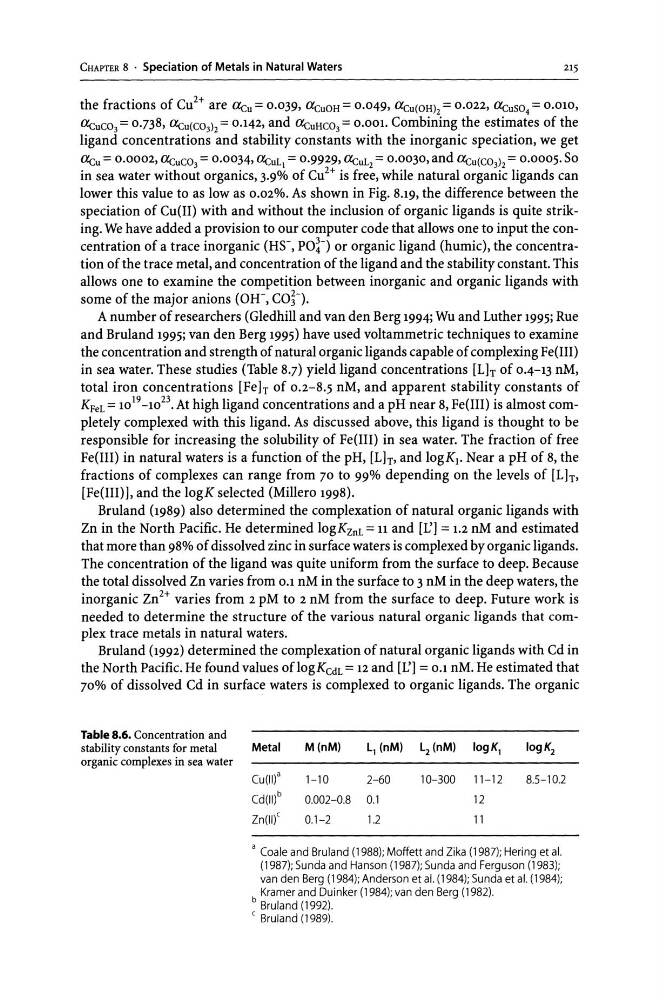
Bruland (1989) also determined the complexation of natural organic ligands with
Zn in the North Pacific. He determined log KZnL = 11 and [1'] = 1.2 nM and estimated
that more than 98% of dissolved zinc in surface waters is complexed by organic ligands.
The concentration of the ligand was quite uniform from the surface to deep. Because
the total dissolved Zn varies from 0.1 nM in the surface to 3 nM in the deep waters, the
inorganic Zn2+ varies from 2 pM to 2 nM from the surface to deep. Future work is
needed to determine the structure of the various natural organic ligands that complex trace metals in natural waters.
Bruland (1992) determined the complexation of natural organic ligands with Cd in
the North Pacific. He found values oflogKcdL = 12 and [1'] = 0.1 nM. He estimated that
70% of dissolved Cd in surface waters is complexed to organic ligands. The organic
Table 8.6. Concentration and
stability constants for metal
organic complexes in sea water
Metal
M(nM)
Ll (nM)
L 2 (nM)
logKl
logK2
Cu(ll)a
1-10
2-60
10-300
11-12
8.5-10.2
Cd(ll)b
0.002-0.8
0.1
12
Zn(ll)c
0.1-2
1.2
11
a Coale and Bruland (1988); Moffett and Zika (1987); Hering et al.
(1987); Sunda and Hanson (1987); Sunda and Ferguson (1983);
van den Berg (1984); Anderson et al. (1984); Sunda et al. (1984);
b Kramer and Duinker (1984); van den Berg (1982).
Bruland (1992).
C Bruland (1989).
215
the fractions of Cu 2 + are acu = 0.039, aCuOH = 0.049, aCu(OHh = 0.022, lXcUS04 = 0.010,
lXcuc0 3 = 0·738, lXcu(C0 3 lz = 0.142, and lXcuHC0 3 = 0.001. Combining the estimates of the
ligand concentrations and stability constants with the inorganic speciation, we get
lXcu = 0.0002, lXcuc0 3 = 0.0034, lXcuLI = 0.9929, lXcuL2 = 0.0030, and lXcu(C0 3 h = 0.0005. So
in sea water without organics, 3.9% of Cu2+ is free, while natural organic ligands can
lower this value to as low as 0.02%. As shown in Fig. 8.19, the difference between the
speciation of Cu(II) with and without the inclusion of organic ligands is quite striking. We have added a provision to our computer code that allows one to input the concentration of a trace inorganic (HS-, PO~-) or organic ligand (humic), the concentration of the trace metal, and concentration of the ligand and the stability constant. This
allows one to examine the competition between inorganic and organic ligands with
some of the major anions (OW, CO;-).
A number of researchers (Gledhill and van den Berg 1994; Wu and Luther 1995; Rue
and Bruland 1995; van den Berg 1995) have used voltammetric techniques to examine
the concentration and strength of natural organic ligands capable of complexing Fe(III)
in sea water. These studies (Table 8.7) yield ligand concentrations [LJr of 0.4-13 nM,
total iron concentrations [FeJr of 0.2-8.5 nM, and apparent stability constants of
KpeL = 10 19 _10 23 . At high ligand concentrations and a pH near 8, Fe(III) is almost completely complexed with this ligand. As discussed above, this ligand is thought to be
responsible for increasing the solubility of Fe(I1I) in sea water. The fraction of free
Fe(I1I) in natural waters is a function of the pH, [LJr, and logK 1 • Near a pH of 8, the
fractions of complexes can range from 70 to 99% depending on the levels of [LJr,
[Fe(I1I)], and the logK selected (Millero 1998).
Bruland (1989) also determined the complexation of natural organic ligands with
Zn in the North Pacific. He determined log KZnL = 11 and [1'] = 1.2 nM and estimated
that more than 98% of dissolved zinc in surface waters is complexed by organic ligands.
The concentration of the ligand was quite uniform from the surface to deep. Because
the total dissolved Zn varies from 0.1 nM in the surface to 3 nM in the deep waters, the
inorganic Zn2+ varies from 2 pM to 2 nM from the surface to deep. Future work is
needed to determine the structure of the various natural organic ligands that complex trace metals in natural waters.
Bruland (1992) determined the complexation of natural organic ligands with Cd in
the North Pacific. He found values oflogKcdL = 12 and [1'] = 0.1 nM. He estimated that
70% of dissolved Cd in surface waters is complexed to organic ligands. The organic
Table 8.6. Concentration and
stability constants for metal
organic complexes in sea water
Metal
M(nM)
Ll (nM)
L 2 (nM)
logKl
logK2
Cu(ll)a
1-10
2-60
10-300
11-12
8.5-10.2
Cd(ll)b
0.002-0.8
0.1
12
Zn(ll)c
0.1-2
1.2
11
a Coale and Bruland (1988); Moffett and Zika (1987); Hering et al.
(1987); Sunda and Hanson (1987); Sunda and Ferguson (1983);
van den Berg (1984); Anderson et al. (1984); Sunda et al. (1984);
b Kramer and Duinker (1984); van den Berg (1982).
Bruland (1992).
C Bruland (1989).