

214
F. Millero . D. Pierrot
ganic complexation can be important. For example, if KML = 10 9 M-l, the concentration of [1'] must be greater than 1 nM to start to affect the speciation. The competition between inorganic and organic ligands can be examined quickly by using the
speciation programmes described above in Visual Basic.
Because fulvic and humic acids are the most abundant organic material in natural
waters, a number of researchers have determined the stability constants for the formation of metal complexes with extracted fulvics and humics. The constants are frequently determined at low concentration (0.01 M) and pH (6) in an ionic medium
(NaCI04). Although these organics may not be the most important ligands in natural
waters, they give one an idea of the magnitude of the effect organics can have on the
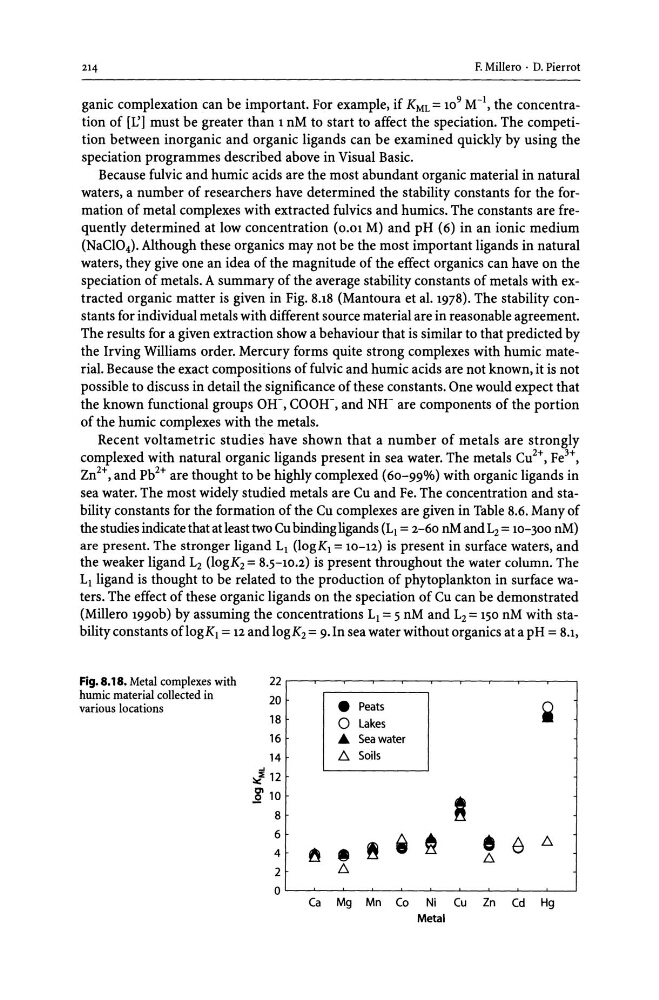
speciation of metals. A summary of the average stability constants of metals with extracted organic matter is given in Fig. 8.18 (Mantoura et al. 1978). The stability constants for individual metals with different source material are in reasonable agreement.
The results for a given extraction show a behaviour that is similar to that predicted by
the Irving Williams order. Mercury forms quite strong complexes with humic material. Because the exact compositions of fulvic and humic acids are not known, it is not
possible to discuss in detail the significance of these constants. One would expect that
the known functional groups OH-, COOH-, and NH- are components of the portion
of the humic complexes with the metals.
Recent voltametric studies have shown that a number of metals are strongly
complexed with natural organic ligands present in sea water. The metals Cu2+, Fe 3 +,
Zn 2 +, and Pb2+ are thought to be highly complexed (60-99%) with organic ligands in
sea water. The most widely studied metals are Cu and Fe. The concentration and stability constants for the formation of the Cu complexes are given in Table 8.6. Many of
the studies indicate that at least two Cu binding ligands (L1 = 2-60 nM and L2 = 10-300 nM)
are present. The stronger ligand LI (logKI = 10-12) is present in surface waters, and
the weaker ligand L2 (lOgK2 = 8.5-10.2) is present throughout the water column. The
Ll ligand is thought to be related to the production of phytoplankton in surface waters. The effect of these organic ligands on the speciation of Cu can be demonstrated
(Millero 1990b) by assuming the concentrations Ll = 5 nM and L2 = 150 nM with stability constants oflogKI = 12 and logK2 = 9. In sea water without organics at a pH = 8.1,
Fig. 8.18. Metal complexes with
22
humic material collected in
20[
various locations
• Peats
~
18
o Lakes
16
.. Seawater
14
f::" Soils
~l· 12
llO
~
8
6
"
~
e e
f::"
4
~
•
ft
f::"
2
f::"
0
Ca Mg Mn Co Ni Cu Zn Cd Hg
Metal
F. Millero . D. Pierrot
ganic complexation can be important. For example, if KML = 10 9 M-l, the concentration of [1'] must be greater than 1 nM to start to affect the speciation. The competition between inorganic and organic ligands can be examined quickly by using the
speciation programmes described above in Visual Basic.
Because fulvic and humic acids are the most abundant organic material in natural
waters, a number of researchers have determined the stability constants for the formation of metal complexes with extracted fulvics and humics. The constants are frequently determined at low concentration (0.01 M) and pH (6) in an ionic medium
(NaCI04). Although these organics may not be the most important ligands in natural
waters, they give one an idea of the magnitude of the effect organics can have on the
speciation of metals. A summary of the average stability constants of metals with extracted organic matter is given in Fig. 8.18 (Mantoura et al. 1978). The stability constants for individual metals with different source material are in reasonable agreement.
The results for a given extraction show a behaviour that is similar to that predicted by
the Irving Williams order. Mercury forms quite strong complexes with humic material. Because the exact compositions of fulvic and humic acids are not known, it is not
possible to discuss in detail the significance of these constants. One would expect that
the known functional groups OH-, COOH-, and NH- are components of the portion
of the humic complexes with the metals.
Recent voltametric studies have shown that a number of metals are strongly
complexed with natural organic ligands present in sea water. The metals Cu2+, Fe 3 +,
Zn 2 +, and Pb2+ are thought to be highly complexed (60-99%) with organic ligands in
sea water. The most widely studied metals are Cu and Fe. The concentration and stability constants for the formation of the Cu complexes are given in Table 8.6. Many of
the studies indicate that at least two Cu binding ligands (L1 = 2-60 nM and L2 = 10-300 nM)
are present. The stronger ligand LI (logKI = 10-12) is present in surface waters, and
the weaker ligand L2 (lOgK2 = 8.5-10.2) is present throughout the water column. The
Ll ligand is thought to be related to the production of phytoplankton in surface waters. The effect of these organic ligands on the speciation of Cu can be demonstrated
(Millero 1990b) by assuming the concentrations Ll = 5 nM and L2 = 150 nM with stability constants oflogKI = 12 and logK2 = 9. In sea water without organics at a pH = 8.1,
Fig. 8.18. Metal complexes with
22
humic material collected in
20[
various locations
• Peats
~
18
o Lakes
16
.. Seawater
14
f::" Soils
~l· 12
llO
~
8
6
"
~
e e
f::"
4
~
•
ft
f::"
2
f::"
0
Ca Mg Mn Co Ni Cu Zn Cd Hg
Metal