

CHAPTER 8 ' Speciation of Metals in Natural Waters
203
M0ller 1988; Greenberg and M0ller 1989) of sea water to 250°C are in the model, it
can be used to make estimates for these ions at higher temperatures (Millero and
Pierrot 1998), The model includes the formation of a number of ion pairs (HF, MgF+,
CaF+, HS0 4 , MgOH+, MgB(OH);, CaB(OH);, MgC0 3 , CaC0 3 , SrC0 3 ). Most of the binary terms (f3'lvIx, 13k, f3~, C~x) come from activity coefficient measurements (Pitzer
1991). The higher order interaction terms (e ij , 'P;jk) have been determined from emf
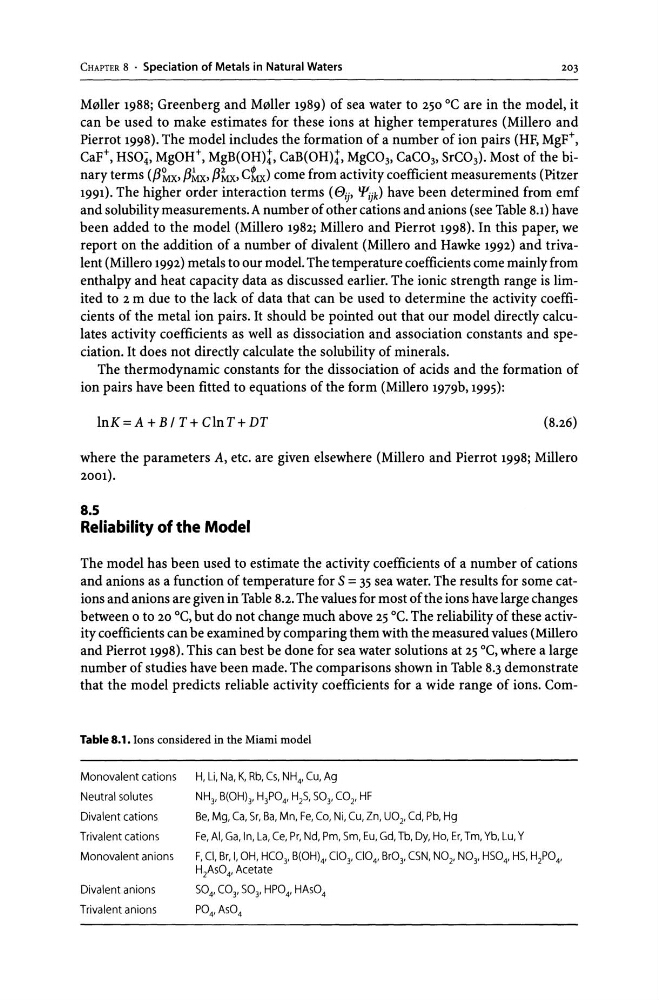
and solubility measurements. A number of other cations and anions (see Table 8.1) have
been added to the model (Millero 1982; Millero and Pierrot 1998). In this paper, we
report on the addition of a number of divalent (Millero and Hawke 1992) and trivalent (Millero 1992) metals to our model. The temperature coefficients come mainly from
enthalpy and heat capacity data as discussed earlier. The ionic strength range is limited to 2 m due to the lack of data that can be used to determine the activity coefficients of the metal ion pairs. It should be pointed out that our model directly calculates activity coefficients as well as dissociation and association constants and speciation. It does not directly calculate the solubility of minerals.
The thermodynamic constants for the dissociation of acids and the formation of
ion pairs have been fitted to equations of the form (Millero 1979b, 1995):
InK=A +BI T+ ClnT+DT
(8.26)
where the parameters A, etc. are given elsewhere (Millero and Pierrot 1998; Millero
2001).
8.5
Reliability of the Model
The model has been used to estimate the activity coefficients of a number of cations
and anions as a function of temperature for S = 35 sea water. The results for some cations and anions are given in Table 8.2. The values for most of the ions have large changes
between 0 to 20°C, but do not change much above 25 0c, The reliability of these activity coefficients can be examined by comparing them with the measured values (Millero
and Pierrot 1998). This can best be done for sea water solutions at 25°C, where a large
number of studies have been made. The comparisons shown in Table 8.3 demonstrate
that the model predicts reliable activity coefficients for a wide range of ions. ComTable 8.1. Ions considered in the Miami model
Monovalent cations
H, Li, Na, K, Rb, Cs, NH 4 , Cu, Ag
Neutral solutes
NH 3 , B(OH)3' Hl0 4 , H 2 S, 503' CO 2 , HF
Divalent cations
Be, Mg, Ca, Sr, Ba, Mn, Fe, Co, Ni, Cu, Zn, U0 2 , Cd, Pb, Hg
Trivalent cations
Fe, AI, Ga, In, La, Ce, Pr, Nd, Pm, Sm, Eu, Gd, Tb, Dy, Ho, Er, Tm, Yb, Lu, Y
Monovalent anions
F, CI, Br, I, OH, HCOy B(OH)4' ClOy C10 4 , Br0 3 , CSN, N0 2 , N0 3 , HS0 4 , HS, Hl0 4 ,
H 2 As0 4 , Acetate
Divalent anions
504' C0 3 , 503' HP0 4 , HAs0 4
Trivalent anions
P0 4 , As0 4
203
M0ller 1988; Greenberg and M0ller 1989) of sea water to 250°C are in the model, it
can be used to make estimates for these ions at higher temperatures (Millero and
Pierrot 1998), The model includes the formation of a number of ion pairs (HF, MgF+,
CaF+, HS0 4 , MgOH+, MgB(OH);, CaB(OH);, MgC0 3 , CaC0 3 , SrC0 3 ). Most of the binary terms (f3'lvIx, 13k, f3~, C~x) come from activity coefficient measurements (Pitzer
1991). The higher order interaction terms (e ij , 'P;jk) have been determined from emf
and solubility measurements. A number of other cations and anions (see Table 8.1) have
been added to the model (Millero 1982; Millero and Pierrot 1998). In this paper, we
report on the addition of a number of divalent (Millero and Hawke 1992) and trivalent (Millero 1992) metals to our model. The temperature coefficients come mainly from
enthalpy and heat capacity data as discussed earlier. The ionic strength range is limited to 2 m due to the lack of data that can be used to determine the activity coefficients of the metal ion pairs. It should be pointed out that our model directly calculates activity coefficients as well as dissociation and association constants and speciation. It does not directly calculate the solubility of minerals.
The thermodynamic constants for the dissociation of acids and the formation of
ion pairs have been fitted to equations of the form (Millero 1979b, 1995):
InK=A +BI T+ ClnT+DT
(8.26)
where the parameters A, etc. are given elsewhere (Millero and Pierrot 1998; Millero
2001).
8.5
Reliability of the Model
The model has been used to estimate the activity coefficients of a number of cations
and anions as a function of temperature for S = 35 sea water. The results for some cations and anions are given in Table 8.2. The values for most of the ions have large changes
between 0 to 20°C, but do not change much above 25 0c, The reliability of these activity coefficients can be examined by comparing them with the measured values (Millero
and Pierrot 1998). This can best be done for sea water solutions at 25°C, where a large
number of studies have been made. The comparisons shown in Table 8.3 demonstrate
that the model predicts reliable activity coefficients for a wide range of ions. ComTable 8.1. Ions considered in the Miami model
Monovalent cations
H, Li, Na, K, Rb, Cs, NH 4 , Cu, Ag
Neutral solutes
NH 3 , B(OH)3' Hl0 4 , H 2 S, 503' CO 2 , HF
Divalent cations
Be, Mg, Ca, Sr, Ba, Mn, Fe, Co, Ni, Cu, Zn, U0 2 , Cd, Pb, Hg
Trivalent cations
Fe, AI, Ga, In, La, Ce, Pr, Nd, Pm, Sm, Eu, Gd, Tb, Dy, Ho, Er, Tm, Yb, Lu, Y
Monovalent anions
F, CI, Br, I, OH, HCOy B(OH)4' ClOy C10 4 , Br0 3 , CSN, N0 2 , N0 3 , HS0 4 , HS, Hl0 4 ,
H 2 As0 4 , Acetate
Divalent anions
504' C0 3 , 503' HP0 4 , HAs0 4
Trivalent anions
P0 4 , As0 4