

CHAPTER 8 . Speciation of Metals in Natural Waters
201
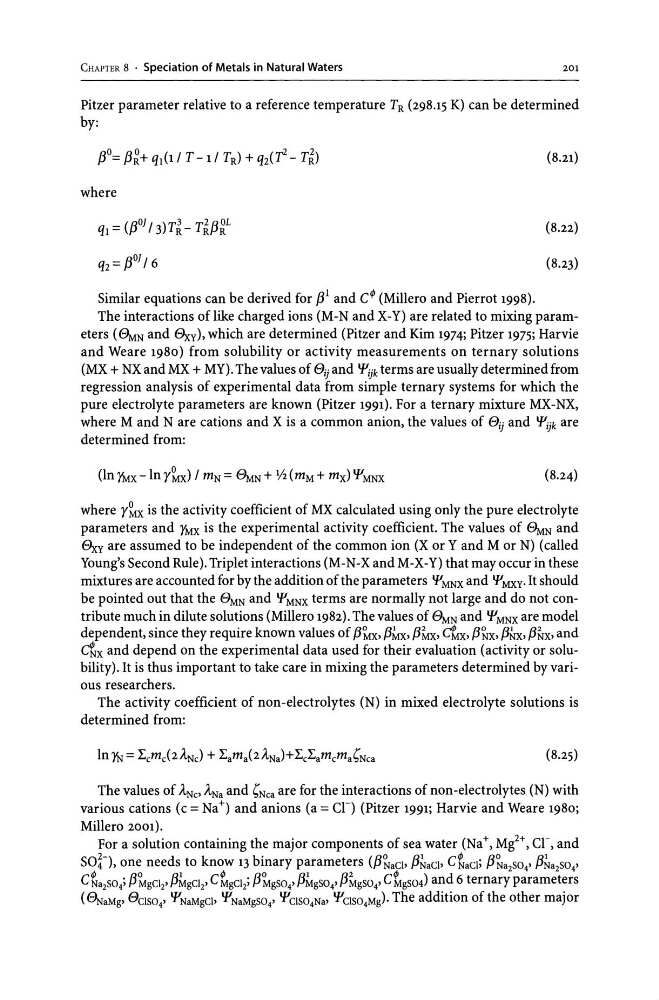
Pitzer parameter relative to a reference temperature TR (298.15 K) can be determined
by:
13°= f3~+ ql (1/ T -1/ TR) + q2Cf2 - T~)
(8.21)
where
ql = (f30J / 3)T~ - T~f3~L
(8.22)
q2 = f3 0J /6
(8.23)
Similar equations can be derived for 13 1 and C The interactions of like charged ions (M-N and X-Y) are related to mixing parameters (E\iN and E>xy), which are determined (Pitzer and Kim 1974; Pitzer 1975; Harvie
and Weare 1980) from solubility or activity measurements on ternary solutions
(MX + NX and MX + MY). The values of eij and '¥;jk terms are usually determined from
regression analysis of experimental data from simple ternary systems for which the
pure electrolyte parameters are known (Pitzer 1991). For a ternary mixture MX-NX,
where M and N are cations and X is a common anion, the values of e ij and 'P ijk are
determined from:
(In "YMx - In y~) / mN = E\iN + 1/2 (mM + mx) 'PMNX
(8.24)
where y~x is the activity coefficient of MX calculated using only the pure electrolyte
parameters and YMx is the experimental activity coefficient. The values of E\iN and
E>xy are assumed to be independent of the common ion (X or Y and M or N) (called
Young's Second Rule). Triplet interactions (M -N -X and M -X -Y) that may occurin these
mixtures are accounted for by the addition of the parameters 'P MNX and 'PMXY' It should
be pointed out that the E\iN and 'PMNX terms are normally not large and do not contribute much in dilute solutions (Millero 1982). The values of E\iN and 'P MNX are model
dependent, since they require known values of 13k, 13k., 13k, dMX, f3'Nx, f3Nx, f3NX, and
ctx and depend on the experimental data used for their evaluation (activity or solubility). It is thus important to take care in mixing the parameters determined by various researchers.
The activity coefficient of non-electrolytes (N) in mixed electrolyte solutions is
determined from:
In}N = ~cmc(2ANc) + ~ama(2ANa)+~c~amcmaSNca
(8.25)
The values of ANc> ANa and SNca are for the interactions of non-electrolytes (N) with
various cations (c = Na+) and anions (a = en (Pitzer 1991; Harvie and Weare 1980;
Millero 2001).
For a solution containing the major components of sea water (Na+, Mg2+, er, and
SO~-), one needs to know 13 binary parameters (f3~aCl' f3~aCl' CtaCl; f3~a so , f3~a so ,
131
132
2 4
C Na2S04; MgCl 2 , MgCl 2 , C MgCl 2 ; MgS0 4 , MgS0 4 ' MgS0 4 ' C MgS04 an 6 ternary parameters
(~aMg, eClS04' 'PNaMgCl> 'PNaMgS04' 'PClS04Na, 'Pcls04Mg)' The addition of the other major
201
Pitzer parameter relative to a reference temperature TR (298.15 K) can be determined
by:
13°= f3~+ ql (1/ T -1/ TR) + q2Cf2 - T~)
(8.21)
where
ql = (f30J / 3)T~ - T~f3~L
(8.22)
q2 = f3 0J /6
(8.23)
Similar equations can be derived for 13 1 and C The interactions of like charged ions (M-N and X-Y) are related to mixing parameters (E\iN and E>xy), which are determined (Pitzer and Kim 1974; Pitzer 1975; Harvie
and Weare 1980) from solubility or activity measurements on ternary solutions
(MX + NX and MX + MY). The values of eij and '¥;jk terms are usually determined from
regression analysis of experimental data from simple ternary systems for which the
pure electrolyte parameters are known (Pitzer 1991). For a ternary mixture MX-NX,
where M and N are cations and X is a common anion, the values of e ij and 'P ijk are
determined from:
(In "YMx - In y~) / mN = E\iN + 1/2 (mM + mx) 'PMNX
(8.24)
where y~x is the activity coefficient of MX calculated using only the pure electrolyte
parameters and YMx is the experimental activity coefficient. The values of E\iN and
E>xy are assumed to be independent of the common ion (X or Y and M or N) (called
Young's Second Rule). Triplet interactions (M -N -X and M -X -Y) that may occurin these
mixtures are accounted for by the addition of the parameters 'P MNX and 'PMXY' It should
be pointed out that the E\iN and 'PMNX terms are normally not large and do not contribute much in dilute solutions (Millero 1982). The values of E\iN and 'P MNX are model
dependent, since they require known values of 13k, 13k., 13k, dMX, f3'Nx, f3Nx, f3NX, and
ctx and depend on the experimental data used for their evaluation (activity or solubility). It is thus important to take care in mixing the parameters determined by various researchers.
The activity coefficient of non-electrolytes (N) in mixed electrolyte solutions is
determined from:
In}N = ~cmc(2ANc) + ~ama(2ANa)+~c~amcmaSNca
(8.25)
The values of ANc> ANa and SNca are for the interactions of non-electrolytes (N) with
various cations (c = Na+) and anions (a = en (Pitzer 1991; Harvie and Weare 1980;
Millero 2001).
For a solution containing the major components of sea water (Na+, Mg2+, er, and
SO~-), one needs to know 13 binary parameters (f3~aCl' f3~aCl' CtaCl; f3~a so , f3~a so ,
131
132
2 4
C Na2S04; MgCl 2 , MgCl 2 , C MgCl 2 ; MgS0 4 , MgS0 4 ' MgS0 4 ' C MgS04 an 6 ternary parameters
(~aMg, eClS04' 'PNaMgCl> 'PNaMgS04' 'PClS04Na, 'Pcls04Mg)' The addition of the other major