

CHAPTER 7 . Sedimentary Geochemistry of the Carbonate and Sulphide Systems
177
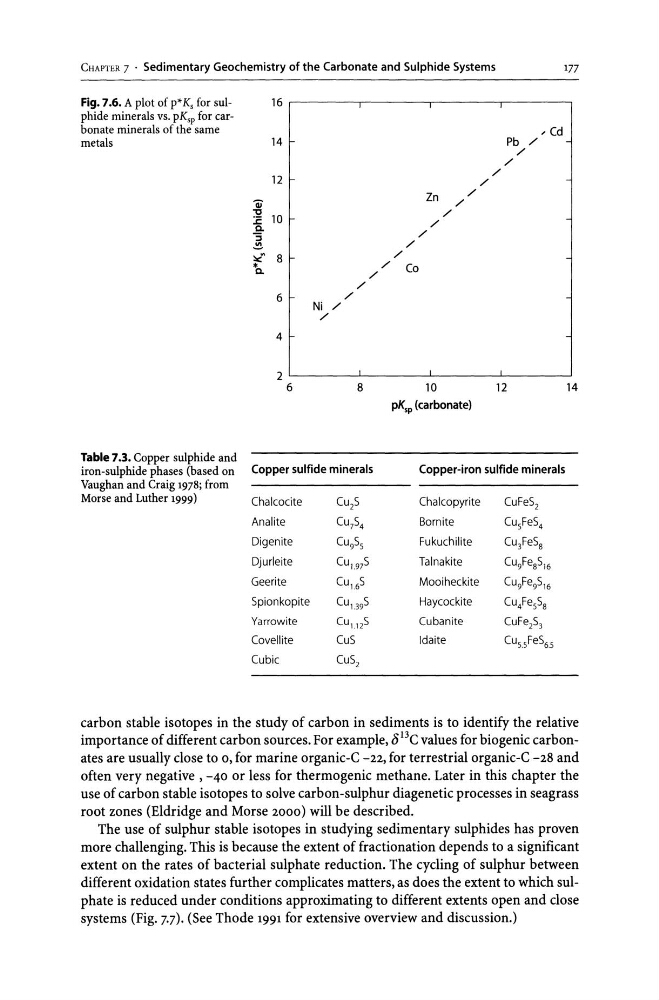
Fig. 7.6. A plot of p* Ks for sulphide minerals vs. pKsp for carbonate minerals of the same
metals
Table 7.3. Copper sulphide and
iron-sulphide phases (based on
Vaughan and Craig 1978; from
Morse and Luther 1999)
16
14
12
Qj"
"C
:c 10
0..
:;
~
/
/
Zn
/
/
/
/
/
/
/
Pb / ' Cd
/
/
"::.t.~
8
* 0..
/ / Co
/
6
Ni / /
/
4
2 6
8
10
12
pK sp (carbonate)
Copper sulfide minerals
Copper-iron sulfide minerals
Chalcocite
Cu 2 S
Chalcopyrite
CuFeS 2
Analite
CU 7 S 4
Bornite
CuleS4
Digenite
CugS S
Fukuchilite
CuleSs
Djurleite
CU 197 S
Talnakite
CugFe s S 16
Geerite
CU 16 S
Mooiheckite
Cu 9 Fe 9 S 16
Spionkopite
CUl.3gS
Haycockite
Cu/esSs
Yarrowite
CU ,.12S
Cubanite
CuFe 2 S 3
Covellite
CuS
Idaite
CU SS FeS 6S
Cubic
CUS 2
14
carbon stable isotopes in the study of carbon in sediments is to identify the relative
importance of different carbon sources. For example, 8l3C values for biogenic carbonates are usually close to 0, for marine organic-C -22, for terrestrial organic-C -28 and
often very negative, -40 or less for thermogenic methane. Later in this chapter the
use of carbon stable isotopes to solve carbon-sulphur diagenetic processes in seagrass
root zones (Eldridge and Morse 2000) will be described.
The use of sulphur stable isotopes in studying sedimentary sulphides has proven
more challenging. This is because the extent of fractionation depends to a significant
extent on the rates of bacterial sulphate reduction. The cycling of sulphur between
different oxidation states further complicates matters, as does the extent to which sulphate is reduced under conditions approximating to different extents open and close
systems (Fig. 7.7). (See Thode 1991 for extensive overview and discussion.)
177
Fig. 7.6. A plot of p* Ks for sulphide minerals vs. pKsp for carbonate minerals of the same
metals
Table 7.3. Copper sulphide and
iron-sulphide phases (based on
Vaughan and Craig 1978; from
Morse and Luther 1999)
16
14
12
Qj"
"C
:c 10
0..
:;
~
/
/
Zn
/
/
/
/
/
/
/
Pb / ' Cd
/
/
"::.t.~
8
* 0..
/ / Co
/
6
Ni / /
/
4
2 6
8
10
12
pK sp (carbonate)
Copper sulfide minerals
Copper-iron sulfide minerals
Chalcocite
Cu 2 S
Chalcopyrite
CuFeS 2
Analite
CU 7 S 4
Bornite
CuleS4
Digenite
CugS S
Fukuchilite
CuleSs
Djurleite
CU 197 S
Talnakite
CugFe s S 16
Geerite
CU 16 S
Mooiheckite
Cu 9 Fe 9 S 16
Spionkopite
CUl.3gS
Haycockite
Cu/esSs
Yarrowite
CU ,.12S
Cubanite
CuFe 2 S 3
Covellite
CuS
Idaite
CU SS FeS 6S
Cubic
CUS 2
14
carbon stable isotopes in the study of carbon in sediments is to identify the relative
importance of different carbon sources. For example, 8l3C values for biogenic carbonates are usually close to 0, for marine organic-C -22, for terrestrial organic-C -28 and
often very negative, -40 or less for thermogenic methane. Later in this chapter the
use of carbon stable isotopes to solve carbon-sulphur diagenetic processes in seagrass
root zones (Eldridge and Morse 2000) will be described.
The use of sulphur stable isotopes in studying sedimentary sulphides has proven
more challenging. This is because the extent of fractionation depends to a significant
extent on the rates of bacterial sulphate reduction. The cycling of sulphur between
different oxidation states further complicates matters, as does the extent to which sulphate is reduced under conditions approximating to different extents open and close
systems (Fig. 7.7). (See Thode 1991 for extensive overview and discussion.)