

CHAPTER 7 . Sedimentary Geochemistry of the Carbonate and Sulphide Systems
175
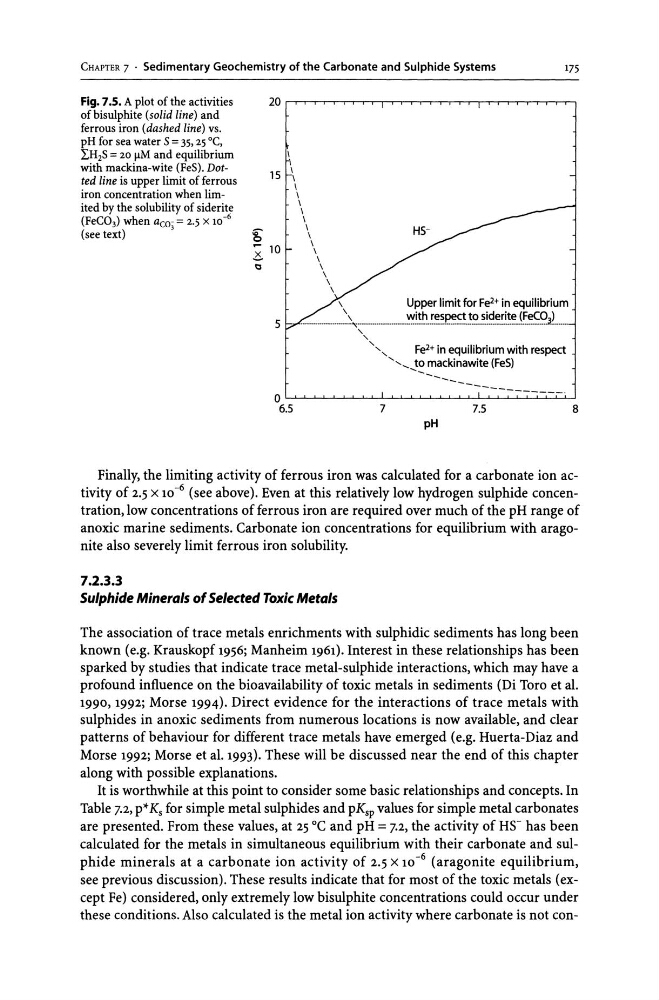
Fig. 7.5. A plot of the activities
ofbisulphite (solid line) and
ferrous iron (dashed line) vs.
pH for sea water S = 35, 25°C,
IH2S = 20 f!M and equilibrium
with mackina-wite (FeS). Dotted line is upper limit of ferrous
iron concentration when limited by the solubility of siderite
(FeC03) when aco;= 2.5 x 10- 6
(see text)
~
20 I
, I
\
'\
15 1-\
\
\
\
\
\
\
\
~ 10
\
\
\ \
a
5
o I ,
6.5
\
\
\
\
Upper limit for Fe 1 + in equilibrium
\
with respect to siderite (FeCO )
................ _ ... " ........................................................ _ ............... _ .. _._ ............... 1 ...... ..
, ,
'"
Fe 2 + in equilibrium with respect
',,~o mackinawite (FeS)
--------7
7.5
pH
8
Finally, the limiting activity of ferrous iron was calculated for a carbonate ion activity of 2.5 x 10- 6 (see above). Even at this relatively low hydrogen sulphide concentration, low concentrations of ferrous iron are required over much of the pH range of
anoxic marine sediments. Carbonate ion concentrations for equilibrium with aragonite also severely limit ferrous iron solubility.
7.2.3.3
Sulphide Minerals of Selected Toxic Metals
The association of trace metals enrichments with sulphidic sediments has long been
known (e.g. Krauskopf 1956; Manheim 1961). Interest in these relationships has been
sparked by studies that indicate trace metal-sulphide interactions, which may have a
profound influence on the bioavailability of toxic metals in sediments (Di Toro et al.
1990,1992; Morse 1994). Direct evidence for the interactions of trace metals with
sulphides in anoxic sediments from numerous locations is now available, and clear
patterns of behaviour for different trace metals have emerged (e.g. Huerta-Diaz and
Morse 1992; Morse et al. 1993). These will be discussed near the end of this chapter
along with possible explanations.
It is worthwhile at this point to consider some basic relationships and concepts. In
Table 7.2, p* Ks for simple metal sulphides and pKsp values for simple metal carbonates
are presented. From these values, at 25°C and pH = 7.2, the activity of HS- has been
calculated for the metals in simultaneous equilibrium with their carbonate and sulphide minerals at a carbonate ion activity of 2.5 x 10 -6 (aragonite equilibrium,
see previous discussion). These results indicate that for most of the toxic metals (except Fe) considered, only extremely low bisulphite concentrations could occur under
these conditions. Also calculated is the metal ion activity where carbonate is not con-
175
Fig. 7.5. A plot of the activities
ofbisulphite (solid line) and
ferrous iron (dashed line) vs.
pH for sea water S = 35, 25°C,
IH2S = 20 f!M and equilibrium
with mackina-wite (FeS). Dotted line is upper limit of ferrous
iron concentration when limited by the solubility of siderite
(FeC03) when aco;= 2.5 x 10- 6
(see text)
~
20 I
, I
\
'\
15 1-\
\
\
\
\
\
\
\
~ 10
\
\
\ \
a
5
o I ,
6.5
\
\
\
\
Upper limit for Fe 1 + in equilibrium
\
with respect to siderite (FeCO )
................ _ ... " ........................................................ _ ............... _ .. _._ ............... 1 ...... ..
, ,
'"
Fe 2 + in equilibrium with respect
',,~o mackinawite (FeS)
--------7
7.5
pH
8
Finally, the limiting activity of ferrous iron was calculated for a carbonate ion activity of 2.5 x 10- 6 (see above). Even at this relatively low hydrogen sulphide concentration, low concentrations of ferrous iron are required over much of the pH range of
anoxic marine sediments. Carbonate ion concentrations for equilibrium with aragonite also severely limit ferrous iron solubility.
7.2.3.3
Sulphide Minerals of Selected Toxic Metals
The association of trace metals enrichments with sulphidic sediments has long been
known (e.g. Krauskopf 1956; Manheim 1961). Interest in these relationships has been
sparked by studies that indicate trace metal-sulphide interactions, which may have a
profound influence on the bioavailability of toxic metals in sediments (Di Toro et al.
1990,1992; Morse 1994). Direct evidence for the interactions of trace metals with
sulphides in anoxic sediments from numerous locations is now available, and clear
patterns of behaviour for different trace metals have emerged (e.g. Huerta-Diaz and
Morse 1992; Morse et al. 1993). These will be discussed near the end of this chapter
along with possible explanations.
It is worthwhile at this point to consider some basic relationships and concepts. In
Table 7.2, p* Ks for simple metal sulphides and pKsp values for simple metal carbonates
are presented. From these values, at 25°C and pH = 7.2, the activity of HS- has been
calculated for the metals in simultaneous equilibrium with their carbonate and sulphide minerals at a carbonate ion activity of 2.5 x 10 -6 (aragonite equilibrium,
see previous discussion). These results indicate that for most of the toxic metals (except Fe) considered, only extremely low bisulphite concentrations could occur under
these conditions. Also calculated is the metal ion activity where carbonate is not con-