

Chapter 7
Sedimentary Geochemistry of the Carbonate and
Sulphide Systems and their Potential Influence
on Toxic Metal Bioavailability
J. W.Morse
7.1
. Introduction
Two of the most biogeo chemically dynamic and quantitatively important components
of anoxic marine sediments are the carbonate and sulphide systems. They are in many
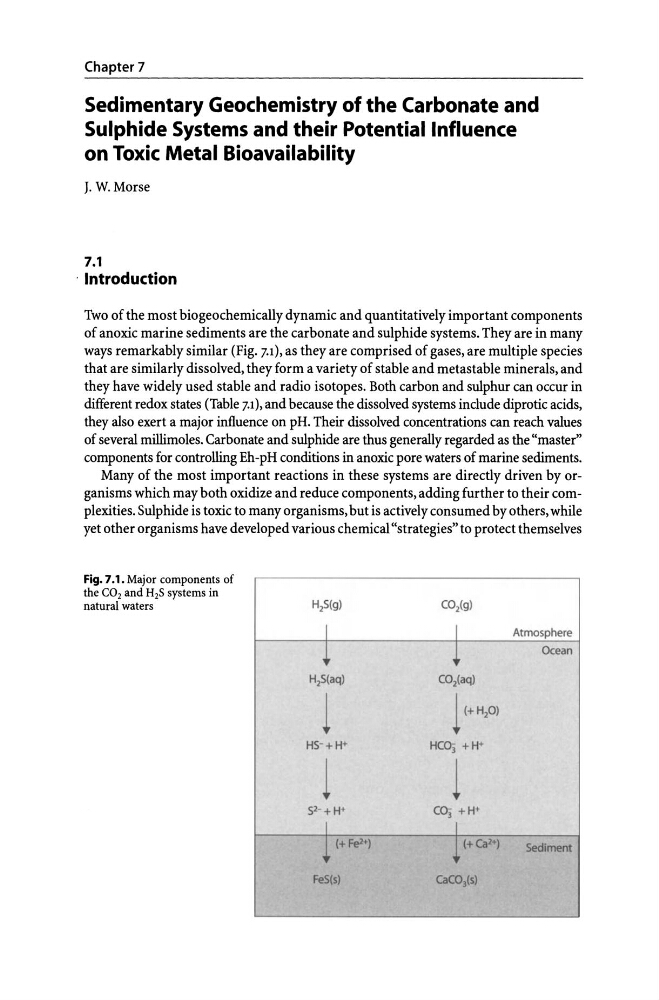
ways remarkably similar (Fig. 7.1), as they are comprised of gases, are multiple species
that are similarly dissolved, they form a variety of stable and metastable minerals, and
they have widely used stable and radio isotopes. Both carbon and sulphur can occur in
different redox states (Table 7.1), and because the dissolved systems include diprotic acids,
they also exert a major influence on pH. Their dissolved concentrations can reach values
of several millimoles. Carbonate and sulphide are thus generally regarded as the "master"
components for controlling Eh-pH conditions in anoxic pore waters of marine sediments.
Many of the most important reactions in these systems are directly driven by organisms which may both oxidize and reduce components, adding further to their complexities. Sulphide is toxic to many organisms, but is actively consumed by others, while
yet other organisms have developed various chemical "strategies" to protect themselves
Fig. 7.1. Major components of
the CO2 and H2S systems in
natural waters
H 2 S(g)
I
~
H 2 S(aq)
1
HS- + H+
1
sz- + H+
I
~ (+ Fe Z +)
FeS(s)
CO 2 (g)
I
Atmosphere
~
Ocean
COz(aq)
1 (+HP)
HCOj +w
1
c0 3 +H+
I
~ (+Ca2+)
Sediment
Caco 3 (s)
Sedimentary Geochemistry of the Carbonate and
Sulphide Systems and their Potential Influence
on Toxic Metal Bioavailability
J. W.Morse
7.1
. Introduction
Two of the most biogeo chemically dynamic and quantitatively important components
of anoxic marine sediments are the carbonate and sulphide systems. They are in many
ways remarkably similar (Fig. 7.1), as they are comprised of gases, are multiple species
that are similarly dissolved, they form a variety of stable and metastable minerals, and
they have widely used stable and radio isotopes. Both carbon and sulphur can occur in
different redox states (Table 7.1), and because the dissolved systems include diprotic acids,
they also exert a major influence on pH. Their dissolved concentrations can reach values
of several millimoles. Carbonate and sulphide are thus generally regarded as the "master"
components for controlling Eh-pH conditions in anoxic pore waters of marine sediments.
Many of the most important reactions in these systems are directly driven by organisms which may both oxidize and reduce components, adding further to their complexities. Sulphide is toxic to many organisms, but is actively consumed by others, while
yet other organisms have developed various chemical "strategies" to protect themselves
Fig. 7.1. Major components of
the CO2 and H2S systems in
natural waters
H 2 S(g)
I
~
H 2 S(aq)
1
HS- + H+
1
sz- + H+
I
~ (+ Fe Z +)
FeS(s)
CO 2 (g)
I
Atmosphere
~
Ocean
COz(aq)
1 (+HP)
HCOj +w
1
c0 3 +H+
I
~ (+Ca2+)
Sediment
Caco 3 (s)