

CHAPTER 5 . Particulate Organic Matter Composition and Fluxes in the Sea
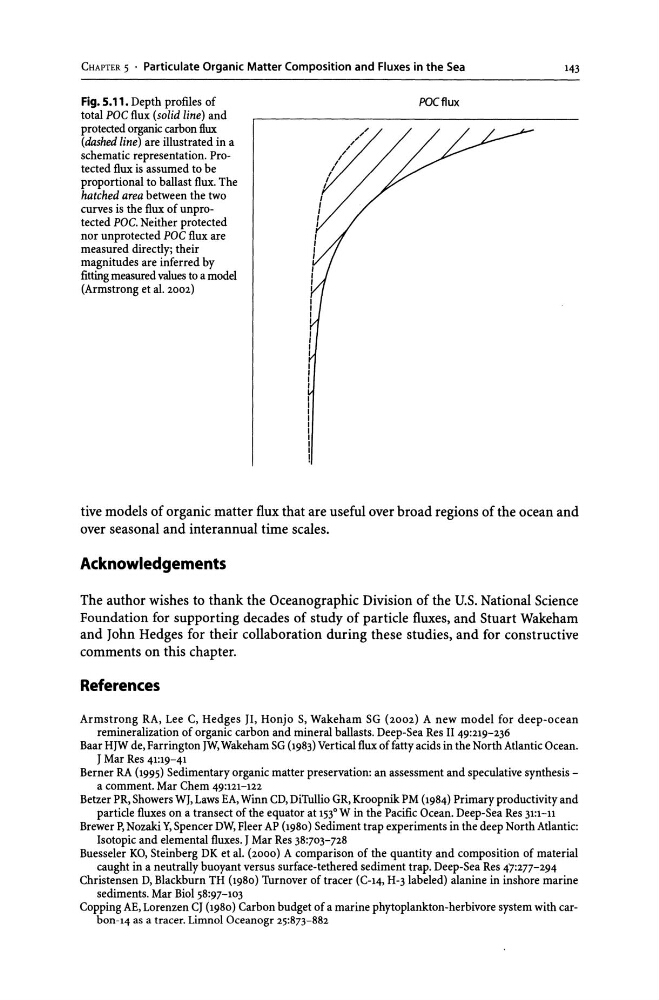
Fig. 5.11. Depth profiles of
total POC flux (solid line) and
protected organic carbon flux
(dashed line) are illustrated in a
schematic representation. Protected flux is assumed to be
proportional to ballast flux. The
hatched area between the two
curves is the flux of unprotected POC. Neither protected
nor unprotected POC flux are
measured directly; their
magnitudes are inferred by
fitting measured values to a model
(Armstrong et al. 2002)
POCflux
143
tive models of organic matter flux that are useful over broad regions of the ocean and
over seasonal and interannual time scales.
Acknowledgements
The author wishes to thank the Oceanographic Division of the u.s. National Science
Foundation for supporting decades of study of particle fluxes, and Stuart Wakeham
and John Hedges for their collaboration during these studies, and for constructive
comments on this chapter.
References
Armstrong RA, Lee C, Hedges JI, Honjo S, Wakeham SG (2002) A new model for deep-ocean
remineralization of organic carbon and mineral ballasts. Deep-Sea Res II 49:219-236
Baar HJW de, Farrington JW, Wakeham SG (1983) Vertical flux of fatty acids in the Nortil Atlantic Ocean.
J Mar Res 41:19-41
Berner RA (1995) Sedimentary organic matter preservation: an assessment and speculative synthesis -
a comment. Mar Chern 49:121-122
Betzer PR, Showers WJ, Laws EA, Winn CD, DiTullio GR, Kroopnik PM (1984) Primary productivity and
particle fluxes on a transect of tile equator at 153 0 W in the Pacific Ocean. Deep-Sea Res 31:1-11
Brewer P, Nozaki Y, Spencer DW, Fleer AP (1980) Sediment trap experiments in the deep Nortil Atlantic:
Isotopic and elemental fluxes. J Mar Res 38:703-728
Buesseler KO, Steinberg DK et al. (2000) A comparison of the quantity and composition of material
caught in a neutrally buoyant versus surface-tetilered sediment trap. Deep-Sea Res 47:277-294
Christensen D, Blackburn TH (1980) Turnover of tracer (C-14, H-3Iabeled) alanine in inshore marine
sediments. Mar Bioi 58:97-103
Copping AE, Lorenzen CJ (1980) Carbon budget of a marine phytoplankton-herbivore system with carbon-14 as a tracer. Limnol Oceanogr 25:873-882
Fig. 5.11. Depth profiles of
total POC flux (solid line) and
protected organic carbon flux
(dashed line) are illustrated in a
schematic representation. Protected flux is assumed to be
proportional to ballast flux. The
hatched area between the two
curves is the flux of unprotected POC. Neither protected
nor unprotected POC flux are
measured directly; their
magnitudes are inferred by
fitting measured values to a model
(Armstrong et al. 2002)
POCflux
143
tive models of organic matter flux that are useful over broad regions of the ocean and
over seasonal and interannual time scales.
Acknowledgements
The author wishes to thank the Oceanographic Division of the u.s. National Science
Foundation for supporting decades of study of particle fluxes, and Stuart Wakeham
and John Hedges for their collaboration during these studies, and for constructive
comments on this chapter.
References
Armstrong RA, Lee C, Hedges JI, Honjo S, Wakeham SG (2002) A new model for deep-ocean
remineralization of organic carbon and mineral ballasts. Deep-Sea Res II 49:219-236
Baar HJW de, Farrington JW, Wakeham SG (1983) Vertical flux of fatty acids in the Nortil Atlantic Ocean.
J Mar Res 41:19-41
Berner RA (1995) Sedimentary organic matter preservation: an assessment and speculative synthesis -
a comment. Mar Chern 49:121-122
Betzer PR, Showers WJ, Laws EA, Winn CD, DiTullio GR, Kroopnik PM (1984) Primary productivity and
particle fluxes on a transect of tile equator at 153 0 W in the Pacific Ocean. Deep-Sea Res 31:1-11
Brewer P, Nozaki Y, Spencer DW, Fleer AP (1980) Sediment trap experiments in the deep Nortil Atlantic:
Isotopic and elemental fluxes. J Mar Res 38:703-728
Buesseler KO, Steinberg DK et al. (2000) A comparison of the quantity and composition of material
caught in a neutrally buoyant versus surface-tetilered sediment trap. Deep-Sea Res 47:277-294
Christensen D, Blackburn TH (1980) Turnover of tracer (C-14, H-3Iabeled) alanine in inshore marine
sediments. Mar Bioi 58:97-103
Copping AE, Lorenzen CJ (1980) Carbon budget of a marine phytoplankton-herbivore system with carbon-14 as a tracer. Limnol Oceanogr 25:873-882