

CHAPTER 5 . Particulate Organic Matter Composition and Fluxes in the Sea
133
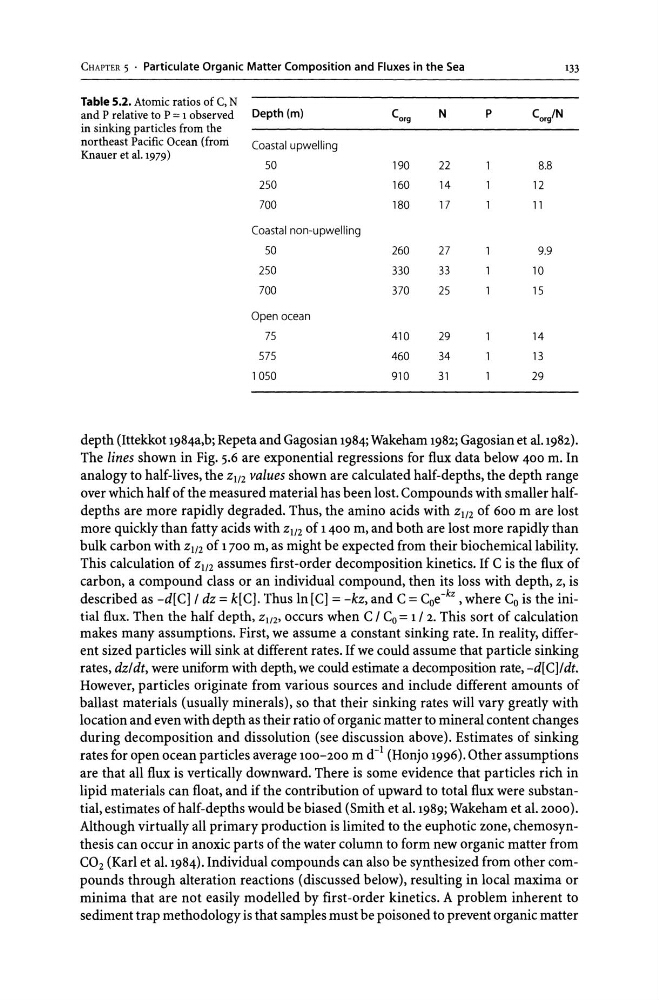
Table S.2. Atomic ratios of C, N
and P relative to P = 1 observed
in sinking particles from the
Depth (m)
C org
N
P
Cori N
northeast Pacific Ocean (from
Coastal upwelling
Knauer et al. 1979)
50
190
22
8.8
250
160
14
12
700
180
17
11
Coastal non-upwelling
50
260
27
9.9
250
330
33
10
700
370
25
15
Open ocean
75
410
29
14
575
460
34
13
1050
910
31
29
depth (Ittekkot 1984a,b; Repeta and Gagosian 1984; Wakeham 1982; Gagosian et al.1982).
The lines shown in Fig. 5.6 are exponential regressions for flux data below 400 m. In
analogy to half-lives, the Z1/2 values shown are calculated half-depths, the depth range
over which half of the measured material has been lost. Compounds with smaller halfdepths are more rapidly degraded. Thus, the amino acids with Z1/2 of 600 m are lost
more quickly than fatty acids with Z1/2 of 1 400 m, and both are lost more rapidly than
bulk carbon with Z1/2 of 1700 m, as might be expected from their biochemical lability.
This calculation of Z1/2 assumes first-order decomposition kinetics. If C is the flux of
carbon, a compound class or an individual compound, then its loss with depth, z, is
described as -d[C) I dz = k[C). Thus In [C) = -kz, and C = Coe- kz ,where Co is the initial flux. Then the half depth, 21/2' occurs when C I Co = 11 2. This sort of calculation
makes many assumptions. First, we assume a constant sinking rate. In reality, different sized particles will sink at different rates. If we could assume that particle sinking
rates, dzldt, were uniform with depth, we could estimate a decomposition rate, -d[C)ldt.
However, particles originate from various sources and include different amounts of
ballast materials (usually minerals), so that their sinking rates will vary greatly with
location and even with depth as their ratio of organic matter to mineral content changes
during decomposition and dissolution (see discussion above). Estimates of sinking
rates for open ocean particles average 100-200 m d- 1 (Honjo 1996). Other assumptions
are that all flux is vertically downward. There is some evidence that particles rich in
lipid materials can float, and if the contribution of upward to total flux were substantial, estimates of half-depths would be biased (Smith et al. 1989; Wakeham et al. 2000).
Although virtually all primary production is limited to the euphotic zone, chemosynthesis can occur in anoxic parts of the water column to form new organic matter from
CO 2 (Karl et al. 1984). Individual compounds can also be synthesized from other compounds through alteration reactions (discussed below), resulting in local maxima or
minima that are not easily modelled by first-order kinetics. A problem inherent to
sediment trap methodology is that samples must be poisoned to prevent organic matter
133
Table S.2. Atomic ratios of C, N
and P relative to P = 1 observed
in sinking particles from the
Depth (m)
C org
N
P
Cori N
northeast Pacific Ocean (from
Coastal upwelling
Knauer et al. 1979)
50
190
22
8.8
250
160
14
12
700
180
17
11
Coastal non-upwelling
50
260
27
9.9
250
330
33
10
700
370
25
15
Open ocean
75
410
29
14
575
460
34
13
1050
910
31
29
depth (Ittekkot 1984a,b; Repeta and Gagosian 1984; Wakeham 1982; Gagosian et al.1982).
The lines shown in Fig. 5.6 are exponential regressions for flux data below 400 m. In
analogy to half-lives, the Z1/2 values shown are calculated half-depths, the depth range
over which half of the measured material has been lost. Compounds with smaller halfdepths are more rapidly degraded. Thus, the amino acids with Z1/2 of 600 m are lost
more quickly than fatty acids with Z1/2 of 1 400 m, and both are lost more rapidly than
bulk carbon with Z1/2 of 1700 m, as might be expected from their biochemical lability.
This calculation of Z1/2 assumes first-order decomposition kinetics. If C is the flux of
carbon, a compound class or an individual compound, then its loss with depth, z, is
described as -d[C) I dz = k[C). Thus In [C) = -kz, and C = Coe- kz ,where Co is the initial flux. Then the half depth, 21/2' occurs when C I Co = 11 2. This sort of calculation
makes many assumptions. First, we assume a constant sinking rate. In reality, different sized particles will sink at different rates. If we could assume that particle sinking
rates, dzldt, were uniform with depth, we could estimate a decomposition rate, -d[C)ldt.
However, particles originate from various sources and include different amounts of
ballast materials (usually minerals), so that their sinking rates will vary greatly with
location and even with depth as their ratio of organic matter to mineral content changes
during decomposition and dissolution (see discussion above). Estimates of sinking
rates for open ocean particles average 100-200 m d- 1 (Honjo 1996). Other assumptions
are that all flux is vertically downward. There is some evidence that particles rich in
lipid materials can float, and if the contribution of upward to total flux were substantial, estimates of half-depths would be biased (Smith et al. 1989; Wakeham et al. 2000).
Although virtually all primary production is limited to the euphotic zone, chemosynthesis can occur in anoxic parts of the water column to form new organic matter from
CO 2 (Karl et al. 1984). Individual compounds can also be synthesized from other compounds through alteration reactions (discussed below), resulting in local maxima or
minima that are not easily modelled by first-order kinetics. A problem inherent to
sediment trap methodology is that samples must be poisoned to prevent organic matter