

132
C.Lee
Measurements of individual compounds indicate that flux attenuation factors in the
upper water column are consistent with the biochemical stability of different compound classes. Information on relative reactivities is useful both for judging the quality of organic matter at different stages of degradation and for more accuratelyapplying biomarkers as source indicators. For example, at a site in the equatorial North Atlantic, poe flux estimated from sediment trap collections decreased by a factor of 5
between 400 and 5 000 m. In contrast, hydrocarbon fluxes decreased by a factor of 14,
amino acids by 25, sterols by 45, and fatty acids by 60 (Lee and Cronin 1982; Wakeham
1982; Gagosian et al. 1982; de Baar et al. 1983; Wakeham et al. 1984; Wakeham and Lee
1993). These individual compounds are all more labile than bulk carbon and thus degrade faster. A large fraction of the poe cannot be readily identified at the molecular
level by standard analytical techniques, and the proportion of this un characterized
fraction in poe increases with depth (Wakeham et al. 1997).
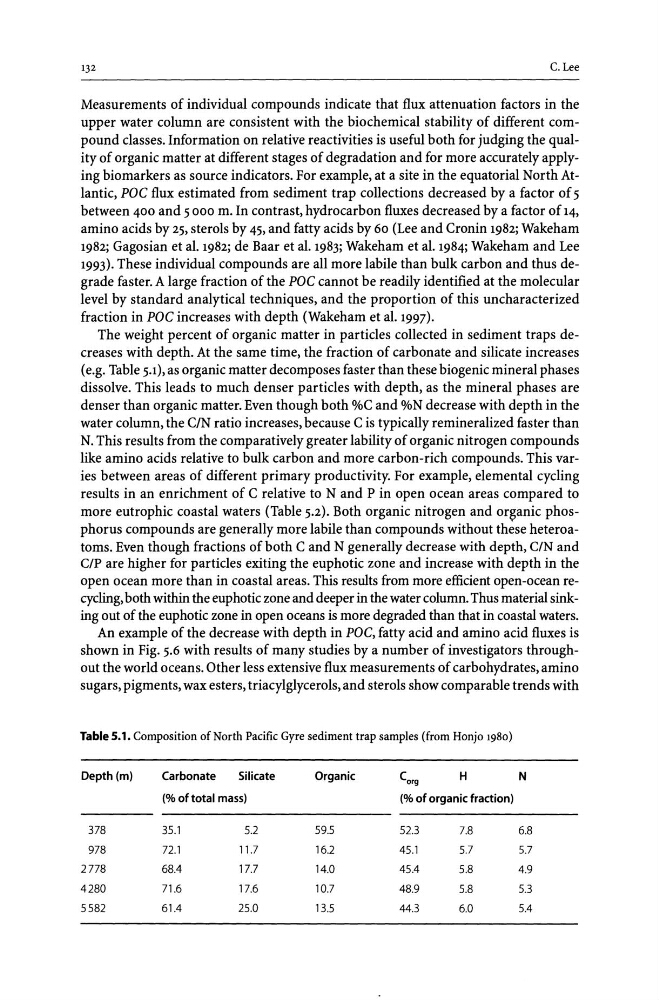
The weight percent of organic matter in particles collected in sediment traps decreases with depth. At the same time, the fraction of carbonate and silicate increases
(e.g. Table 5.1), as organic matter decomposes faster than these biogenic mineral phases
dissolve. This leads to much denser particles with depth, as the mineral phases are
denser than organic matter. Even though both %C and O/ON decrease with depth in the
water column, the C/N ratio increases, because C is typically remineralized faster than
N. This results from the comparatively greater lability of organic nitrogen compounds
like amino acids relative to bulk carbon and more carbon-rich compounds. This varies between areas of different primary productivity. For example, elemental cycling
results in an enrichment of C relative to Nand P in open ocean areas compared to
more eutrophic coastal waters (Table 5.2). Both organic nitrogen and orsanic phosphorus compounds are generally more labile than compounds without these heteroatoms. Even though fractions of both C and N generally decrease with depth, C/N and
e/P are higher for particles exiting the euphotic zone and increase with depth in the
open ocean more than in coastal areas. This results from more efficient open-ocean recycling, both within the euphotic zone and deeper in the water column. Thus material sinking out of the euphotic zone in open oceans is more degraded than that in coastal waters.
An example of the decrease with depth in poe, fatty acid and amino acid fluxes is
shown in Fig. 5.6 with results of many studies by a number of investigators throughout the world oceans. Other less extensive flux measurements of carbohydrates, amino
sugars, pigments, wax esters, triacylglycerols, and sterols show comparable trends with
Table 5.1. Composition of North Pacific Gyre sediment trap samples (from Honjo 1980)
Depth (m)
Carbonate
Silicate
Organic
C org
H
N
(% of total mass)
(% of organic fraction)
378
35.1
5.2
59.5
52.3
7.8
6.8
978
72.1
11.7
16.2
45.1
5.7
5.7
2778
68.4
17.7
14.0
45.4
5.8
4.9
4280
71.6
17.6
10.7
48.9
5.8
5.3
5582
61.4
25.0
13.5
44.3
6.0
5.4
C.Lee
Measurements of individual compounds indicate that flux attenuation factors in the
upper water column are consistent with the biochemical stability of different compound classes. Information on relative reactivities is useful both for judging the quality of organic matter at different stages of degradation and for more accuratelyapplying biomarkers as source indicators. For example, at a site in the equatorial North Atlantic, poe flux estimated from sediment trap collections decreased by a factor of 5
between 400 and 5 000 m. In contrast, hydrocarbon fluxes decreased by a factor of 14,
amino acids by 25, sterols by 45, and fatty acids by 60 (Lee and Cronin 1982; Wakeham
1982; Gagosian et al. 1982; de Baar et al. 1983; Wakeham et al. 1984; Wakeham and Lee
1993). These individual compounds are all more labile than bulk carbon and thus degrade faster. A large fraction of the poe cannot be readily identified at the molecular
level by standard analytical techniques, and the proportion of this un characterized
fraction in poe increases with depth (Wakeham et al. 1997).
The weight percent of organic matter in particles collected in sediment traps decreases with depth. At the same time, the fraction of carbonate and silicate increases
(e.g. Table 5.1), as organic matter decomposes faster than these biogenic mineral phases
dissolve. This leads to much denser particles with depth, as the mineral phases are
denser than organic matter. Even though both %C and O/ON decrease with depth in the
water column, the C/N ratio increases, because C is typically remineralized faster than
N. This results from the comparatively greater lability of organic nitrogen compounds
like amino acids relative to bulk carbon and more carbon-rich compounds. This varies between areas of different primary productivity. For example, elemental cycling
results in an enrichment of C relative to Nand P in open ocean areas compared to
more eutrophic coastal waters (Table 5.2). Both organic nitrogen and orsanic phosphorus compounds are generally more labile than compounds without these heteroatoms. Even though fractions of both C and N generally decrease with depth, C/N and
e/P are higher for particles exiting the euphotic zone and increase with depth in the
open ocean more than in coastal areas. This results from more efficient open-ocean recycling, both within the euphotic zone and deeper in the water column. Thus material sinking out of the euphotic zone in open oceans is more degraded than that in coastal waters.
An example of the decrease with depth in poe, fatty acid and amino acid fluxes is
shown in Fig. 5.6 with results of many studies by a number of investigators throughout the world oceans. Other less extensive flux measurements of carbohydrates, amino
sugars, pigments, wax esters, triacylglycerols, and sterols show comparable trends with
Table 5.1. Composition of North Pacific Gyre sediment trap samples (from Honjo 1980)
Depth (m)
Carbonate
Silicate
Organic
C org
H
N
(% of total mass)
(% of organic fraction)
378
35.1
5.2
59.5
52.3
7.8
6.8
978
72.1
11.7
16.2
45.1
5.7
5.7
2778
68.4
17.7
14.0
45.4
5.8
4.9
4280
71.6
17.6
10.7
48.9
5.8
5.3
5582
61.4
25.0
13.5
44.3
6.0
5.4