

130
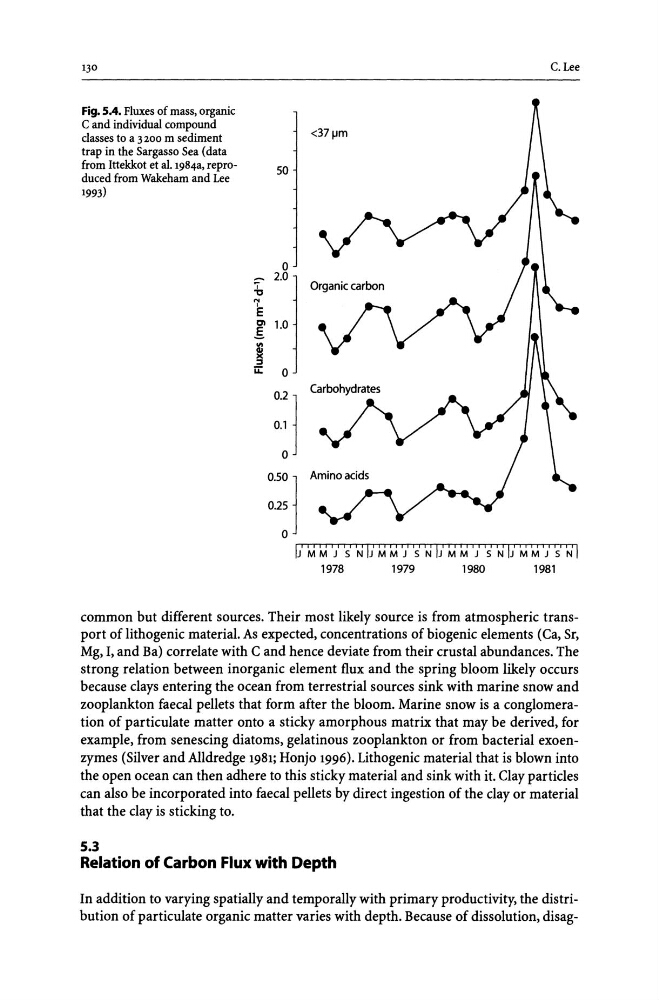
Fig. SA. Fluxes of mass, organic
C and individual compound
classes to a 3200 m sediment
trap in the Sargasso Sea (data
from Ittekkot et a1. 1984a, reproduced from Wakeham and Lee
1993)
*'
' 1'
E
50
o
2.0
r 1.0
~
u:: 0
0.2l
0.1
o
0.50 1
0.25
o
C.Lee
rrMMJsNlJ"M'MJSN!J' M M 'J ' 5 ' N !J' M M 'J' '5' ' N I
1978
1979
1980
1981
common but different sources. Their most likely source is from atmospheric transport of lithogenic material. As expected, concentrations of biogenic elements (Ca, Sr,
Mg, I, and Ba) correlate with C and hence deviate from their crustal abundances. The
strong relation between inorganic element flux and the spring bloom likely occurs
because clays entering the ocean from terrestrial sources sink with marine snow and
zooplankton faecal pellets that form after the bloom. Marine snow is a conglomeration of particulate matter onto a sticky amorphous matrix that may be derived, for
example, from senescing diatoms, gelatinous zooplankton or from bacterial exoenzymes (Silver and Alldredge 1981; Honjo 1996). Lithogenic material that is blown into
the open ocean can then adhere to this sticky material and sink with it. Clay particles
can also be incorporated into faecal pellets by direct ingestion of the clay or material
that the clay is sticking to.
5.3
Relation of Carbon Flux with Depth
In addition to varying spatially and temporally with primary productivity, the distribution of particulate organic matter varies with depth. Because of dissolution, disag-
Fig. SA. Fluxes of mass, organic
C and individual compound
classes to a 3200 m sediment
trap in the Sargasso Sea (data
from Ittekkot et a1. 1984a, reproduced from Wakeham and Lee
1993)
*'
' 1'
E
50
o
2.0
r 1.0
~
u:: 0
0.2l
0.1
o
0.50 1
0.25
o
C.Lee
rrMMJsNlJ"M'MJSN!J' M M 'J ' 5 ' N !J' M M 'J' '5' ' N I
1978
1979
1980
1981
common but different sources. Their most likely source is from atmospheric transport of lithogenic material. As expected, concentrations of biogenic elements (Ca, Sr,
Mg, I, and Ba) correlate with C and hence deviate from their crustal abundances. The
strong relation between inorganic element flux and the spring bloom likely occurs
because clays entering the ocean from terrestrial sources sink with marine snow and
zooplankton faecal pellets that form after the bloom. Marine snow is a conglomeration of particulate matter onto a sticky amorphous matrix that may be derived, for
example, from senescing diatoms, gelatinous zooplankton or from bacterial exoenzymes (Silver and Alldredge 1981; Honjo 1996). Lithogenic material that is blown into
the open ocean can then adhere to this sticky material and sink with it. Clay particles
can also be incorporated into faecal pellets by direct ingestion of the clay or material
that the clay is sticking to.
5.3
Relation of Carbon Flux with Depth
In addition to varying spatially and temporally with primary productivity, the distribution of particulate organic matter varies with depth. Because of dissolution, disag-