

CHAPTER 5 . Particulate Organic Matter Composition and Fluxes in the Sea
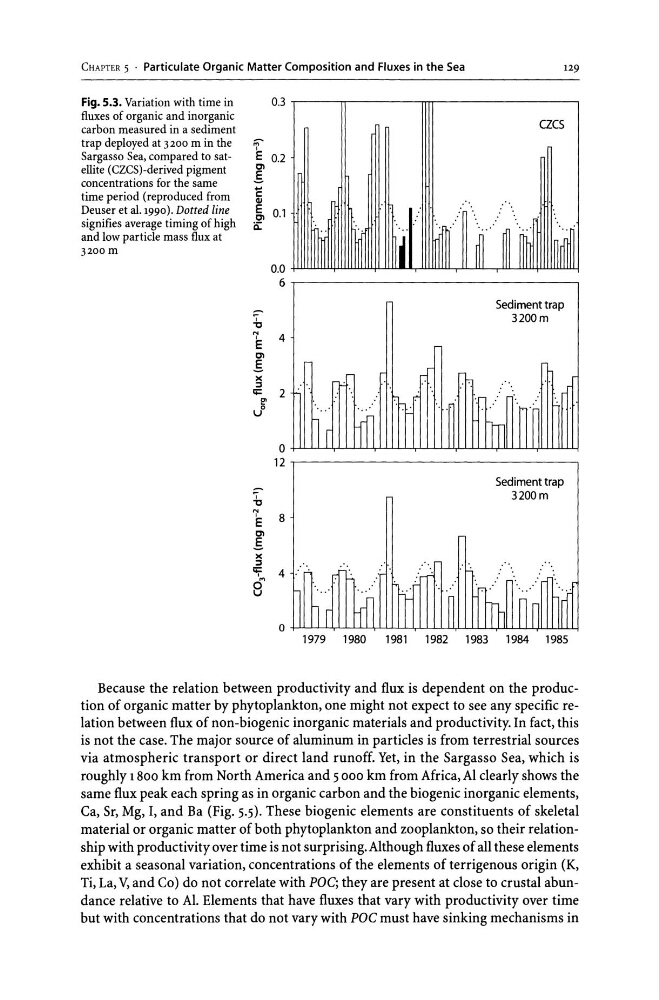
Fig. 5.3. Variation with time in
fluxes of organic and inorganic
carbon measured in a sediment
trap deployed at 3200 m in the
Sargasso Sea, compared to satellite (CZCS)-derived pigment
concentrations for the same
time period (reproduced from
Deuser et al. 1990). Dotted line
signifies average timing of high
and low particle mass flux at
3200m
0.3 ' "
""
' 1'
E 0.2
C'I
S
1:
Qj
§, 0.1 ".,
c::
0.0
6
'i
'tl
N
4
E
C'I
129
CZCS
Sediment trap
3200m
S
)(
::J
2
c;:
20
U
0
~, I~~~~~~~
.......
. .....
.,
12
Sediment trap
'i
3200m
'tl
'i'
8
E
C'I
S
)(
::J
I.'.
.'1.1
.', ,......,
ro;: 4
8"'
0
1979 1980
1981
1982 1983 1984 1985
Because the relation between productivity and flux is dependent on the production of organic matter by phytoplankton, one might not expect to see any specific relation between flux of non-biogenic inorganic materials and productivity. In fact, this
is not the case. The major source of aluminum in particles is from terrestrial sources
via atmospheric transport or direct land runoff. Yet, in the Sargasso Sea, which is
roughly 1 800 km from North America and 5000 km from Africa, Al clearly shows the
same flux peak each spring as in organic carbon and the biogenic inorganic elements,
Ca, Sr, Mg, I, and Ba (Fig. 5.5). These biogenic elements are constituents of skeletal
material or organic matter of both phytoplankton and zooplankton, so their relationship with productivity over time is not surprising. Although fluxes of all these elements
exhibit a seasonal variation, concentrations of the elements of terrigenous origin (K,
Ti, La, V, and Co) do not correlate with POC; they are present at close to crustal abundance relative to AI. Elements that have fluxes that vary with productivity over time
but with concentrations that do not vary with POC must have sinking mechanisms in
Fig. 5.3. Variation with time in
fluxes of organic and inorganic
carbon measured in a sediment
trap deployed at 3200 m in the
Sargasso Sea, compared to satellite (CZCS)-derived pigment
concentrations for the same
time period (reproduced from
Deuser et al. 1990). Dotted line
signifies average timing of high
and low particle mass flux at
3200m
0.3 ' "
""
' 1'
E 0.2
C'I
S
1:
Qj
§, 0.1 ".,
c::
0.0
6
'i
'tl
N
4
E
C'I
129
CZCS
Sediment trap
3200m
S
)(
::J
2
c;:
20
U
0
~, I~~~~~~~
.......
. .....
.,
12
Sediment trap
'i
3200m
'tl
'i'
8
E
C'I
S
)(
::J
I.'.
.'1.1
.', ,......,
ro;: 4
8"'
0
1979 1980
1981
1982 1983 1984 1985
Because the relation between productivity and flux is dependent on the production of organic matter by phytoplankton, one might not expect to see any specific relation between flux of non-biogenic inorganic materials and productivity. In fact, this
is not the case. The major source of aluminum in particles is from terrestrial sources
via atmospheric transport or direct land runoff. Yet, in the Sargasso Sea, which is
roughly 1 800 km from North America and 5000 km from Africa, Al clearly shows the
same flux peak each spring as in organic carbon and the biogenic inorganic elements,
Ca, Sr, Mg, I, and Ba (Fig. 5.5). These biogenic elements are constituents of skeletal
material or organic matter of both phytoplankton and zooplankton, so their relationship with productivity over time is not surprising. Although fluxes of all these elements
exhibit a seasonal variation, concentrations of the elements of terrigenous origin (K,
Ti, La, V, and Co) do not correlate with POC; they are present at close to crustal abundance relative to AI. Elements that have fluxes that vary with productivity over time
but with concentrations that do not vary with POC must have sinking mechanisms in