

uS
J. I. Hedges
Canfield 1989}, temporal trends in stable isotope composition (Lasaga 1989), and phosphorus limitation on marine primary production (Van Cappellen and Ingalll996;
Petsch and Berner 1998). The latter constraint is based on the observation that burial
of the limiting nutrient P is less efficient when ocean bottom waters are low in oxygen. The driving mechanism appears to be that a more oxidizing ocean leads to globally increased sequestration of phosphate into sedimentary iron oxyhydroxides (or
bacteria). The net result is that an increase in atmospheric O2 leads, via increased
downwelling of O 2 enriched surface sea water, to a more oxidizing ocean floor, larger
P uptake by sediments and a reduced reservoir of dissolved phosphate to support
marine photosynthesis. Models incorporating this feedback mechanism (without a
weathering counterpart) are able to generate numeric results that match in amplitude
and duration the history of atmospheric O2 change inferred from the sedimentary
record (Petsch and Berner 1998). Recognition of phosphate as a major constraint on
the intermeshed cycles of carbon and oxygen is critical, because without this basic
constraint, marine primary productivity has the potential to generate large amounts
10 10
t Balance point
E
I I I I I L
I
Stability zone
I
...... -. .. ., ..
lOS
~
GoO
E
.~
\
...
GoO
>
0
c
~
1()6
- f -
lo--" ......
~
""
i"' -~
I'--............
I
Anoxia
•
~
Wildfire
I
1~
0.001
0.01
0.1
Organic carbon burial (moles 02 yr' x 10 15 )
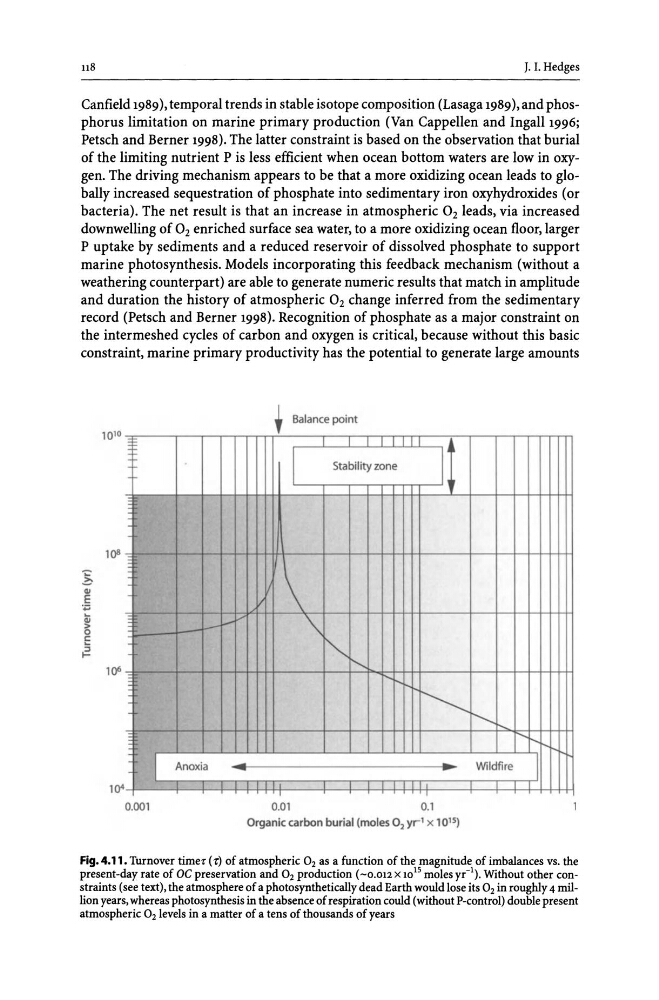
Fig. 4.11. Turnover timer (r) of atmospheric O2 as a function of the magnitude of imbalances vs. the
present-day rate of OC preservation and O2 production (-0.012 X 10 15 moles yr- I ). Without other constraints (see text), the atmosphere of a photosynthetically dead Earth would lose its O2 in roughly 4 million years, whereas photosynthesis in the absence of respiration could (without P-control) double present
atmospheric O2 levels in a matter of a tens of thousands of years
J. I. Hedges
Canfield 1989}, temporal trends in stable isotope composition (Lasaga 1989), and phosphorus limitation on marine primary production (Van Cappellen and Ingalll996;
Petsch and Berner 1998). The latter constraint is based on the observation that burial
of the limiting nutrient P is less efficient when ocean bottom waters are low in oxygen. The driving mechanism appears to be that a more oxidizing ocean leads to globally increased sequestration of phosphate into sedimentary iron oxyhydroxides (or
bacteria). The net result is that an increase in atmospheric O2 leads, via increased
downwelling of O 2 enriched surface sea water, to a more oxidizing ocean floor, larger
P uptake by sediments and a reduced reservoir of dissolved phosphate to support
marine photosynthesis. Models incorporating this feedback mechanism (without a
weathering counterpart) are able to generate numeric results that match in amplitude
and duration the history of atmospheric O2 change inferred from the sedimentary
record (Petsch and Berner 1998). Recognition of phosphate as a major constraint on
the intermeshed cycles of carbon and oxygen is critical, because without this basic
constraint, marine primary productivity has the potential to generate large amounts
10 10
t Balance point
E
I I I I I L
I
Stability zone
I
...... -. .. ., ..
lOS
~
GoO
E
.~
\
...
GoO
>
0
c
~
1()6
- f -
lo--" ......
~
""
i"' -~
I'--............
I
Anoxia
•
~
Wildfire
I
1~
0.001
0.01
0.1
Organic carbon burial (moles 02 yr' x 10 15 )
Fig. 4.11. Turnover timer (r) of atmospheric O2 as a function of the magnitude of imbalances vs. the
present-day rate of OC preservation and O2 production (-0.012 X 10 15 moles yr- I ). Without other constraints (see text), the atmosphere of a photosynthetically dead Earth would lose its O2 in roughly 4 million years, whereas photosynthesis in the absence of respiration could (without P-control) double present
atmospheric O2 levels in a matter of a tens of thousands of years