

98
E. Pelizzetti . P. Calza
waters form very stable complexes with dissolved Fe(III). Thus, it is most likely that
the concentration of inorganic, dissolved Fe(III) species determines the upper limit
for bioavailable Fe(III). The Fe(II) produced is likely to form less stable complexes with
organic ligands present in the euphotic zone of sea water and hence is biologically more
available than Fe(III). In the case of Fe(II), organic complexes may be rather weak, and
hence ligands at the cell surface may form stronger complexes with Fe(II) than organic
ligands in the medium (Anderson and Morel 1982).
3.4.2.1
Photoreactions Occurring on Iron
The speciation, and thus the biological availability, of redox-active metals are often
strongly influenced by light.
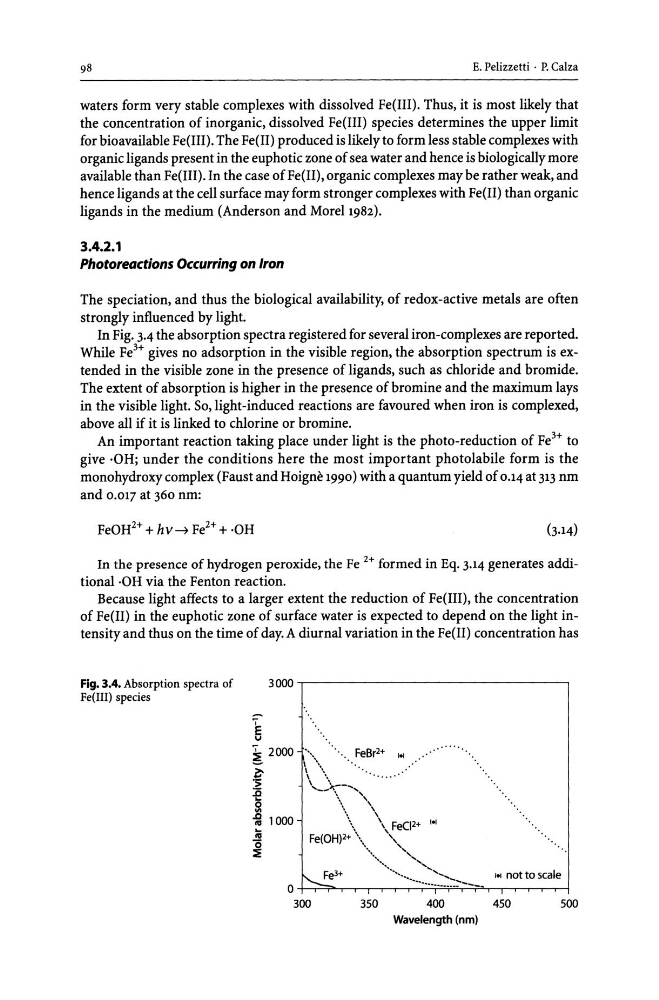
In Fig. 3-4 the absorption spectra registered for several iron-complexes are reported.
While Fe 3 + gives no adsorption in the visible region, the absorption spectrum is extended in the visible zone in the presence of ligands, such as chloride and bromide.
The extent of absorption is higher in the presence of bromine and the maximum lays
in the visible light. So, light-induced reactions are favoured when iron is complexed,
above all if it is linked to chlorine or bromine.
An important reaction taking place under light is the photo-reduction of Fe 3 + to
give ·OH; under the conditions here the most important photolabile form is the
monohydroxy complex (Faust and Hoigne 1990) with a quantum yield of 0.14 at 313 nm
and 0.017 at 360 nm:
FeOH 2 + + hv~ Fe 2 + + ·OH
(3-14)
In the presence of hydrogen peroxide, the Fe 2+ formed in Eq. 3.14 generates additional ·OH via the Fenton reaction.
Because light affects to a larger extent the reduction of Fe(III), the concentration
of Fe(II) in the euphotic zone of surface water is expected to depend on the light intensity and thus on the time of day. A diurnal variation in the Fe(II) concentration has
Fig. 3.4. Absorption spectra of
3 0 0 0 . . . , - - - - - - - - - - - - - - - - - - - ,
Fe(III) species
.,
E u
~ 2000
.~
I ~ 1000
.!ll
~
i "\ ". FeBr2+
\ ....
,.,
\
..
.... _ .... );:--. ......
.. ...
.. ...
\.. '"
.. \
Fe(OH)2+ \..
\!eCl2+ ,.,
\'.
"
'.
...
'.
...
o I --!:-3+ . . . . . . . . . . . . . . . . . . . , . . .
i
- .................. ~~:::---j' ..
....,-",---.-,., not to scale
300
350
400
Wavelength (nm)
450
500
E. Pelizzetti . P. Calza
waters form very stable complexes with dissolved Fe(III). Thus, it is most likely that
the concentration of inorganic, dissolved Fe(III) species determines the upper limit
for bioavailable Fe(III). The Fe(II) produced is likely to form less stable complexes with
organic ligands present in the euphotic zone of sea water and hence is biologically more
available than Fe(III). In the case of Fe(II), organic complexes may be rather weak, and
hence ligands at the cell surface may form stronger complexes with Fe(II) than organic
ligands in the medium (Anderson and Morel 1982).
3.4.2.1
Photoreactions Occurring on Iron
The speciation, and thus the biological availability, of redox-active metals are often
strongly influenced by light.
In Fig. 3-4 the absorption spectra registered for several iron-complexes are reported.
While Fe 3 + gives no adsorption in the visible region, the absorption spectrum is extended in the visible zone in the presence of ligands, such as chloride and bromide.
The extent of absorption is higher in the presence of bromine and the maximum lays
in the visible light. So, light-induced reactions are favoured when iron is complexed,
above all if it is linked to chlorine or bromine.
An important reaction taking place under light is the photo-reduction of Fe 3 + to
give ·OH; under the conditions here the most important photolabile form is the
monohydroxy complex (Faust and Hoigne 1990) with a quantum yield of 0.14 at 313 nm
and 0.017 at 360 nm:
FeOH 2 + + hv~ Fe 2 + + ·OH
(3-14)
In the presence of hydrogen peroxide, the Fe 2+ formed in Eq. 3.14 generates additional ·OH via the Fenton reaction.
Because light affects to a larger extent the reduction of Fe(III), the concentration
of Fe(II) in the euphotic zone of surface water is expected to depend on the light intensity and thus on the time of day. A diurnal variation in the Fe(II) concentration has
Fig. 3.4. Absorption spectra of
3 0 0 0 . . . , - - - - - - - - - - - - - - - - - - - ,
Fe(III) species
.,
E u
~ 2000
.~
I ~ 1000
.!ll
~
i "\ ". FeBr2+
\ ....
,.,
\
..
.... _ .... );:--. ......
.. ...
.. ...
\.. '"
.. \
Fe(OH)2+ \..
\!eCl2+ ,.,
\'.
"
'.
...
'.
...
o I --!:-3+ . . . . . . . . . . . . . . . . . . . , . . .
i
- .................. ~~:::---j' ..
....,-",---.-,., not to scale
300
350
400
Wavelength (nm)
450
500