

CHAPTER 3 . Photochemical Processes in the Euphotic Zone of Sea Water
97
3. It is able to act as semiconductor and to participate with the redox photoreactions.
In those reactions, the electromagnetic radiation is utilized either to conduct reactions thermodynamically not favoured (heterogeneous photosynthesis) or to catalyse a reaction thermodynamically favoured (heterogeneous photocatalysis).
The iron cycle includes the reductive solubilization of iron(IU) by organic ligands,
a process that can also be photocatalysed in surface waters, and the oxidation of iron (II)
by oxygen, a process catalysed by superficial interactions. During the iron(II) oxidation to iron(III), reactive compounds as heavy metals, phosphate ions and some organic compounds are linked to the precipitate surface. Those compounds are later
released in solution during the reduction of iron oxides. The total balance of the cycle
gives also the oxidation of organic matter by oxygen mediated by iron.
Fe(III) is also absorbed on external surfaces of humic materials, weakly bound octahedrally and easily complexed and reduced. When Fe(III) is added to the humic
materials, most of the iron becomes bound to octahedral sites.
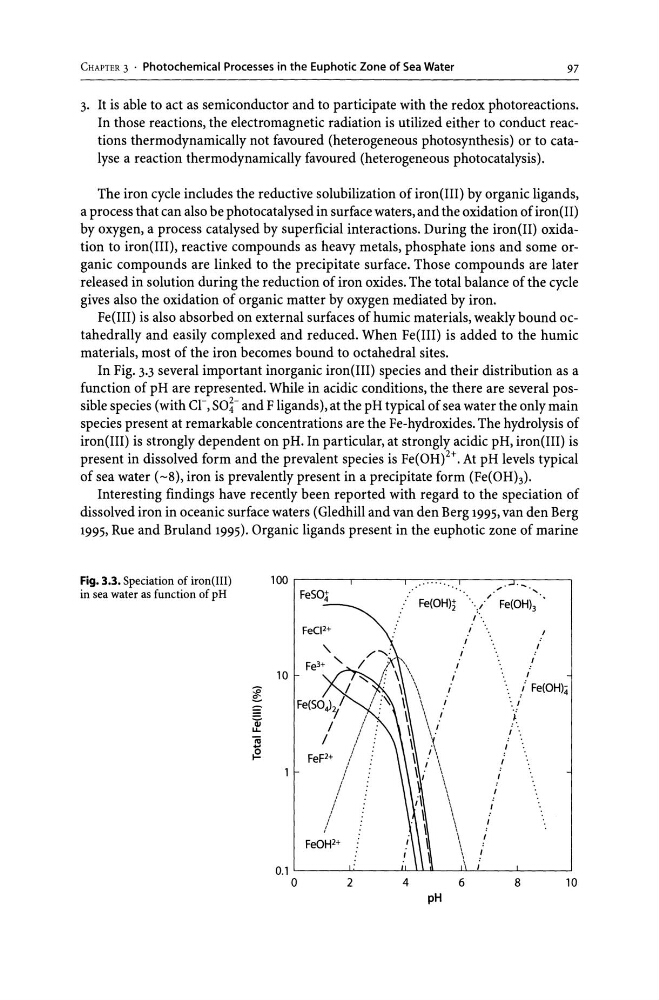
In Fig. 3.3 several important inorganic iron(III) species and their distribution as a
function of pH are represented. While in acidic conditions, the there are several possible species (with cr, SO~- and F ligands), at the pH typical of sea water the only main
species present at remarkable concentrations are the Fe-hydroxides. The hydrolysis of
iron(III) is strongly dependent on pH. In particular, at strongly acidic pH, iron(III) is
present in dissolved form and the prevalent species is Fe(OH)2+. At pH levels typical
of sea water (-8), iron is prevalently present in a precipitate form (Fe(OHh).
Interesting findings have recently been reported with regard to the speciation of
dissolved iron in oceanic surface waters (Gledhill and van den Berg 1995, van den Berg
1995, Rue and Bruland 1995). Organic ligands present in the euphotic zone of marine
Fig. 3.3. Speciation of iron(III)
100
......
...... -.- .....
I FeS01
/
in sea water as function of pH
Fe(OH}! ',,/' Fe(OHh
, ....
FeCl2+
i
i
,
,
,
10
,
. / Fe(OH}4
~
'.'
,
/.
QJ
/
u.
I'.
n;
;2
FeF2+ /f
/
!
!
/
\"\ II
FeOH2+
0.1 I
0
2
4
6
8
10
pH
97
3. It is able to act as semiconductor and to participate with the redox photoreactions.
In those reactions, the electromagnetic radiation is utilized either to conduct reactions thermodynamically not favoured (heterogeneous photosynthesis) or to catalyse a reaction thermodynamically favoured (heterogeneous photocatalysis).
The iron cycle includes the reductive solubilization of iron(IU) by organic ligands,
a process that can also be photocatalysed in surface waters, and the oxidation of iron (II)
by oxygen, a process catalysed by superficial interactions. During the iron(II) oxidation to iron(III), reactive compounds as heavy metals, phosphate ions and some organic compounds are linked to the precipitate surface. Those compounds are later
released in solution during the reduction of iron oxides. The total balance of the cycle
gives also the oxidation of organic matter by oxygen mediated by iron.
Fe(III) is also absorbed on external surfaces of humic materials, weakly bound octahedrally and easily complexed and reduced. When Fe(III) is added to the humic
materials, most of the iron becomes bound to octahedral sites.
In Fig. 3.3 several important inorganic iron(III) species and their distribution as a
function of pH are represented. While in acidic conditions, the there are several possible species (with cr, SO~- and F ligands), at the pH typical of sea water the only main
species present at remarkable concentrations are the Fe-hydroxides. The hydrolysis of
iron(III) is strongly dependent on pH. In particular, at strongly acidic pH, iron(III) is
present in dissolved form and the prevalent species is Fe(OH)2+. At pH levels typical
of sea water (-8), iron is prevalently present in a precipitate form (Fe(OHh).
Interesting findings have recently been reported with regard to the speciation of
dissolved iron in oceanic surface waters (Gledhill and van den Berg 1995, van den Berg
1995, Rue and Bruland 1995). Organic ligands present in the euphotic zone of marine
Fig. 3.3. Speciation of iron(III)
100
......
...... -.- .....
I FeS01
/
in sea water as function of pH
Fe(OH}! ',,/' Fe(OHh
, ....
FeCl2+
i
i
,
,
,
10
,
. / Fe(OH}4
~
'.'
,
/.
QJ
/
u.
I'.
n;
;2
FeF2+ /f
/
!
!
/
\"\ II
FeOH2+
0.1 I
0
2
4
6
8
10
pH