

90
E. Pelizzetti . P. Calza
rate per unit of solution absorbency at 366 nm was less variable. The quantum yield for
singlet oxygen formation ranged from l.4 to 9.3% with an average of 4.3%. Despite uncertainties, if these experiments indicate the correct order of magnitude, singlet oxygen
formation is very active in many coastal, estuarine and fresh waters.
The chemistry of singlet oxygen has been widely studied (Foote and Clennan 1995).
A large percentage of it simply returns to the ground state oxygen in a fast interaction
(1.6 x 10- 5 S-I) with the vibrational overtone bands of water (Rodgers and Snowden
1982). This fast reaction is the dominant singlet oxygen sink and the major reason why,
even with high formation rates, singlet oxygen concentrations are always expected to
be very low. Singlet oxygen is predominantly quenched to ground state oxygen by water;
its half-life is about 3 fis. Nevertheless, some reactions might compete with water
quenching to give significant chemical changes. Joussot-Dubien and Kadiri (1970)
suggested that singlet oxygen might be involved in chemical nitrification, as the oxidation of ammonia. They showed that singlet oxygen in water would oxidize ammonia, but that this process is unlikely to compete effectively with biological ammonia
sinks in surface waters. Thus, in bulk solution the rates of energy-transfer reactions
of even the most reactive materials now seem constrained, on the one hand by physical quenching of singlet oxygen, and on the other by the strong competition with direct transfer to organics by O 2 , However, in oxygen-depleted or hydrophobic micro environments, such reactions could proceed with higher rates and affect properties such
as the surface chemistry and the composition of particulate material.
Hydrogen peroxide. The finding of hydrogen peroxide in surface sea waters has
strongly supported the notion that photochemical processes occur in the oceans. The
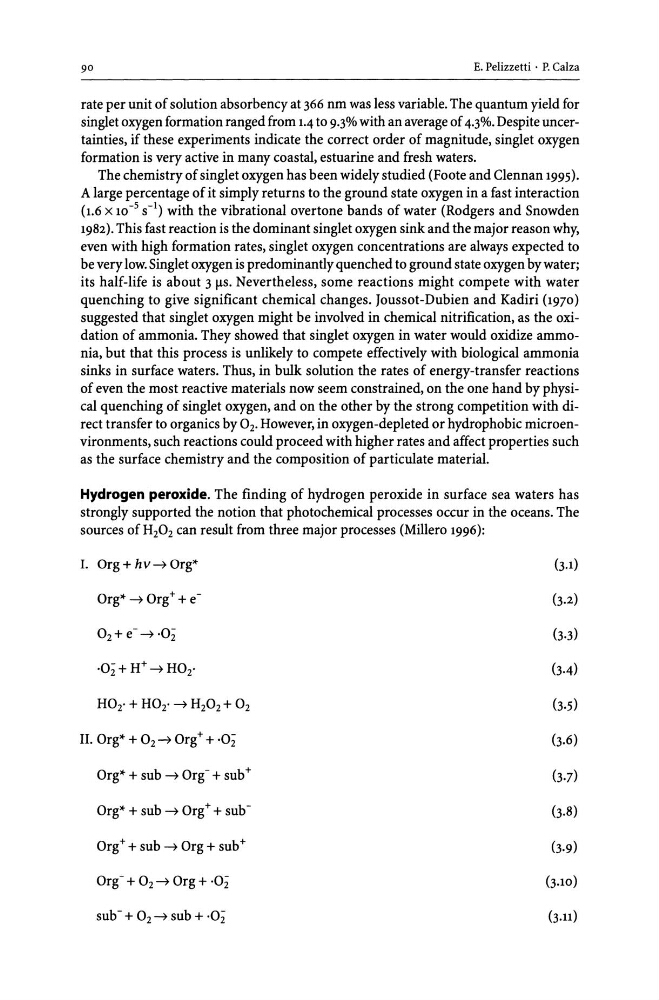
sources of H20 2 can result from three major processes (Millero 1996):
1. Org + hv ~ Org*
(3-1)
Org* ~ Org+ + e(3.2)
O 2 + e- ~·O;
(3.3)
·0; + H+ ~ H02•
(3-4)
H02• + H02• ~ H20 2 + O2
(3.5)
II. Org* + O2 ~ Org + + ·0;
(3.6)
Org* + sub ~ Org- + sub+
(3-7)
Org* + sub ~ Org+ + sub(3·8)
Org+ + sub ~ Org + sub+
(3.9)
Org- + O 2 ~ Org + ·0;
(3-10 )
sub- + O 2 ~ sub + ·0;
(3·n)
E. Pelizzetti . P. Calza
rate per unit of solution absorbency at 366 nm was less variable. The quantum yield for
singlet oxygen formation ranged from l.4 to 9.3% with an average of 4.3%. Despite uncertainties, if these experiments indicate the correct order of magnitude, singlet oxygen
formation is very active in many coastal, estuarine and fresh waters.
The chemistry of singlet oxygen has been widely studied (Foote and Clennan 1995).
A large percentage of it simply returns to the ground state oxygen in a fast interaction
(1.6 x 10- 5 S-I) with the vibrational overtone bands of water (Rodgers and Snowden
1982). This fast reaction is the dominant singlet oxygen sink and the major reason why,
even with high formation rates, singlet oxygen concentrations are always expected to
be very low. Singlet oxygen is predominantly quenched to ground state oxygen by water;
its half-life is about 3 fis. Nevertheless, some reactions might compete with water
quenching to give significant chemical changes. Joussot-Dubien and Kadiri (1970)
suggested that singlet oxygen might be involved in chemical nitrification, as the oxidation of ammonia. They showed that singlet oxygen in water would oxidize ammonia, but that this process is unlikely to compete effectively with biological ammonia
sinks in surface waters. Thus, in bulk solution the rates of energy-transfer reactions
of even the most reactive materials now seem constrained, on the one hand by physical quenching of singlet oxygen, and on the other by the strong competition with direct transfer to organics by O 2 , However, in oxygen-depleted or hydrophobic micro environments, such reactions could proceed with higher rates and affect properties such
as the surface chemistry and the composition of particulate material.
Hydrogen peroxide. The finding of hydrogen peroxide in surface sea waters has
strongly supported the notion that photochemical processes occur in the oceans. The
sources of H20 2 can result from three major processes (Millero 1996):
1. Org + hv ~ Org*
(3-1)
Org* ~ Org+ + e(3.2)
O 2 + e- ~·O;
(3.3)
·0; + H+ ~ H02•
(3-4)
H02• + H02• ~ H20 2 + O2
(3.5)
II. Org* + O2 ~ Org + + ·0;
(3.6)
Org* + sub ~ Org- + sub+
(3-7)
Org* + sub ~ Org+ + sub(3·8)
Org+ + sub ~ Org + sub+
(3.9)
Org- + O 2 ~ Org + ·0;
(3-10 )
sub- + O 2 ~ sub + ·0;
(3·n)