

CHAPTER 3 . Photochemical Processes in the Euphotic Zone of Sea Water
89
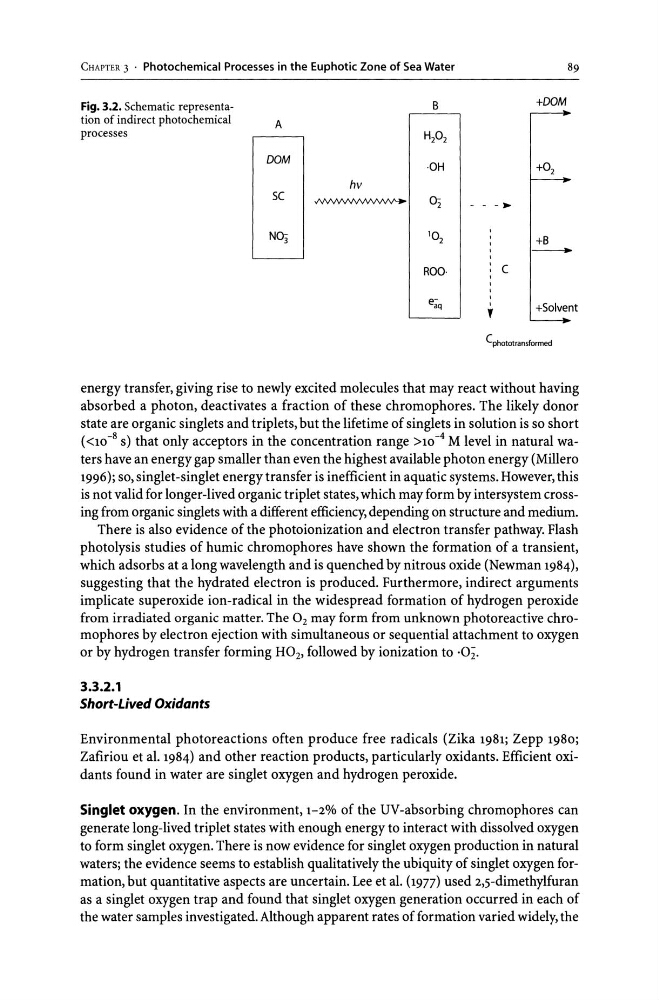
Fig. 3.2. Schematic representation of indirect photochemical
A
processes
Io:l
hv
sc
~I
NO]
B
HP2
·OH
D2
1°2
I - - -~
+OOM
+°2
+B
-
ROO· I
,C
e~q
, +Solvent
Cphototransformed
energy transfer, giving rise to newly excited molecules that may react without having
absorbed a photon, deactivates a fraction of these chromophores. The likely donor
state are organic singlets and triplets, but the lifetime of singlets in solution is so short
«10- 8 s) that only acceptors in the concentration range >10- 4 M level in natural waters have an energy gap smaller than even the highest available photon energy (Millero
1996); so, singlet-singlet energy transfer is inefficient in aquatic systems. However, this
is not valid for longer-lived organic triplet states, which may form by intersystem crossing from organic singlets with a different efficiency, depending on structure and medium.
There is also evidence of the photoionization and electron transfer pathway. Flash
photolysis studies of humic chromophores have shown the formation of a transient,
which adsorbs at a long wavelength and is quenched by nitrous oxide (Newman 1984),
suggesting that the hydrated electron is produced. Furthermore, indirect arguments
implicate superoxide ion-radical in the widespread formation of hydrogen peroxide
from irradiated organic matter. The O2 may form from unknown photoreactive chromophores by electron ejection with simultaneous or sequential attachment to oxygen
or by hydrogen transfer forming HO z, followed by ionization to ·0;:.
3.3.2.1
Short-Lived Oxidants
Environmental photoreactions often produce free radicals (Zika 1981; Zepp 1980;
Zafiriou et al. 1984) and other reaction products, particularly oxidants. Efficient oxidants found in water are singlet oxygen and hydrogen peroxide.
Singlet oxygen. In the environment, 1-2% of the UV-absorbing chromophores can
generate long-lived triplet states with enough energy to interact with dissolved oxygen
to form singlet oxygen. There is now evidence for singlet oxygen production in natural
waters; the evidence seems to establish qualitatively the ubiquity of singlet oxygen formation, but quantitative aspects are uncertain. Lee et al. (1977) used 2,5-dimethylfuran
as a singlet oxygen trap and found that singlet oxygen generation occurred in each of
the water samples investigated. Although apparent rates of formation varied widely, the
89
Fig. 3.2. Schematic representation of indirect photochemical
A
processes
Io:l
hv
sc
~I
NO]
B
HP2
·OH
D2
1°2
I - - -~
+OOM
+°2
+B
-
ROO· I
,C
e~q
, +Solvent
Cphototransformed
energy transfer, giving rise to newly excited molecules that may react without having
absorbed a photon, deactivates a fraction of these chromophores. The likely donor
state are organic singlets and triplets, but the lifetime of singlets in solution is so short
«10- 8 s) that only acceptors in the concentration range >10- 4 M level in natural waters have an energy gap smaller than even the highest available photon energy (Millero
1996); so, singlet-singlet energy transfer is inefficient in aquatic systems. However, this
is not valid for longer-lived organic triplet states, which may form by intersystem crossing from organic singlets with a different efficiency, depending on structure and medium.
There is also evidence of the photoionization and electron transfer pathway. Flash
photolysis studies of humic chromophores have shown the formation of a transient,
which adsorbs at a long wavelength and is quenched by nitrous oxide (Newman 1984),
suggesting that the hydrated electron is produced. Furthermore, indirect arguments
implicate superoxide ion-radical in the widespread formation of hydrogen peroxide
from irradiated organic matter. The O2 may form from unknown photoreactive chromophores by electron ejection with simultaneous or sequential attachment to oxygen
or by hydrogen transfer forming HO z, followed by ionization to ·0;:.
3.3.2.1
Short-Lived Oxidants
Environmental photoreactions often produce free radicals (Zika 1981; Zepp 1980;
Zafiriou et al. 1984) and other reaction products, particularly oxidants. Efficient oxidants found in water are singlet oxygen and hydrogen peroxide.
Singlet oxygen. In the environment, 1-2% of the UV-absorbing chromophores can
generate long-lived triplet states with enough energy to interact with dissolved oxygen
to form singlet oxygen. There is now evidence for singlet oxygen production in natural
waters; the evidence seems to establish qualitatively the ubiquity of singlet oxygen formation, but quantitative aspects are uncertain. Lee et al. (1977) used 2,5-dimethylfuran
as a singlet oxygen trap and found that singlet oxygen generation occurred in each of
the water samples investigated. Although apparent rates of formation varied widely, the